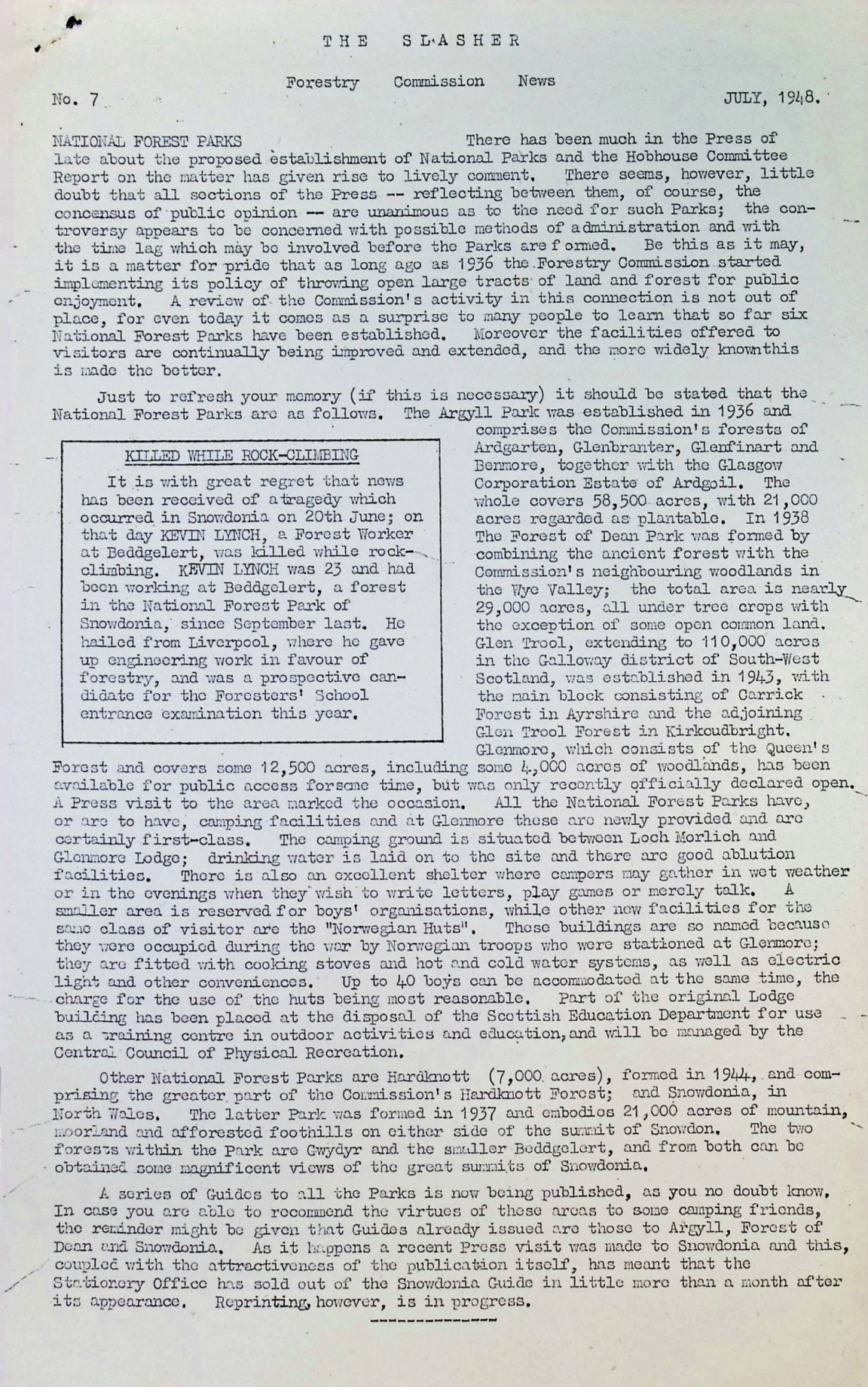
Slasher Magazine Summary: Publication No. 7 - July 1948
The scanned images of the Slasher were produced by and courtesy of the Forest Research Data and Information Team staff based at Roslin, where some of the original copies are located. The Forestry England Information Knowledge Management Team and New Forest Heritage made available copies of The Slasher from their collections. Brian Mahony of the FC Retirement Association devised and coordinates the Slasher Project and has been instrumental in locating many missing editions and coordinating the searches to locate all the earlier publication numbers.
The content summary below was again very kindly compiled by Diane Birkett, Bedfordshire. See PDF attachment link below the text summary to view the full document. A total of over 420 issues or publications were produced between January 1948 and the final publication in 2010.
National Forest Parks
There has been much in the Press about the proposed establishment of National Parks and the Hobhouse Committee Report on the matter has given rise to lively comment. There seems, however, little doubt from all sections of the press, that the consensus of public opinion is unanimous as to the need for such Parks; the controversy appears to be concerned with possible methods of administration and with the time lag which may be involved before the Parks are formed.
In 1936 the Forestry Commission started implementing its policy of throwing open large tracts of land and forest for public enjoyment. It comes as a surprise to many people to learn that so far six National Forest Parks have been established and the facilities offered to visitors are continually being improved and extended.
The National Forest Parks are as follows. The Argyll Park was established in 1936 and comprises the Commission's forests of Ardgarten, Glenbranter, Glenfinart and Benmore, together with the Glasgow Corporation Estate of Ardgoil. The whole covers 58,500 acres, with 21,000 acres regarded as plantable.
In 1938 the Forest of Dean Park was formed by combining the ancient forest with the Commission's neighbouring woodlands in the Wye Valley; the total area is nearly 29,000 acres, all under tree crops with the exception of some open common land.
Glen Trool, extending to 110,000 acres in the Galloway district of South-West Scotland, was established in 1943, with the main block consisting of Carrick Forest in Ayrshire and the adjoining Glen Trool Forest in Kirkcudbright.
Glenmore, which consists of the Queen's Forest and covers 12,500 acres, including 4,000 acres of woodlands, has been available for public access for some time, but was only recently officially declared open.
All the National Forest Parks have, or are to have, camping facilities and at Glenmore these are newly provided and are certainly first-class. The camping ground is situated between Loch Morlich and Glenmore Lodge; drinking water is laid on to the site and there are good ablution facilities. There is also an excellent shelter where campers may gather in wet weather or in the evenings when they wish to write letters, play games or merely talk. A smaller area is reserved for boys' organisations, while other new facilities for the same class of visitor are the 'Norwegian Huts', These buildings are so named because they were occupied during the war by Norwegian troops who were stationed at Glenmore; they are fitted with cooking stoves and hot and cold water systems, as well as electric light and other conveniences. Up to 40 boys can be accommodated at the same time, the charge for the use of the huts being most reasonable. Part of the original Lodge building has been placed at the disposal of the Scottish Education Department for use as a training centre in outdoor activities and education, and will be managed by the Central Council of Physical Recreation.
Other National Forest Parks are Hardknott (7,000 acres), formed in 1944, and comprising the greater part of the Commission's Hardknott Forest; and Snowdonia in North Wales. The latter Park was formed in 1937 and embodies 21,000 acres of mountain, moorland and afforested foothills on either side of the summit of Snowdon. The two forests within the Park are Gwydyr and the smaller Beddgelert, and from both can be seen some magnificent views of the great summits of Snowdonia.
A series of Guides to all the Parks is being published.
Past, Present and Future
The staff of the South Conservancy (Scotland) Office have recently moved into new premises at Greystone Park, Moffat Road, Dumfries. On the lawn behind the offices are two stones, relics of a circle of monoliths which was still complete a hundred years ago, and from whence comes the name "Greystones". When the building was erected in 1887, bones and a funeral urn were found beside the largest stone. According to the authorities, such circles are of Neolithic origin and are from 3,500 to 4,500 years old. At that time, of course, there was no timber shortage, and clear felling may be said to have been the order of the day. On pondering these facts, the Conservancy's tame poet was inspired to record:
These Neolithic Fellows found
In Forest Growth no cause for fervency,
And little thought their Sacred Mound
Would house a future South Conservancy!
After a long sojourn in cramped surroundings in Buccleugh Street, the Conservator and his staff deserve our best wishes for a happy and useful future at Greystone Park.
News From Bristol
The SW(E) Conservancy Office Tennis Club is now well established and recent visitors included Messrs Tinson and Springall, of the travelling audit staff. Our Bristol correspondent reports that a good time was had by all in gathering balls from the banks of the Avon after an exceptional exhibition by Mr Tinson. A challenge received from Forester Wildash to a cricket match at Savernake has, we are informed, been received by the Conservancy staff with mixed feelings, for there is at the moment no means of knowing just how strong a side Forester Wildash will turn out against them.
Clerical Officer Damerell has returned to the Bristol Office after Army service.
That Tower Flagpole
Reference was made in last month's issue of The Slasher to the 82 ft. flagpole which has been presented to the Tower of London by a Canadian businessman, and to the 100 ft. pole grown in the New Forest, which is destined for erection at Northerwood House. There is now news of greater giants. Timber Trades Journal refers to a 151 ft. mast which was the gift in 1861 of the Government of British Columbia, and which was erected in Kew Gardens. At the beginning of the present century this mast showed signs of decay; it was taken down in 1912 and replaced some years later by another pole from British Columbia. This was said to be the second largest flagstaff in the world and the largest in Europe, for it was 214 ft. long, 33 inches square at the butt, tapered to 12 inches at the top and weighed 14 tons. This particular pole came from a Douglas fir which, when felled, was 259 ft. in length and had a butt 6 ft. in diameter. It was brought to London in a timber ship in 1915, floated up the Thames, rolled ashore on a very high tide and dragged through Kew Gardens, where it lay until its erection in 1919.
Unusual Setting
Forester G.W. Parker, who is in charge of the Plashetts section of Kielder Forest, lives in a house at Plashetts Station. Communications are almost non-existent and the railway, in fact, is the only means of access to the area. The result is that the Rector of the near-by village of Falstone approached Forester Parker with a view to holding religious services at Plashetts, and now a service is held on the last Sunday of each month in the front room of the Forester's house. So far the congregation has never numbered less than 14 and is drawn from the occupants of farms and Forestry Commission cottages in the neighbourhood.
Political Uniform?
The Forestry Commission's official tie bears a marked resemblance to that of the Welsh Nationalist Party. The effect of this coincidence in some of the rural strongholds of the Party may well be imagined.
Forest Officers, not all of whom are native Welshmen, or politically minded, are sometimes taken aback when they receive cordial greetings in the native tongue, while ardent Nationalists, sporting a jaded Party tie, are liable to be taken to task as 'foreign land-grabbers' by natives with a knowledge of Civil Service 'heraldry'.
The tie bears an even closer resemblance to that of the Urdd Gobaith Cymru (Welsh League of Youth), but so far there is no record of a loitering Officer being pressed into service as adjudicator at an Urdd Eisteddfod on the strength of his neck-wear. It is well known, however, that Forester R.H. Roberts of Cynwyd Forest, North Wales, has, under the tuition of his wife, become a star folk dancer at Eisteddfodau. Mrs Roberts is leading the contingent of Welsh Dancers at the International Folk Dancing Festival at Edinburgh this summer.
Forest Cameos (Continued)
District Officer P.F. Garthwaite writes about Allerston Forest, sometimes referred to as Dalby. "It is some 7,000 acres in extent", he says," and was one of the first areas to be acquired by the Commission; planting started in 1921 and has continued every year since, with the result that 5,436 acres have now been planted. The Forest lies north and east of Thornton-le-dale, with elevations of 250 feet in the west, rising to 750 feet in the north and east.
"Mr A.P. Long, Director of Forestry for Wales, was Divisional Officer when the land was first taken over, and his original plantings now include some fine stands of flourishing Sitka and Norway spruce and Japanese larch, some of the latter in their third thinning.
"Other officers who had a hand in the early history of the forest are G.B. Ryle and A.H.H. Ross. In the late 192Os G.J.L. Batters was here and his name must be added to those of well known foresters who have been associated with the area.
"From 1933 to 1948 it could almost be called 'Fossey's Forest', so closely was R.E. Fossey connected it. He was ably assisted by Head Forester T.E. Anderson who, arriving in 1933, has seen the seasons in and out ever since, and has recently aided posterity by completing the census of the forest.
"Deep ploughing by tractor-drawn plough started in 1930 and was regularly carried out on the moorland until the advent of the 'R.L.R.' plough, which was used with remarkable results by comparison with the old methods. Ploughing actually started in the area before 1930, for an old document shows that 70 acres of moorland were ploughed and subsoiled in 1870 with a specially made plough drawn by six horses, which was claimed to break up the pan to a depth of 12-18 inches. The crop then grown was felled during the 1914-18 war and replanted in 1922 by the Commission with Japanese larch. This now forms one of the finest stands of this species in the country.
"The forest is a beauty spot visited by tourists and other travellers, not the least notable being the rare white-tailed eagle which lived here throughout February this year and was itself visited by naturalists from as far afield as Manchester."
The Grandeur of Drummond Hill
"I recently visited Drummond Hill", writes the Information Officer. "More than 3,000 acres of plantations grace the Hill and on one side the trees sweep down almost to the shores of Loch Tay, Perthshire. To my mind Drummond Hill provides an outstanding example of how the pattern of our plantations can go hand in hand with the preservation of scenic amenity, and in this particular case one might say the forester has enhanced nature's glory. True, without its cloak of trees the Hill would still dominate the head of the Loch, but it would be a somewhat sombre sentinel. As it is the larches, European, Hybrid and Japanese, along with the Norway and Sitka spruces and the Douglas fir, combine to provide, a pleasing gradation of foliage and tints.
"Drummond Hill has a unique claim to fame, for it was here, when the land was held by the Campbells, Lords of Breadalbane, that perhaps the biggest larch ever felled in Scotland became a fallen monarch of the forest. It had then reached the ripe old age of 150 years and was 110 feet in length and six feet in diameter at the base. It was largely because of the renown of this larch that the Commission decided on acquiring Drummond Hill in 1922, to ensure that larch should be perpetuated among the species planted.
"Drummond Hill may be said to have been a systematically managed forest (shades of the would-be dedicators) for hundreds of years, for the Campbells, who held the land from some time in the 15th century, were great foresters; at least the southern slopes of the Hill have been under forest since about 1600 and were probably one of the earliest planted areas in the whole of Scotland.
"During the last war nearly 7,000 tons of pitwood came from the thinnings of about 320 acres. Now it is estimated that about 500 acres will be thinned each year for the next 15 years, giving an annual yield of some 3,200 tons of timber. Most of this will go to the mines as pitprops, but there will also be an increasing amount available to the local sawmills for conversion to sawn timber.
"The layman visitor to the forest may well stand in the shadow of Drummond Hill and wonder how timber is extracted and brought down the precipitous rides, but ways and means have been, and are being found, for Drummond Hill boasts a gravity railway. At first glance one is almost persuaded to visualise Heath Robinson turned forester; but one soon perceives the true utilitarian virtues of the contraption as one heavily timber-loaded truck descends and an empty wagon moves upwards. It all probably adds up to the best effort yet at the introduction of perpetual motion. It is a most effective means of transferring forest wealth to the outside world.
"At Drummond Hill the wire ropeway system is also employed, and on the less steep slopes a forest road is being constructed.
"There is some interesting, if in some cases destructive, wildlife to be found at Drummond Hill. Roe, fallow and red deer are seen, as well as wild cat, foxes, capercaillie and black game; the latter were particularly troublesome during planting on recent years, for they fed extensively off the buds of young larch and pine."
So much, then, for proud Drummond Hill.
Leaver
F.G. Apedaile, Estates Officer, Bristol, has resigned.
Honours
Conservator James Fraser of Inverness, North Scotland, has received the O.B.E. for consistently meritorious service on behalf of the Commission.
Chief Education Officer John Q. Williamson has received an M.B.E. for his outstanding work on behalf of the Commission's Educational Services. He received praise for the efficient way in which, as Secretary, he coped with last year's Empire Forestry Conference.
Head Forester A.B. Weir, Kielder, received the B.E.M. for his dedicated service to the Commission for 26 years.
Transfers
F.E.B. de Uphaugh, Divisional Officer, Cambridge E(E) transferred to Woking, SE(E), for duties as Private Woodlands Officer in succession to District Officer, J.M. Ross, who is taking over State Forest work in the same Conservancy.
T.N. Browne, Forester, Giedd, S(W), transferred to Wentwood S(W);
T.L. Jenkins, Forester, Delamere, NW(E), transferred to Lynford Hall for educational duties;
K.A. Beaton, Forester, Inverinan W(S), transferred to Fearnoch for Census work;
J.W. Herrington, Assistant Engineer, Chirk, N(W), transferred to Shrewsbury;
C.O. Mackintosh, Foreman, Bennan S(S), transferred to Inchnacardoch N(S);
D.E. Earl, Foreman, Kennington Nursery, transferred to Alice Holt;
E.R. Huggard, Assistant Engineer, Brechfa, S(W), transferred to Rheola, S(W);
G.M. Gordon, Glenbranter Camp, W(S), transferred to Glasgow, W(S);
A. Reid, Temporary Clerk, Dumfries, transferred to Edinburgh Office;
D. Bennet, Assistant Clerk of Works, Carradale, W(S) transferred to North Connell, W(S).
Obituary
Kevin Lynch, a Forest Worker at Beddgelert aged 23, was killed while rock-climbing in Snowdonia on 20th June. He hailed from Liverpool, where he gave up engineering work in favour of forestry.
Download Large Version (1.7MB)
Groups: Forestry Commission staff magazines