Slasher Magazine Summary: Publication No. 80 – August 1954
The scanned images of the Slasher were produced by and courtesy of the Forest Research Data and Information Team staff based at Roslin, where some of the original copies are located. The Forestry England Information Knowledge Management Team and New Forest Heritage made available copies of The Slasher from their collections. Brian Mahony of the FC Retirement Association devised and coordinates the Slasher Project and has been instrumental in locating many missing editions and coordinating the searches to locate all the earlier publication numbers.
The content summary below was again very kindly compiled by Diane Birkett, Bedfordshire. See PDF attachment link below the text summary to view the full document. A total of over 420 issues or publications were produced between January 1948 and the final publication in 2010.
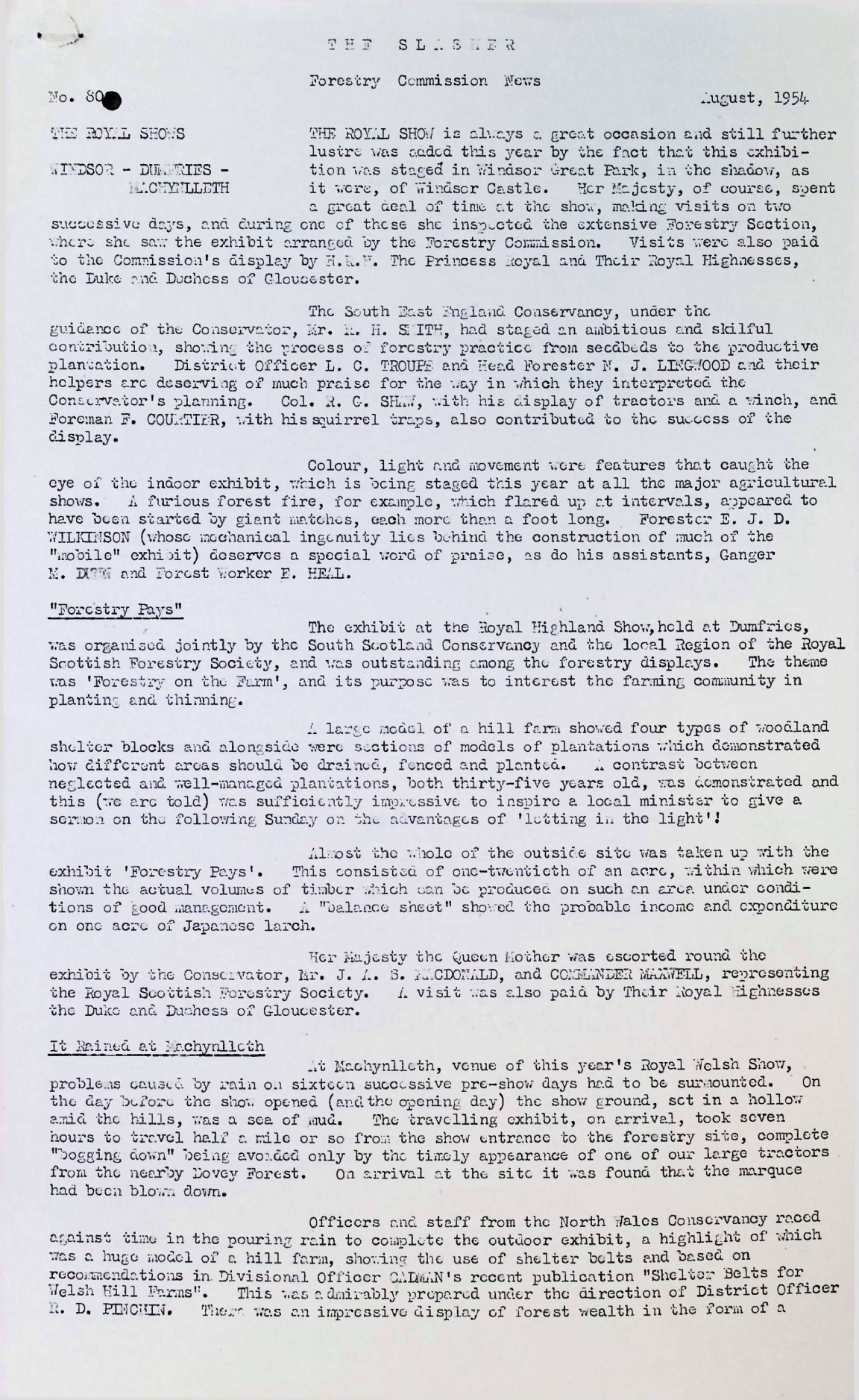
The Royal Shows - Windsor - Dumfries - Machynlleth
This year's Royal Show was staged in Windsor Great Park in the shadow of Windsor Castle.
Her Majesty spent a great deal of time at the show, making visits on two successive days, and during one of these she inspected the extensive Forestry Section, where she saw the exhibit arranged by the Forestry Commission. Visits were also paid to the Commission's display by H.R.H. The princess Royal and Their Royal Highnesses, the Duke and Duchess of Gloucester.
The South East England Conservancy, under the guidance of the Conservator, Mr R.H. Smith, had staged an ambitious and skilful contribution, showing the process of forestry practice from seedbeds to the productive plantation. District Officer L.C. Troupe and Head Forester N.J. Lingwood and their helpers are deserving of much praise for the way in which they interpreted the Conservator's planning. Col. R.G. Shaw, with his display of tractors and a winch, and Foreman F. Courtier, with his squirrel traps, also contributed to the success of the display.
Colour, light and movement were features that caught the eye of the indoor exhibit, which is being staged this year at all the major agricultural shows. A furious forest fire, for example, which flared up at intervals, appeared to have been started by giant matches, each more than a foot long. Forester E J.D. Wilkinson (whose mechanical ingenuity lies behind the construction of much of the 'mobile' exhibit) deserves a special word of praise, as do his assistants, Ganger M. Dunn and Forest worker E. Heal.
'Forestry Pays'
The exhibit at the Royal Highland Show, held at Dumfries, was organised jointly by the South Scotland Conservancy and the local Region of the Royal Scottish Forestry Society, and was outstanding among the forestry displays. The theme was 'Forestry on the Farm', and its purpose was to interest the farming community in planting, and thinning.
A large model of a hill farm showed four types of woodland shelter blocks and alongside were sections of models of plantations which demonstrated how different areas should be drained, fenced and planted. A contrast between neglected and well-managed plantations, both thirty-five years old, was demonstrated and this was sufficiently impressive to inspire a local minister to give a sermon on the following Sunday on the advantages of 'letting in the light'.
Almost the whole of the outside site was taken up with the exhibit 'Forestry Pays'. This consisted of one-twentieth of an acre, within which were shown the actual volumes of timber which can be produced on such an area under conditions of good management. A 'balance sheet' showed the probable income and expenditure on one acre of Japanese larch.
Her Majesty the Queen Mother was escorted round the exhibit by the Conservator, Mr J.A.S. MacDonald and Commander Maxwell, representing the Royal Scottish Forestry Society. A visit was also paid by Their Royal Highnesses the Duke and Duchess of Gloucester.
It Rained at Machynlleth
At Machynlleth, venue of this year's Royal Welsh Show, there was rain on sixteen successive pre-show days. On the day before the show opened (and the opening day), the show ground, set in a hollow amid the hills, was a sea of mud. The travelling exhibit, on arrival, took seven hours to travel half a mile or so from the show entrance to the forestry site, complete 'bogging down' being avoided only by the timely appearance of one of our large tractors from the nearby Dovey Forest. On arrival at the site it was found that the marquee had been blown down.
Officers and staff from the North Wales Conservancy raced against time in the pouring rain to complete the outdoor exhibit, a highlight of which was a huge model of a hill farm, showing the use of shelter belts and based on recommendations in Divisional Officer Cadman's recent publication 'Shelter Belts for Welsh Hill Farms'. This was admirably prepared under the direction of District Officer R.D. Pinchin. There was an impressive display of forest wealth in the form of a wide variety of produce, arranged under the supervision of District Officer P. Morgan. Forester A. Smith Jones was in charge of 'ground' operations and 'overall' assistance came from District Officer J.R. Hampson. The whole display was a tribute to the Conservancy and the Conservator, Mr F.C. Best.
The show progressed and then, on the third and last day, came calamity. There was more heavy rain and the show had virtually to be abandoned in the early afternoon; many stands were flooded. The marquee which housed the travelling exhibit was again blown down!
A Great Day in The Dean - The Jubilee Celebrations
The Jubilee celebrations at the Dean School were marked by fine weather. The certificates were distributed by the Director General, Mr A.H. Gosling in the local Memorial Hall, which was filled with students, former students and their families.
Mr Gosling, who attended the school in 1919-20, described the Jubilee as a memorable occasion in the history of forest education, for the school was not only the oldest in the country but, he thought, in the Commonwealth. Sir Richard Cotterell, one of the Forestry Commissioners, presided, and other speakers included Mr Tom Brown, one of the first students who was to start Eggesford, our first forest, and who is now, at an age of more than 70, a consultant forester. Early days of the school were also recalled by Mr A.H. Popert, Conservator, South West England, a former Instructor. Also among those on the platform was Mr R.G. Broadwood, another former Instructor, and the present Education Officer Mr J.F. Godwin. Mr C.O. Hanson, the first Instructor, who is now over 80, was unable to attend, but he sent his good wishes by telegram.
There followed a garden fete and marquee tea on the local sports field and then, in the evening, came the cabaret and the gala ball in Lydney. To commemorate the Jubilee, the school has produced The Deansday Book, which we propose to review next month.
A Recreation Ground For Tair Onen - Welcomed With Jubilation
Tair Onen, which is some 12 miles from Cardiff and is the biggest forest tree nursery in Britain, now has a recreation ground - a field of more than two acres that has been placed by the Commission at the disposal of the local Social Club. Tair Onen gives regular employment to 130 workers; there are now nearly 40 modern houses.
Mrs McNulty, wife of Head Forester M.E. McNulty, who is in charge of the nursery, performed the opening ceremony by formally cutting a ribbon. Among the speakers was Forestry Commissioner Mr W.H. Vaughan, who has taken a keen interest in the establishment of amenities at Tair Onen. The South Wales Conservancy office was represented by Senior Estates Officer A.W. Arends. There were children's races and a well-organised tea - and selections from a brass band!
A Visit to Jugo-Slavia - 4,000 Miles - Only Two Rabbits
Sir William Taylor, former Director General of the Commission, gives an account of a visit to Jugo-Slavia.
We covered Slavonia, Dalmatia, Herzegovina, Bosnia and Croatia (he writes), penetrating also for a few miles into Serbia. The coastal region is dominated by the precipitous Julian and Dinaric Alps of bare dolomitic limestone, the foothills, low ground and islands now being boulder-strewn and arid. The former forest was cut down by the Venetians in the middle ages and subsequent erosion has done its worst. Bare mountain and almost bare upland valleys stretch from the coast far into the interior before any really fertile land is encountered.
After leaving Istria and the forests of black pine (P. laricio sp.) I saw no more forest along the coast. There is, however, everywhere a good deal of low scrub at the lower levels - oak, hornbeam, elm, ash, sumach and a buckthorn (unidentified), together with many wild flowers. The dog roses were a sight to behold. At Plitvice, in the National Park, where we made all too short a stay, forest covers a wide area up to a height of over 6,000 feet. The species are chiefly beech with spruce, silver fir and Scots pine at the higher elevations. Wild flowers of many kinds not included in the British flora grow profusely. A warden informed me that a she-bear had two cubs in a den quite near the chalet in which we were accommodated. Within the ambit of the Park there are bear, wolf, lynx, wild cat, wild boar, red deer, chamois, ibex and the lesser European carnivores and rodents, but it was not my good fortune to see any of these.
No more forest worthy of the name was seen until we got into Bosnia on the return journey. There, there are many thousands of hectares of well-kept forest stocked with oak, beech, hornbeam and a sycamore (A. obtusatum) with conifers above. I saw no Picea omorica. Motoring is not, perhaps, ideal for bird observation. The few species seen during the journey include an eagle, kite, stork, heron (two species), bee-eater, shrike, goldfinch and sparrow. Cuckoos were ubiquitous. Swallows were numerous, also swifts, including the alpine swift, but it is probable that the scarcity of water over so many square miles of Dalmatia makes life difficult for most species.
The population of Jugo-Slavia is made up of a number of races (and languages). The atmosphere is eastern and there are numerous mosques each with a minaret from which the faithful are called to prayer. There are also many gypsies. Except in the more fertile regions of Bosnia and Croatia, the population is sparse. The peasants are very poor; every little patch of soil is carefully enclosed and cultivated. The chief crops are rye, maize, beans, potatoes and vines with here and there a little tobacco. Wars have treated these people harshly; many villages have been razed and it would seem that much of the destruction was wanton. A good deal of reconstruction and public works are being undertaken, including concrete platforms for rain water catchment in the dry parts.
Sarajevo is not a particularly impressive city and the famous bridge and its approach where the Archduke was assassinated, thus precipitating the 1914-18 war, are meanly designed. Zagreb, with some 300,000 inhabitants, is by far the finer city. Here, as in other towns, peasants come daily in their picturesque native dress to trade in the market. Everywhere in the interior there are walnut trees; I saw numbers of walnut logs presumably awaiting export, eastern Europe being the main source of this timber. Our last two-day stay in Jugo-Slavia was at Bled in the Julian Alps, a former royal summer resort sited on a small but beautiful lake amid the mountains.
From Herzegovina, through Bosnia, Croatia, Italy, the Tyrol, Switzerland, the Vosges and Belgian Ardennes, one could not help being again impressed by the vast extent of forests. None of the countries traversed fails to realise that forestry and agriculture are complementary forms of husbandry and that both are important in the scheme of rural economics. Forests of spruce, silver fir, larch and Scots pine often, in the Brenner neighbourhood, growing with an understory of mountain pine, were especially noticeable, as was the tendency to underthin (by standards adopted at home), height rather than girth in the earlier years of growth being the object. In Britain we may well envy a planting line up to 7,000 feet and the ease with which the principal species can be regenerated naturally in these old forest soils, and envy also the firmly established forest tradition that prevails among all these peoples.
In a tour which took us nearly 4,000 miles, out and home, I saw only two rabbits.
Educational Visits
The staff of the West Conservancy Office, Scotland, paid an educational visit to Strathyre and Drummond Hill, in the East Scotland Conservancy. The party was conducted round Strathyre nursery by Head Forester A. Cameron and Mr H.A. Maxwell, State Forest Officer, who accompanied the party, described a number of interesting local features. At Drummond Hill the visitors were met by District Officer R.D.P. Jackson and Head Forester W.L. Ross. Much interest was shown in the experimental seed orchard of European larch, and the sample plot of Norway spruce.
The staff of the Bristol office, H.Q. of the South West England Conservancy, visited the Research Station at Alice Holt where, headed by Mr A.W. Matthews, Chief Clerk, they were welcomed by Mr M.V. Laurie, Chief Research Officer. Talks and demonstrations were given by Research Officers.
Golf
The Scottish Civil Service Golf Championship is being revived. The event takes place over the Kings and Queens Courses, Gleneagles, on Tuesday, 21st September, and in addition to the main competition there is a handicap section.
Tropical Fish Keeping
Mr L. Fagg, an enthusiast at Headquarters, continues his article on fish-keeping.
There are two distinct kinds of tropical fish - the egg laying species and the 'live-bearing' species. This month I propose giving a few details of one or two fish of the former species which may be obtained without difficulty from a dealer.
Hyphessobrycon flammens, the Flame Fish, costs about 3s. 6d. It comes from Brazil and attains a length of just over an inch. The front portion of the body is olive-green, with two dark bars just behind the gill-plates; the hind portion and the fins are vivid red. The male is brighter in colour than the female. This species breeds with the water at about 78 degrees. The female scatters the eggs, most of which adhere to the underwater vegetation. Following spawning, the parent fish should be removed to another tank and the eggs left to hatch out. The incubation period is about three days.
After a day or two of clinging to the plant life the baby fish, which look like tiny splinters of glass, start searching for food and exist on the microscopic organisms called Infusoria that are always present in aquarium water.
Since the average tank is too small to provide sufficient nourishment to feed so many baby fish, extra organisms must be introduced, and to produce Infusoria, a number of jam jars should be filled with water from an established aquarium; then, into each jar should be placed several bruised lettuce leaves, lawn clippings, hay and water plants; a teaspoonful of topsoil from the garden should be added and the jar left to stand for a few days in a warm, dark place.
The water in the jars will develop an unpleasant smell and then contain plenty of Infusoria. Half a jar of the Infusoria-laden water should then be emptied into the tank every day for about a week, after which the young fish should be capable of taking dust-fine dried food or mashed earth worm placed in a muslin bag and repeatedly dipped in the water.
Hyphessobrycon innesi, the celebrated Neon Tetra, is truly the aristocrat of the small community tank. A brilliant blue-green streak traverses the length of the body from eye to tail and is enhanced by the bright red splash that suffuses part of the end of the body. Unfortunately few breeders succeed in breeding this little beauty and consequently the species are mostly imported, which means that their price is as high as 7s. 6d. per fish.
Transfers
District Officer J.C. Harrison from Santon Downham, E(E) to Lyndhurst, New;
District Officer A.J. Grayson from Rothbury, NE(E) to Durham, NE(E);
Forester J.D. McDonald from Fleet, S(S) to Glentress, S(S);
Forester W.H. Mackay from Glentress, S(S) to Fleet, S(S);
Forester R. McGeorge from Greskine, S(S) to Saltoun, S(S);
Forester F. Usher from Micheldever, SE(E) to Havant, SE(E);
Forester R. Linden from Culbin, E(S) to Clashindarroch, E(S);
Forester A.J. Freeth from Lyndhurst, New to Bishopstoke, SE(E);
Foreman W.R. Sinclair from Newton Nursery, E(S) to Monaughty, E(S);
Foreman R.A. Catchpole from Bishopstoke, SE(E) to Micheldever, SE(E);
Foreman H. McKay from Grizedale, NW(E) to Kershope, NW(E);
Foreman F.H. Drake from Coed-y-Goror, N(W) to Bedgebury, SE(E);
Clerk of Works W. Baxter from Edinburgh to Inverness;
Clerical Officer R.W. Soars from Research, Alice Holt to Education, London;
Clerical Officer P.H. Hamilton from Dean to Research, Alice Holt.
Engagement
District Officer John Aldhous, Research, has become engaged to Miss Heather Black.
Marriage
Clerical Officer A.E. Bradfield, New Forest, has married Miss M. Hollingsworth.
Births
The birth of a son to District Officer J. Jobling, Research, and Mrs Jobling.
The birth of a son to Senior Photographer I.A. Anderson and Mrs Anderson.
The birth of a son to Mrs E. Pettigrew, Edinburgh Office, and Mr. Pettigrew.
The birth of a son to Forester O.I. Morris, North Wales, and Mrs Morris.
The birth of a son to Executive Officer W. Stewart, Glasgow, and Mrs Stewart.
The birth of a son to Clerical Officer Ian Brunton, Glasgow, and Mrs Brunton.
The birth of a daughter to Experimental Officer G.M. Buszewicz, Alice Holt, and Mrs Buszewicz. X
The birth of a daughter to District Officer C.E. Peaty, North Wales, and Mrs Peaty.
The birth of a daughter to Clerical Officer J.G. Jackman, Alice Holt, and Mrs Jackman.
Retired
Miss J.K. Pratt, Executive Officer, Accounts Section, Edinburgh Office has retired through ill-health.
Please see the PDF link below to view all the pages.
Download Large Version (1.5MB)
Groups: Forestry Commission staff magazines