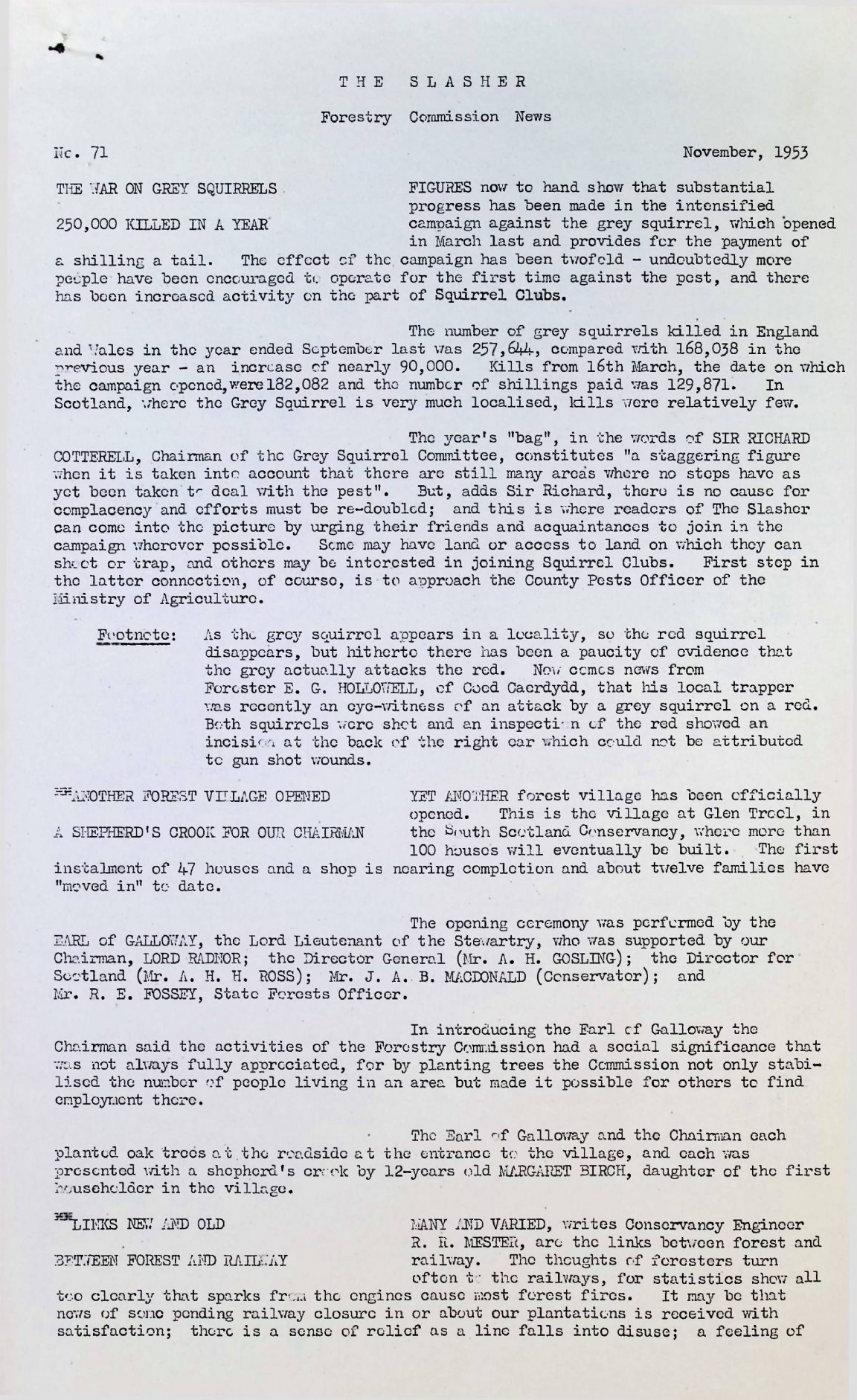
Slasher Magazine Summary: Publication No. 71 – November 1953
The scanned images of the Slasher were produced by and courtesy of the Forest Research Data and Information Team staff based at Roslin, where some of the original copies are located. The Forestry England Information Knowledge Management Team and New Forest Heritage made available copies of The Slasher from their collections. Brian Mahony of the FC Retirement Association devised and coordinates the Slasher Project and has been instrumental in locating many missing editions and coordinating the searches to locate all the earlier publication numbers.
The content summary below was again very kindly compiled by Diane Birkett, Bedfordshire. See PDF attachment link below the text summary to view the full document. A total of over 420 issues or publications were produced between January 1948 and the final publication in 2010.
The War on Grey Squirrels - 250,000 Killed in a Year
Substantial progress has been made in the intensified campaign against the grey squirrel, which opened last March and provides for the payment of a shilling a tail. 257,644, grey squirrels were killed in England and Wales in the year ended September last, compared to 168,038 in the previous year. Kills from 16th March, the date on which the campaign opened, were 182,082 and the number of shillings paid was 129,871. In Scotland, where the Grey Squirrel is very much localised, kills were relatively few.
Sir Richard Cotterell, Chairman of the Grey Squirrel Committee, said there are still areas where no steps have been taken to deal with the pest.
As the grey squirrel appears in a locality, so the red squirrel disappears, but hitherto there has been a paucity of evidence that the grey actually attacks the red. Now comes news from Forester E.G. Hollowell, of Coed Caerdydd, that his local trapper was recently an eye-witness of an attack by a grey squirrel on a red. Both squirrels were shot and an inspection of the red showed an incision at the back of the right ear which could not be attributed to gun shot wounds.
Another Village Opened
Another forest village has been officially opened. This is the village at Glen Trool, in the South Scotland Conservancy, where more than 100 houses will eventually be built. The first instalment of 47 houses and a shop is nearing completion and about twelve families have 'moved in' to date. The opening ceremony was performed by the Earl of Galloway, the Lord Lieutenant of the Stewartry, who was supported by our Chairman, Lord Radnor; the Director General Mr A.H. Gosling; the Director for Scotland Mr A.H.H. Ross; Mr J.A.B. MacDonald (Conservator); and Mr R.E. Fossey, State Forests Officer.
The Earl of Galloway and the Chairman each planted oak trees by the roadside at the entrance to the village, and each was presented with a shepherd's crook by 12-year old Margaret Birch, daughter of the first householder in the village.
Links New and Old Between Forest and Railway
Many and varied are the links between forest and railway writes R.R. Mester. The thoughts of foresters turn often to the railways, for statistics show that sparks from the engines cause most forest fires. It may be that news of some pending railway closure in or about our plantations is received with satisfaction; there is a sense of relief as a line falls into disuse; a feeling of special achievement in such cases as the occupation by Chirk Depot of some of the very buildings of the newly dismantled Glyn Valley Tramway, closed to traffic in 1935. In the Forest of Dean, the motor road approach into Lightmoor Depot is aligned over a section of abandoned mineral railway.
A notable addition to British Railways was opened in September last year. This was the Calverton Colliery Branch, a double track, standard gauge line seven and a half miles long, serving the colliery, which is north east of Nottingham. For a distance of more than half a mile, this new line runs in a deep cutting through part of Sherwood Forest, in the North West England Conservancy, and the construction of the railway meant the surrender of about thirteen acres of plantation in the form of a strip. The standing timber (C.P., P30 and fully stocked) was clear felled and, with the building of the new line, there has resulted a very considerable and marked change in the appearance of the countryside. In the centre of the plantation, the cutting is 30 feet deep and 80 feet wide, with a maximum depth of about 50 feet of cutting approaching the western perimeter.
As the railway cut this part of Sherwood Forest into two separate blocks, a modern, three-span concrete connecting over-bridge for vehicular traffic was provided by the Railway Executive and is one of nine bridges included in the engineering works on the line. This branch railway is the first of any appreciable length to be constructed since the nationalisation of railways and is designed for operation by main line locomotives and new standard 24½ ton coal wagons.
The contrasting ancient railway in Dovey Forest, at Abergynolwyn in the North Wales Conservancy, the Commission's plantations adjoin the track of what is now the oldest surviving, steam-hauled, passenger-carrying narrow-gauge line in the world, the historic Tal-y-Llyn Railway. This 2ft. 3ins. gauge railway was incorporated in 1865 and a Tal-y-Llyn Railway Preservation Society has been formed to ensure the survival of the line as a going concern. Among the locomotives in an 88-year old veteran - DOLGOCH - still in commission, and four-wheeled coaches which have carried passengers since 1866.
Above Abergynolwyn terminus is clearly displayed the familiar "Take Care: Do Not Start Fire" notice. Perhaps one day it will be joined by a modern forest nameplate.
Odd Jobs
We are all aware of things that are harmful to forestry, and of the need of energetic steps to eradicate them. It is, therefore, perhaps a little surprising to hear that the work of leading surveyor Miss Marion Mansell, of the Forest Research Station, has included the potting-up of weeds, the planting of rhododendrons and, of all things, the nurturing of baby grey squirrels. Where the last task is concerned, it should be explained that a number of grey squirrels is to be kept in captivity at Alice Holt Lodge, the main object being to permit a study of their food preferences, so that the most effective bait may be used for future trapping. At first the colony consisted of just two baby squirrels, acquired by Fred Courtier, who is undertaking much of our grey squirrel research work. They were fed through a fountain-pen filler on milk and honey, the menu being supplemented in due course with a nut dessert. The colony is now more than 20 strong.
Paging a Former Art Teacher
A paragraph in a Yorkshire newspaper described how the landlord of a London hotel is planning a reunion of a band of men who, nearly 30 years ago, "stood up to the corkscrew bowling of big Bill Bowes on a concrete hard pitch in Leeds". A pile of bricks served as stumps. The said landlord listed 13 names in a Press advertisement and all persons have been traced, and eleven of them intend to take part in the reunion early next year. They include "a former art teacher now with the Forestry Commission in Cumberland", and we would hardly be human if we failed to speculate as to the identity of this particular gentleman.
Ganger as Rugby Player
South Wales Conservancy can boast of a first class rugby player. He is Ganger G. Morris, of St. Gwynno, who applied for a trial with the Newport Rugby club and has now obtained a regular place as lock forward.
"In The Hands of Police" - Edinburgh Visit to Wireless Station
Members of the Directorate Office (Edinburgh) Social Club recently spent an enjoyable evening in the hands of the Edinburgh police. Enjoyable? Yes, for the police were good enough to show our colleagues over the wireless station on the top of Blackford Hill. They were allowed to listen-in to actual broadcasts to patrol cars, directing the vehicles to the scenes of various misdemeanours. "Our only regret", writes our correspondent, "was to miss by a few days the big 'break out' from Saughton Prison."
The party was also shown the make-up of the transmission and receiving sets carried in patrol cars, and a few were permitted to use the "walkie-talkie" apparatus. They also visited Kirk o' Shots TV station, also through the good offices of the police.
The Social Club Committee was fortunate enough to get Yardley's of Old Bond Street, to send along one of their experts to give a talk on the art of make-up.
Messrs Leefe, Plant and Deal
Due to sickness and the taking of leave at Lynford Hall, the Forester Training School in East Anglia, District Officer Leefe was deputising for the Education Officer; and the Forester-Instructor, also deputising, was Mr Plant (now District Officer). The Forester in charge of the School beat is Mr Deal.
Taking it to Extremes - Forests 32 Miles From Northern Ireland
Some of our forests lie at the extreme geographical limits of Great Britain. From about 1920, we believe the record for being farthest north was held by Borgie Forest in Sutherland, which is only ten miles south of Dunnet Head. (It is Dunnet Head, not John o' Groats, that is the northernmost point of the British mainland.) Recently, however, the new acquisition called Strathy, also in Sutherland, has taken the Commission a mile or two nearer the North Pole.
Also in the North Conservancy, Scotland, are our most westerly forests - Fiunary, on the Morven peninsula is only 10 miles east of the Point of Ardnamurchan, which is the westernmost part of the Scottish mainland, and indeed of Great Britain. Still further out, on the Isle of Skye, is Glen Brittle Forest, which at its extreme point is five miles west of the Point of Ardnamurchan; incidentally, it is also nearly 20 miles west of Belfast. Our most easterly forests are all in Suffolk and at the moment it looks like a tie between Dunwich and the new unit called Waveney, both being within five miles of Lowestoft Ness, the easternmost point of England. Waveney is on an island called Lethingland; although you can easily reach it by road or rail, you always have to cross a bridge, and it is even possible to sail around it.
Can Dunwich or Waveney claim our most easterly tree - or possibly Tunstall.
The record for furthest south was held for a few years by Erme Forest, in Devon, but this year a new acquisition has been made in the Goonhilly Downs of Cornwall, within five miles of Lizard Head - that will take a lot of beating. This area is farther west than any point in Wales, and only 20 miles east of Land’s End, the westernmost point of England.
Glen Brittle is 320 miles west of Waveney, or a greater distance than that from London to Carlisle. No fewer than 600 miles, in a north to south direction, separate Strathy from the Goonhilly Downs; this is a greater distance than that from London to Spain. There is room for quite a lot of differences in climate and weather in such far-flung extremes.
Research Branch may try to go one better by bringing in experimental areas they are running on Lewis in the Outer Hebrides, and Hoy in Orkney.
Saddell Forest in West Scotland, and Bareagle Forest in South Scotland, are only 32 miles from Northern Ireland, while Lyminge Forest, in Kent, comes within 30 miles of France.
Newcomers
District Officer I.A.D. Grant to N(S);
District Officer J.R. Aldhous to Research;
District Officer A.J. Grayson to NE(E);
District Officer M.C. Shirley to SW(E) ;
District Officer W.G. Jeffrey to E(S);
District Officer T.S. Thompson to S(W)
District Officer D.Y.M. Robertson to S(W);
District Officer M.H. Orram to NW(E) ;
District Officer J.R. Skinner to N(W);
District Officer J.D. Cameron to Dean.
Executive Officer Miss M.J. Eden to H.Q.;
Executive Officer J.W. Davis to D(S).
Clerical Officer W.R.G. Hall to E(S) ;
Clerical Officer J.A. Dunford to SW(E);
Clerical Officer Miss J.S. Reid to N(S).
Transfers
District Officer D.R. Johnston from Alice Holt, SE(E) to Chichester, SE(E);
District Officer A.R. Sutton from Woking to Chichester SE(E);
District Officer J.V. Crossland from Ulverston, NW(E) to Kendal, NW(E);
District Officer R.C. Stern from Aberystwyth to Ruthin;
District Officer L.C. Troupe from Alice Holt, SE(E) to Farnham, SE(E);
District Officer J.E.A. Keen from Woking to Farnham;
Forester J.R. Henderson from Gravetye, SE(E), to Brightling, SE(E);
Forester M.K. Young from Glenduror, W(S) to Loch Katrine, W(S);
Forester I.O. Evans from Polena, S(W) to Towy, S(W);
Forester C.O. Mackintosh from Leanachan, N(S) to Speymouth, E(S);
Forester J. Day from Clipstone, NW(E) to Charnwood, NW(E);
Forester F. Jones from Kershope, NW(E) to Inglewood, NW(E);
Foreman D. Toibin from Wentwood, S(W) to Slebech, S(W);
Foreman J. Howson from Giedd, S(W) to Mynydd Ddu, S(W);
Foreman R.A.F. Kemp from Education, Faskally School to Education, Gwydyr School;
Foreman P.H. Parsons from Savernake, SW(E) to Erme, SW(E);
Foreman D. Robertson from Research, Wykeham to Research, Glentrool;
Foreman G.F. Thomas from Charnwood to Clipstone;
Foreman J.J. Munro from Wark, NE(E) to Redesdale, NE(E);
Clerk of Works T. Dalgleish from Glenhurich, N(S) to Straiton, S(S);
Executive Officer W.O. Wittering from Research, Alice Holt to Edinburgh;
Executive Officer C. Ridley from Bristol to Alice Holt.
Marriages
District Officer, Research Branch, Roy Faulkner has married.
District Officer Research Branch, George Holmes married Miss Sheila Woodger.
Foreman G. Buszewicz, Research Branch, married Miss Lydia Rossner.
Births
The birth of a third daughter to District Officer, Research Branch, D. Bevan and Mrs Bevan.
The birth of a second son to District Officer, Research Branch, John Matthews and Mrs Matthews.
Obituaries
B.V. James, former Forester has died less than three months after his retirement, which was referred to in the last issue of Slasher. Mr James was employed in State forestry for 46 years, for he started his career with the Office of Woods in 1907, spending most of his time in The Dean. He joined the Forestry Commission in 1924 and subsequently became a Ganger, then a Foreman in 1937 and a Forester in 1939. During the war he served with H.T.P.D., returning to the Commission at Tintern early in 1947. Later in the same year he was transferred to Pembrey, one of our forests which has been largely formed on sand-dunes, and there he remained until his retirement in August last. The cremation took place at Pontypridd.
W.E. Wilkes, formerly Clerk of Works in the South Wales Conservancy, died in Bridgend Hospital.