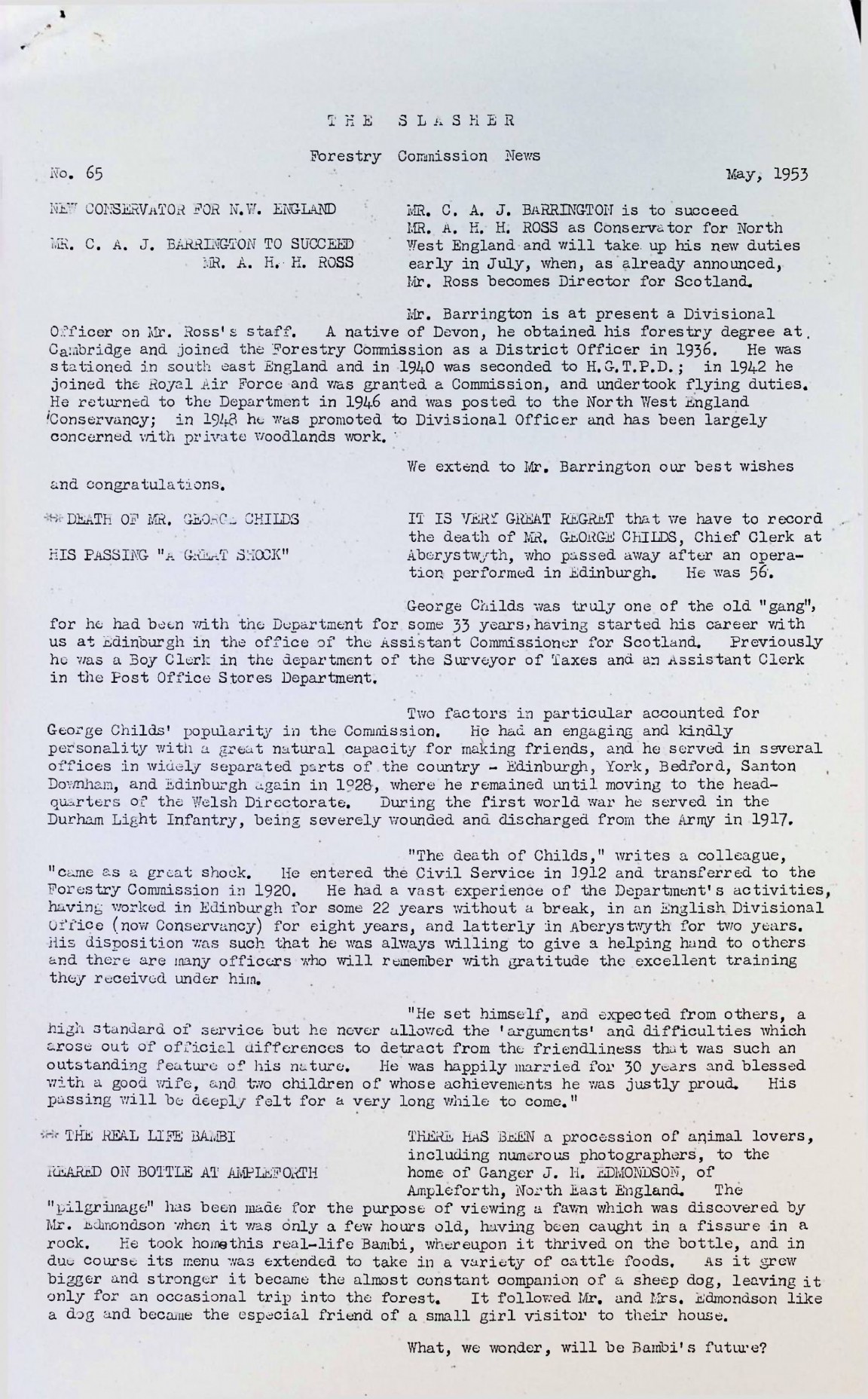
Slasher Magazine Summary: Publication No. 65 – May 1953
The scanned images of the Slasher were produced by and courtesy of the Forest Research Data and Information Team staff based at Roslin, where some of the original copies are located. The Forestry England Information Knowledge Management Team and New Forest Heritage made available copies of The Slasher from their collections. Brian Mahony of the FC Retirement Association devised and coordinates the Slasher Project and has been instrumental in locating many missing editions and coordinating the searches to locate all the earlier publication numbers.
The content summary below was again very kindly compiled by Diane Birkett, Bedfordshire. See PDF attachment link below the text summary to view the full document. A total of over 420 issues or publications were produced between January 1948 and the final publication in 2010.
New Conservator for N.W. England - Mr C.A.J. Barrington
Mr C.A.J. Barrington is to succeed Mr A.H.H. Ross as Conservator for North West England, and will take up his new duties early in July, when Mr Ross becomes Director for Scotland. Mr Barrington is at present a Divisional Officer on Mr Ross's staff. A native of Devon, he obtained his forestry degree at Cambridge and joined the Forestry Commission as a District Officer in 1936. He was stationed in south east England and in 1940 was seconded to H.G.T.P.D. In 1942 he joined the Royal Air Force, was granted a Commission, and undertook flying duties. He returned to the Forestry Commission in 1946 and was posted to the North West England Conservancy. In 1948 he was promoted to Divisional Officer and has been largely concerned with private woodlands work.
The Real Life Bambi Reared on Bottle at Ampleforth
There has been a procession of animal lovers, including numerous photographers, to the home of Ganger J.H. Edmondson, of Ampleforth, North East England. The 'pilgrimage' has been made for the purpose of viewing a fawn which was discovered by Mr Edmondson when it was only a few hours old, having been caught in a fissure in a rock. He took home this real-life Bambi, whereupon it thrived on the bottle, and in due course its menu was extended to take in a variety of cattle foods. As it grew bigger and stronger it became the almost constant companion of a sheep dog, leaving it only for an occasional trip into the forest. It followed Mr and Mrs Edmondson like a dog and became the especial friend of a small girl visitor to their house.
The Giant Redwoods of Leighton Hall and the Powis Castle Oaks
There are fine examples of redwoods renowned in forestry circles, in the Leighton Hall Woodlands, near Welshpool, in Mid-Wales, which is owned by Major C.P. Ackers.
These redwoods were brought to Leighton Hall from America in pots nearly 100 years ago by an earlier owner of the estate. Today they are at heights of well over 100 feet. There are 85 of these trees to the acre and the average height is 111½ feet. The average quarter girth is 33 inches. The volume per acre under bark is 16,545 cubic feet and the volume per acre over bark is 24,000 cubic feet.
There are some redwood 'oddities' on the estate including a tree that blew down and is now reproducing itself along the trunk from the horizontal stem. A redwood which, having reached the age of 80, was blown; its base went back into place after cross-cutting and several 'trees' of good size and form are now growing from the butt.
There is an acre and a half (planted in 1952-53) of Metasequoia glyptostroboides, the species which has been much in the news of late. The young trees at Leighton Hall were raised from seed from the Metasequoias discovered in recent years in China and thought to have been extinct since Tertiary times.
The woods, which cover about 750 acres, have been awarded six silver and five bronze medals in the past 14 years. Through the co-operation of Major Ackers, the Forestry Commission has established six sample plots on the estate, and there is a splendid Douglas fir from which we obtain material for grafts - this, in the words of the owner, being 'the finest Douglas ever'.
A former owner of the estate undertook an ambitious project for the pumping of liquid manure to the highest point, for general distribution through a system of irrigating "pipelines". However, some of the mechanism was made of gun metal which was confiscated to feed the war machine of 1914-18. A special road was built, including the construction of a viaduct, to enable a carriage to be driven round the vantage points of the estate, and there was once a scenic railway at Leighton Hall.
It is a short journey from the Hall to the 1,200-acre woodlands of Powis Castle, wherein may be seen some more sylvicultural wonders, including the Gwen Morgan Douglas fir, the biggest of its species in Britain. This is now some 170 feet tall and contains more than 600 cubic feet of timber. There are great oaks in the Park and the visitor will inevitably hear of the inglorious end of a former giant. That oak was said to be the biggest in all Europe and its volume was 2,000 cubic feet; yet although seemingly healthy it fell to the ground on a quiet, still day in May 1938.
A sight not to be missed at Powis Castle is the South Side Oak Wood. This comprises three age classes, about 140, 170 and 200 years, and the finest of the trees, Lady Harriet’s Oak, is more than 90 feet tall; it has a 50 ft. bole and its volume is more than 300 cubic feet. The volume per acre of this wood, which in 1939 was awarded the Royal Agricultural Society's Gold Cup, is 3,200 cubic feet.
Powis Castle and 57 acres around it are now under the management of the National Trust, but the bulk of the woods on the estate are in process of being dedicated.
The White Fox Cub
After the recently reported white stoats and white squirrels, there is news of a white fox cub. While out hunting at Balloch Forest, South Scotland Conservancy, Keeper Alex Tait, accompanied by keepers from neighbouring areas, unearthed a vixen with five cubs, one of which was pure white. Keeper Tait and the other keepers killed one dog fox, nine vixens and 57 cubs in three days.
Welcome Home
The Social Club at Alice Holt recently held a party to welcome Mr and Mrs R.F. Wood home from Canada. Mr Wood, who is Silviculturist, South, was awarded a Nuffield Scholarship which enabled him to go to Western Canada to study tree species already, or likely to be planted over here.
A Botanical Note - Bearsfoot at Kielder
Recently, Research Forester G.S. Forbes was invited to see two excellent specimens of Green Hellebore or Bearsfoot (Helleborus viridis) which were found by Miss Maureen Curry near Kielder Castle. Identification had been confirmed by Dr C.E. Fisher of the Hancock Museum, Newcastle, who stated that this plant is rare in Northumberland and there is no former record of it in the North Tyne valley. Some specimens have, of course, been found in southern and eastern England. Forester Forbes believes the plant has usually been considered a relic of cultivation, for it was at one time grown for medicinal purposes. In Yorkshire, farmers used to cultivate it for use in the treatment of mastitis in cattle. The specimens referred to above are about 12 to 15 inches tall and are growing at the bottom of a steep bank in a sandy clay soil. Miss Curry and her mother, a shorthand typist at the Castle, are enthusiastic botanists and have in their possession many wild flowers collected in and around Kielder.
The Return of Rob Roy - Film-Making at Loch Ard
In the peaceful locality of Corriegrennan, Loch Ard, in the West Scotland Conservancy, a film company has commenced production of "Rob Roy", with Richard ("Heart-throb") Todd in the name part and Glynis ("Miranda") Johns as Helen. The scene has been one of great activity with lorries, vans and cars hurrying along the Trossachs road. A fort of "ye olden times" has been erected and cottages made to resemble the style of the period. Actors and film extras have been around in great numbers and 500 men of the Argyll and Sutherland Highlanders, many recently back from Korea, have taken part in the filming.
On the first "take" the soldiers dashed into the fray on a battlefield high on the rugged Corriegrennan hill and casualties, it is understood, were numerous, among them being Richard Todd himself. Some of the men were dressed as Redcoats and others as the tattered Highland clansmen of the MacGregor and the battle scene must have been among the most spectacular ever staged in Britain. Muskets were fired and cannon belched smoke, and below the "conflict" stood the ambulances, ready to give aid impartially to Redcoats and Clansmen alike.
We Are For the Wagon - The Cup Kills More Than the Cannon
Recently we reproduced the inscription on a roadside monument near Llandovery, in Carmarthenshire. This, we thought, provided the last word in the way of a warning against strong drink. Now we are not so sure.
The following appears on a stone in the Sussex village of Kirkford, about two miles south of Chiddingfold Forest: -
Degradation Of Drunkenness
"There is no sin which doth more deface God's image than drunkenness; it disguiseth a person and doth even unman him. Drunkenness makes him have the throat of a fish, the belly of a swine, and the head of an ass. Drunkenness is the shame of Nature, the extinguisher of reason, the shipwreck of chastity, and the murderer of conscience. Drunkenness is hurtful to the body; the cup kills more than the cannon; it causes dropsies, catarrhs, apoplexies; it fills the eye with fire, and the legs with water, and turns the body into an hospital".
The stone is let into the outer wall of the Vicarage garden, facing down the village street towards the Parish Church and the "Half Moon". This calls for some reflection as we are reminded that beer was very much stronger in the good old days than it is now.
Table Tennis Champion
Miss Betty Landimore, shorthand typist at Headquarters, has won the Civil Service Ladies' Junior table tennis championship, having defeated Miss J. Cox of the Ministry of Transport in the final by two straight games.
Betty Landimore is now the holder of a rose bowl for a year and a replica which she will retain.
Newcomers
Clerk of Works W. Holmes to N(W);
Clerical Officer R.W. Soars to Research;
Clerical Officer Miss A. Crabtree to NE(E).
Transfers
District Officer J.E. Massey from Fort William, N(S) to Glenurquhart, N(S):
District Officer F.M. MacRae from Inverness to Fort William N(S);
District Officer R.A. Golding from Palnure, S(S) to Kilgrammie, S(S);
District Officer O.N. Blatchford from Cardiff to Llandovery, S(W);
District Officer M.E.S. Dickenson from Uffculme, SW(E) to Ringwood, New;
District Officer A.W.L. Guile from Witley, SW(E) to Shrewsbury;
Forester J.H. Davy from Widehaugh, NE(E) to Abinger, SE(E);
Forester F.W. Everitt from Glynn, SW(E) to Puddletown, SW(E);
Forester A.G. Fulford from Puddletown, SW(E) to Glynn SW(E);
Forester F.W.J. Yeomans from Allerston, NE(E), to Brandon Depot, E(E);
Forester W.E. Dye from Glenduror, W(S), to Strathyre, W(S);
Forester P.P. Awbery from Maresfield, SE(E) to Southwater, SE(E);
Foreman J. Carruthers from Craik, S(S) to Changue, S(S);
Foreman J. France from Kielder, NE(E) to Widehaugh NE(E);
Foreman D. Holder from Walsham, E(E) to Rendlesham, E(E);
Foreman R.J.A. McDuff from Strathyre W(S) to Kilmichael, W(S);
Foreman J. Cooper from Southwater SE(E) to Maresfield, SE(E);
Assistant Engineer J.D. Nisbet from Inverness N(S) to Fort William. N(S).
Marriages
District Officer John Jobling and Miss Elspeth Donaldson, typist of the Forest Research Station have married.
Clerical Officer Ken Bicknell of Alice Holt, and Miss Rowena Dorking have married.
Leading Surveyor Molly Coleman of Alice Holt and Mr Harris have married.
Births
A daughter, Frances Jane, was born to Divisional Officer W.N. Gibson, South Scotland and Mrs Gibson.
A daughter, Anna Elizabeth, was born to Mr J.H. McGeorge, Chief Clerk, Dumfries and Mrs McGeorge.
A son was born to Research Foreman R.D. Wishart of Kielder and Mrs Wishart.
Retired
After 36 years as a Civil Servant, Miss E.K. Rich, C.O. at Headquarters, has retired. Miss Rich commenced her career in the Service with the Ministry of Pensions and also served in the Post Office and Air Ministry, joining the Forestry Commission in 1946.
Obituary
Mr George Childs, Chief Clerk at Aberystwyth, passed away aged 56 after an operation performed in Edinburgh. He was with the Commission for 33 years, having started his career at Edinburgh in the office of the Assistant Commissioner for Scotland. Previously he was a Boy Clerk in the department of the Surveyor of Taxes and an Assistant Clerk in the Post Office Stores Department. He served in several offices in widely separated parts of the country - Edinburgh, York, Bedford, Santon Downham, and Edinburgh again in 1928, where he remained until moving to the Headquarters of the Welsh Directorate.
During the first world war he served in the Durham Light Infantry, being severely wounded and discharged from the Army in 1917. He entered the Civil Service in 1912 and transferred to the Forestry Commission in 1920. He had a vast experience of the Department's activities having worked in Edinburgh for some 22 years without a break, in an English Divisional Office (now Conservancy) for eight years, and latterly in Aberystwyth for two years.
Please see the PDF link below to read the newsletter.
Download Large Version (1.4MB)
Groups: Forestry Commission staff magazines