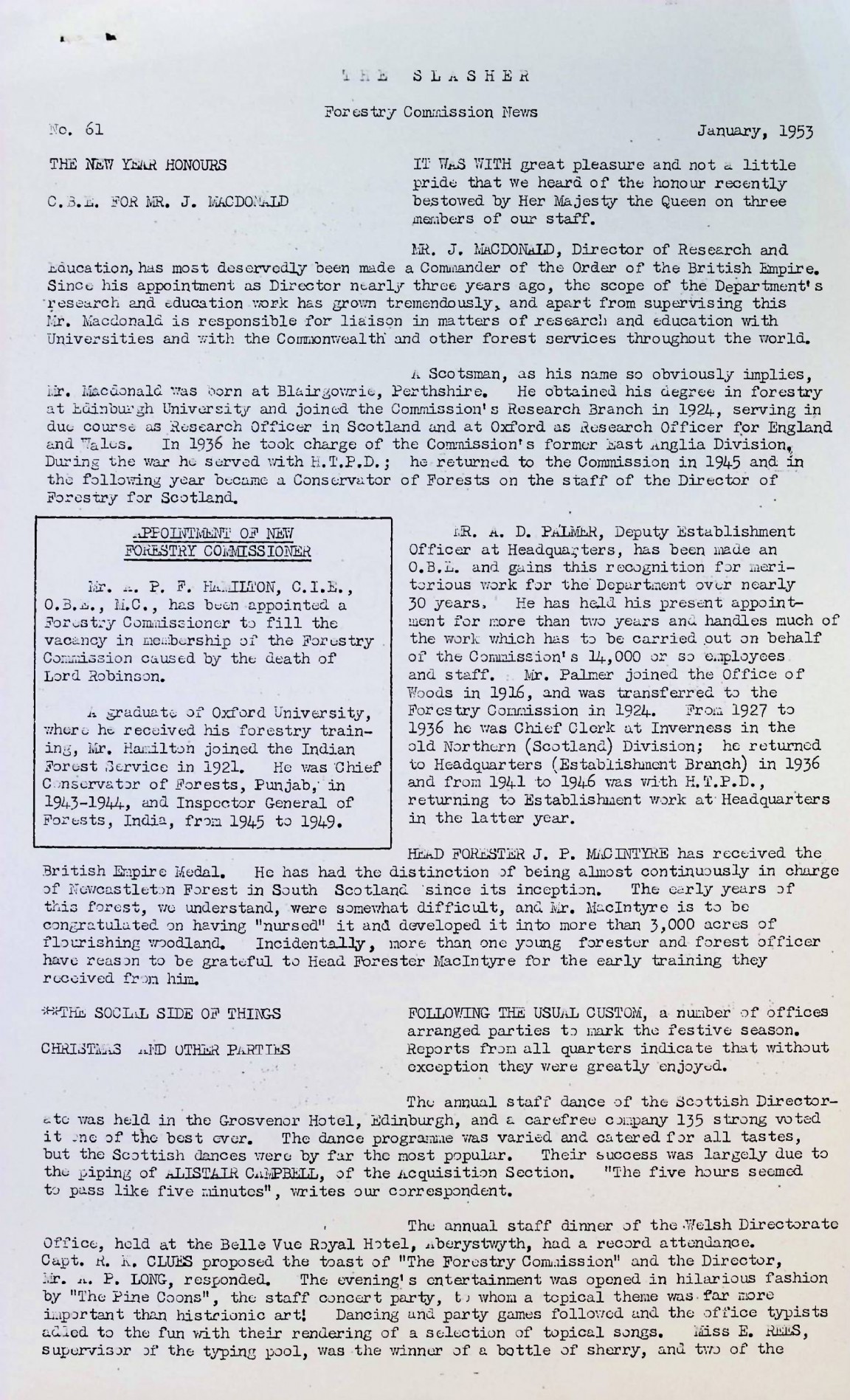
Slasher Magazine Summary: Publication No. 61 – January 1953
The scanned images of the Slasher were produced by and courtesy of the Forest Research Data and Information Team staff based at Roslin, where some of the original copies are located. The Forestry England Information Knowledge Management Team and New Forest Heritage made available copies of The Slasher from their collections. Brian Mahony of the FC Retirement Association devised and coordinates the Slasher Project and has been instrumental in locating many missing editions and coordinating the searches to locate all the earlier publication numbers.
The content summary below was again very kindly compiled by Diane Birkett, Bedfordshire. See PDF attachment link below the text summary to view the full document. A total of over 420 issues or publications were produced between January 1948 and the final publication in 2010.
The New Year Honours
Mr J. MacDonald, Director of Research and education, has been made a Commander of the Order of the British Empire. Since his appointment as Director nearly three years ago, Mr MacDonald has been responsible for liaison in matters of research and education with Universities and with the Commonwealth and other forest services throughout the world. Mr MacDonald was born in Blairgowrie, Perthshire. He obtained his degree in forestry at Edinburgh University and joined the Commission's Research Branch in 1924, serving as Research Officer in Scotland and at Oxford as Research Officer for England and Wales. In 1936 he took charge of the Commission's former East Anglia Division. During the war he served with H.T.P.D. He returned to the Commission in 1945 and in the following year became a Conservator of Forests on the staff of the Director of Forestry for Scotland.
Mr A.D. Palmer, Deputy Establishment Officer at Headquarters, has been made an O.B.E. for meritorious work for the Department over nearly 30 years. He has held his present appointment for more than two years and handles much of the work which has to be carried out on behalf of the Commission's 14,000 or so employees and staff. Mr Palmer joined the Office of Woods in 1916, and was transferred to the Forestry Commission in 1924. From 1927 to 1936 he was Chief Clerk at Inverness in the old Northern (Scotland) Division. He returned to Headquarters (Establishment Branch) in 1936 and from 1941 to 1946 was with H.T.P.D., returning to Establishment work at Headquarters in the latter year.
Head Forester J.P. MacIntyre has received the British Empire Medal. He was almost continuously in charge of Newcastleton Forest in South Scotland since its inception. The early years of this forest were difficult and Mr MacIntyre is to be congratulated on having "nursed" it and developed it into more than 3,000 acres of flourishing woodland. More than one young forester and forest officer have reason to be grateful to Head Forester MacIntyre for the early training they received from him.
Appointment of New Forestry Commissioner
Mr A.P.F. Hamilton, C.I.E., O.B.E., M.C., has been appointed a Forestry Commissioner to fill the vacancy in membership of the Forestry Commission caused by the death of Lord Robinson. A graduate of Oxford University, where he received his forestry training, Mr Hamilton joined the Indian Forest Service in 1921. He was Chief Conservator of Forests, Punjab, in 1943-1944 and Inspector General of Forests, India, from 1945 to 1949.
The Social Side of Things - Christmas and Other Parties
Office parties to mark the festive season were enjoyed. The annual staff dance of the Scottish Directorate was held in the Grosvenor Hotel, Edinburgh, and a company 135 strong voted it one of the best ever. The dance programme was varied and catered for all tastes, but the Scottish dances were the most popular. Their success was largely due to the piping of Alistair Campbell of the Acquisition Section.
The annual staff dinner of the Welsh Directorate Office, held at the Belle Vue Royal Hotel, Aberystwyth, had a record attendance. Capt. R.K. Clues proposed the toast of "The Forestry Commission" and the Director, Mr A.P. Long responded. The evening's entertainment was opened in hilarious fashion with the staff concert party, where a topical theme was far more important than histrionic art! Dancing and party games followed and the office typists added to the fun with their rendering of a selection of topical songs. Miss E. Rees, supervisor of the typing pool, was the winner of a bottle of sherry, and two of the other main prizes - a duck and a pair of nylons were won by guests. Mr G. Childs, the Chief Clerk thanked the organising committee.
A Christmas dinner in the canteen at the Research Station in Surrey was organised by the canteen committee and cooked by Mrs Clanchey and her assistant.
The appearance of the canteen was greatly enhanced by the four murals designed and executed by a Norwegian forester who is assisting Research Branch during a stay in this country. The first class murals, each 6' by 4' represent respectively height, length, depth and time.
Mr M.V. Laurie, Chief Research Officer, welcomed the guests - Dr Neil Chrystal, Mr E.R. Lewis from Director's office, and two former colleagues, Mr Collins and Mrs Pink.
In Scotland, the West Conservancy Social Club held its annual dance in the Prince of Wales Halls, Glasgow. The efforts of the Committee, under Secretary Mr J.G. Byth, contributed to the success, making it the best attended function of its kind to date. The Scottish dances were led by the piping of Foreman / Mechanist Marshall. In the absence of the Conservator at Northerwood House, Mr H.V.S. Dier, in a witty, entertaining speech, thanked everyone for supporting the dance.
The Headquarters Christmas party was held on the birthday of Lord Radnor, our new Chairman, who attended and heard the assembled company of nearly 100 sing their congratulations in traditional manner. The party was organised by the Social Club Committee, aided and abetted by a number of volunteers. Refreshments were arranged by the Misses B. Landimore and E. Tebbitt. Another highlight of the event was the Olde Englishe melodrama which was presented in 'mime'.
Those present, in addition to the Chairman, included the Director General, Mr A.H. Gosling and Mrs Gosling; Mr H.A. Turner, Secretary, and Mrs Turner; and Mr W.M. Cormack, Controller of Finance, and Mrs Cormack.
The "Major Oak" of Sherwood - An Enquiry From America
A letter from Professor W.M. Harlow of the College of Forestry, State University of New York, has brought the Major Oak of Sherwood Forest into the news again. The Professor enquires after the wellbeing of this giant tree and adds that a colleague of his who once saw it took back to America some of its acorns. One has grown into a vigorous tree 20 feet high.
Those who know this veteran oak may be interested in a "bulletin" as to its health, issued by District Officer W.V. Jackson. "I recently saw this oak", he writes, "and found it in a fair state of preservation. There is a considerable amount (probably 50 per cent) of dead wood in the crown and the foliage now mainly consists of epicormics - that is, fresh shoots appearing further down the branches as the ends die back. I have no doubt that when in leaf the crown appears fairly full of live branches - the leaves will, to a certain extent, cover the dead wood.
"The tree consists of a bole of approximately 10 feet, with a girth of 32 feet, 4 inches. The branches are trees in themselves, the girth of one of the lowest having been found to be 13 feet, 2 inches, at three feet from the main stem. The main branches are held together with wire ropes and but for these the whole tree would have collapsed before now, for much of it is completely hollow."
There has been speculation as to the age of the tree. R. Murray Gilchrist, in his book "The Dukeries", says the age of the Major Oak has been estimated at considerably more than 1,000 years. The Major Oak was once called the "Queen's Oak", or the "Cockpen", the latter name, we are told, because a fine breed of gamecocks once roosted in it in the days of a Major Rooke, to whom the tree is said to owe its present name.
The Quern Factory - An Ancient History
Traces of what may have been the first large scale "quern factory" to be established in Britain have been found on the fringe of Wharncliffe Forest, in the North East England Conservancy. Querns were, of course, primitive stone handmills for grinding corn, and the excavations which have been carried out at Wharncliffe suggest that the "factory", which was probably capable of turning out querns by the hundred, existed in Roman, or even pre-Roman, days. The hardness of the local rock no doubt proved admirable for production purposes and, according to a Sheffield archaeologist who has been working at Wharncliffe, there may be many hundreds of querns buried in the vicinity. He has studied an area of 70 acres and has discovered therein more than 600 working sites.
Birthday of a Forest - Eggesford 33 Years Old
Last month marked the 33rd anniversary of the first planting undertaken by the Forestry Commission which was at Eggesford, in Devon. This planting consisted of a mixed plot of European larch and beech and was commemorated by a metal plaque affixed to a granite stone. This plaque records that token planting was undertaken by Lord Clinton, a Forestry Commissioner who was to be Chairman of the Commission from 1927 to 1930; H. Murray, Assistant Commissioner and later Sir Hugh Murray; Divisional Officer C.O. Hanson, who retired in March, 1931; and Forester T. Brown.
Eggesford Forest now covers the biggest part of 1,000 acres and is notable for some Sitka spruce which, planted in 1921, are now more than 100 feet in height. They have attained this stature in barely half a lifetime and, as one commentator on Eggesford has put it, this rate of growth should encourage those who are deterred from planting by the thought that while they are on this earth the trees could not "come to anything".
Spotlight on 'Beating Up'
In the last issue of The Slasher, the question was raised as to the origin of the term "to beat up", and District Officer B.W. Holtam of North Wales, pointed out that the phrase may originate from the word "beet", which means to mend or make good, and comes from the old English "boetan".
In his new book, "A Woodman's Diary", J.D.U. Ward may confirm this with the passage "To the nursery for some Corsican pine required to beet a plantation. 'Beet' may be pedantic, since nineteen out of twenty woodmen and foresters say 'beat up'. The term puzzles the outsider but means to fill the gaps made by failures in a young plantation. The reason for 'beat up' (which dates from before the Fascist flagellations of 1920-40) is apparently unknown, but Dr Mark Anderson has pointed out in "Forestry" that 'beet', without any up, is the correct term, that it means repair or mend, comes from the Anglo-Saxon 'beton', is to be found in Scots and English dictionaries and has the past tense 'beeted'. But the erroneous 'beat up' has probably had too long a start to be overtaken".
Another explanation received from a reader states: "I suggest that this well known expression is derived from the word 'beat', as used in 'a policeman’s beat' or 'beating the bounds'. In this sense beat means walk. 'Beating up' a plantation is mainly a walking job, especially if the percentage of failures is low. As to the 'up' part of the term, I think this comes from the fact that most of our planting work is on hilly ground, and gangs nearly always start at the bottom of the slope and work up".
Telegraph Poles - Steel v Wood
Asst. Engineer G.O. Cook, of the East Conservancy, England, believes the following may be of interest as a "follow up" to the recent debate on steel versus wooden telegraph poles.
During a fire at an Indian frontier station, the metal poles of the telegraph system near the affected buildings became so hot that they buckled and came down, snapping the conductors with their weight; but wooden poles, carrying the power lines for the perimeter floodlights, although sadly charred and blackened, remained upright, and the lights continued burning for the whole period of the fire. "I might mention", goes on Mr Cook, "that the telegraph wires in that area are of galvanised iron, for anything of cadmium copper or bronze is promptly acquired by local people for the manufacture of musket and rifle balls. I have seen, in the Pubbi Valley, excellent .303 bullets made from a mixture of brass radiator caps (from cars parked as far away as Rawalpindi), scraps of electric power cable (by courtesy of the Sappers) and brass handles, which, I was assured by one genial old scamp, came from the third class lavatories of the Frontier Express!"
Another Achievement - Thinnings Nine Years From Planting
We recently told how in 1940, Japanese larch was planted at Pitmedden, East Scotland, and thinned in 1952, the produce being converted into fencing posts. Forester F. Close, of Blengdale, Ennerdale Forest, Cumberland, goes one better. "In 1933", he writes, "we planted Japanese larch at Blengdale, and thinning took place in 1942. The poles were sold to local farmers. The same larch is nearly ready for its fourth thinning, and some of the trees are 45 feet high". Thinning after nine years!
Newcomers
District Officer D.F.C. Forbes to S(S);
District Officer G.G.M. Taylor to N(S);
District Officer A.F. MacKay to N(S);
District Officer B. Walbank to D(W);
District Officer I. McNeill to W(S);
District Officer A.F. Mitchell to Research;
District Officer A. Rix to NE(E);
District Officer A.K. Oram to SW(E);
Clerical Officer J.D. Junor to N(S);
Clerical Officer A.L. Rae to S(S);
Clerical Officer D.J. Cox to Dean;
Clerical Officer Miss M. Price to Dean.
Transfers
District Officer B.J. Allison from York, NE(E) to Bellingham, NE(E);
Forester A. MacLeman from South Strome, N(S) to Ardross, N(S);
Forester A.J. Stannard from Bruton, SW(E) to Bentley, SW(E);
Forester J.A. Ogilvie from Research, Mabie to Research, Fort Augustus;
Forester V. Masson from Research, Wykeham to Research, Mabie;
Forester J.R. Maxtone from Bin, E(S) to Glenlivet, E(S);
Forester J. Cumming from Ampleforth, NE(E) to Jervaulx, NE(E);
Foreman E.C.R. Jones from Cilgwyn, S(W) to Brechfa, S(W);
Foreman D. Robertson from Research, Rashfield-by-Dunoon to Research, Wykeham;
Foreman F.M. MacAllan from Clach Liath, N(S) to South Strome;
Assistant Engineer J.D. Nisbet from Fort William, N(S) to Inverness, N(S);
Clerk of Works J.A. Cowie from Glenrigh, N(S) to Morangie, N(S);
Clerical Officer P.C. Crabtree from Cardiff to Headquarters.
Engagement
District Officer John Jobling and Elspeth Donaldson, typist, have become engaged.
Marriage
District Officer P. Overall, Aberystwyth, has married Miss C. Pirse, of Fraserburgh, Aberdeen.
Birth
A son was born to Mr John Gwynn, Estate Officer, West Scotland and Mrs Gwynn.
Obituaries
Mrs M.A. White, a Clerical Officer in the South West England Conservancy, passed away recently after a long illness. Mrs White had been with the Commission for 28 years, serving first in the office of the then Assistant Commissioner for England and Wales and later in the office of Director Wales. Mr A.H. Popert, Conservator, South West England and a number of colleagues from the Bristol office attended the funeral.
George Harvey Gulliver who, until his retirement in 1938, was Forester at Hazelborough, East England, has died aged 81. He joined the Office of Woods in 1902 and was first employed by the Forestry Commission in 1924.
Please see the PDF link below to see the full newsletter.