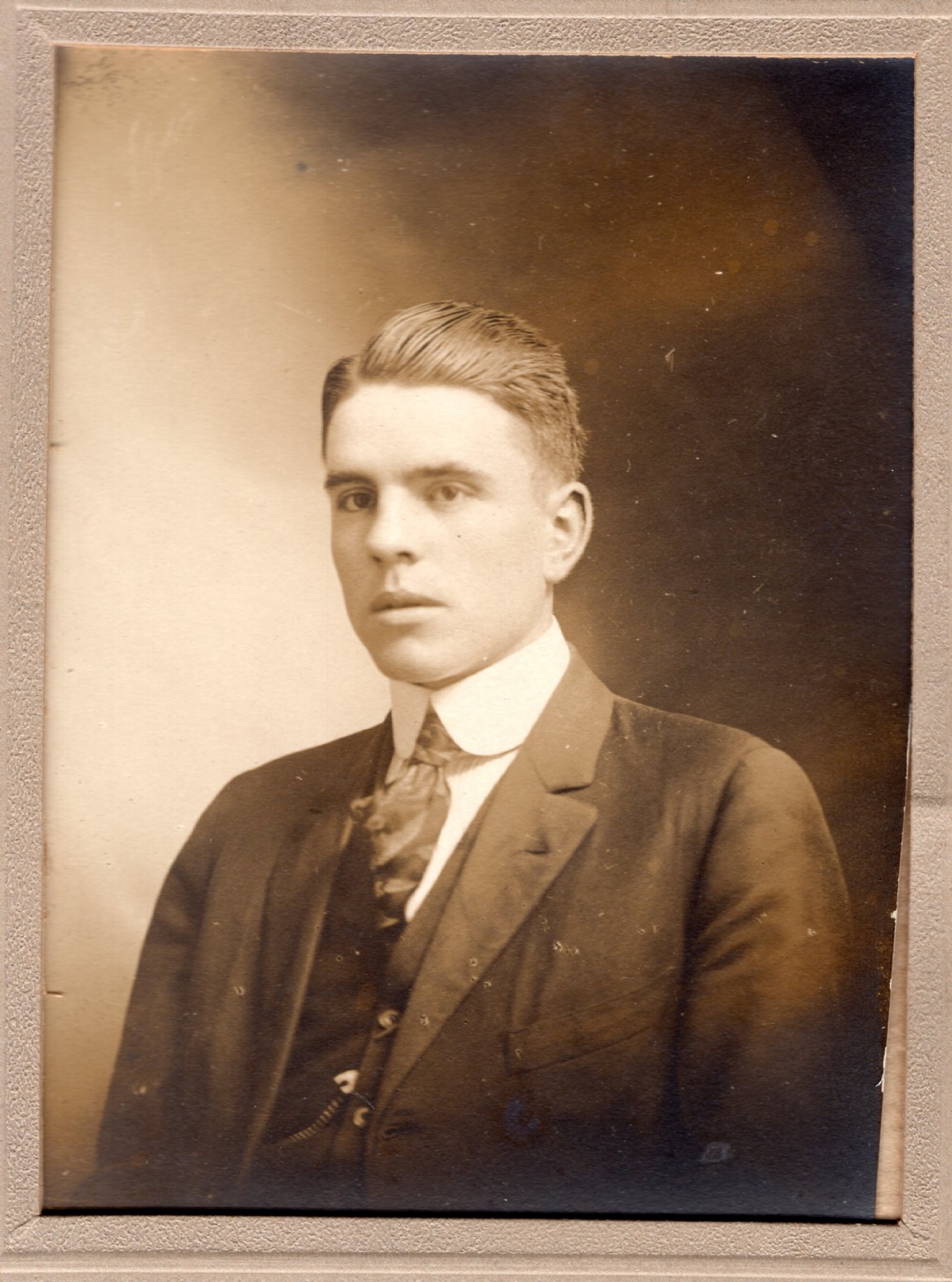
Lovell Churchill from photograph taken in Boston before sailing to Liverpool - Jun 1917
The images and letters are courtesy of Stacey York, Mechanic Falls, Maine, USA. The series of images from Stacey are in the sequence on Forestry Memories from No 6282 to No 6298 and forms part of the Forestry Memories Groups collection ‘American Sawmillers in Scotland 1917’.
In the Great War of 1914-18 the UK and its allies were facing severe shortage of timber products to keep the coal mines operating and providing power for manufacturing for the war effort. Timber railway sleepers for the railways to the war front in Europe were urgently required and also wood for manufacturing of boxes and containers for munitions and other products. German submarines were severely interrupting timber imports and there was a great shortage of men to work in the forests and timber industry in UK because they had been called up in their millions to serve in the war effort as soldiers and sailors. An original request for assistance with timber cutting and sawing in British forests from the British Government was directed to the New England States.
A rapid response to the British crisis was taken on board by six New England States and a specially convened committee organised the supply of one sawmill unit funded by each state. The states involved were Maine, Vermont, New Hampshire, Massachusetts, Connecticut and Rhode Island. In addition several individual companies and many individuals provided the necessary funding for a further four sawmill units resulting in a total of ten units and all their equipment being sent to Liverpool and eventually to Ardgay in Ross-shire in the summer of 1917. The timber workers and saw millers were on a contract to the British Government for a period of one year.
Lovell I Churchill, age 21 from South Paris, Oxford County in the State of Maine, a joiner to trade, was a volunteer who joined the Maine sawmill unit along with around thirty five other forestry and sawmill experienced men. He initially was occupied in helping build their hut and stable accommodation for workers and horses once the first wooden boards came off the newly set up and working mills. He later took on the role of axing off or ‘limbing’ the branches (UK- snedding) off the felled trees.
Once Lovell left home and joined up with the Maine sawmill unit contingent they all headed to Boston where they were preparing for embarkation with all the other sawmill units – ten units in total. Lovell wrote a series of short letters to his parents and sister describing his experiences and adventures. These letters and companying photographs were kept by his parents and then the family. Forestry Memories is very privileged to have been offered the opportunity to place these on the website.
The letters appear to be aimed at informing his family on how well he is faring and reassuring them of his safely and welfare and consequently the event descriptions are possibly more muted and reassuring than possibly may have been the case in real life. They do however convey details and personal feelings on the situations at various stages in the whole project. They also provide some location details on the mills, interactions with local people in Scotland and progress on cutting the trees down and milling substantial quantities of much needed sawn timber.
Note that the letters have been transcribed by this writer (Norman Davidson) into UK English and notes added where written words are not deciphered and American language terms not fully understood. Accuracy and interpretation results are far from guaranteed but readers can turn to the PDF link below the text to see the images of the actual letters and form their own opinions.
This image above is of Lovell Churchill taken in Boston before embarkation and sent to his family. Below is a transcription of several letters sent by Lovell from 13 June 1917, on arriving in Boston, until 12 July when they are well settled into tent life at Soyal near Ardgay, Ross-shire. Note Mar is his term for Mother and Par for Father.
“Boston Mass. June 13 -1917.
Dear Mar,
Landed here yesterday and are stopping at the Armory (Army barracks) on C. Newton St. We are given passes that admits us to any show, ball game or other excitement in town. Shall probably stay here until Saturday, then we will sail to N. Y. & stop a few days there, and from there to Halifax and from there to England. We are going to have British Convoys for protection going across, absolute safety. Lovell
Boston Mass. June 14 – 1917
Dear Mar and Par:
Enclosed you will find two pictures of myself, one which I want you to have. The other give to Beryl and Dell. I don’t know whether I would be able to have them taken in England Christmas time or not. But this being one of the little presents which I wanted you to have at that time, and to be positive that you do have them at that time. I am going to make them now.
We expect to sail tomorrow. I fear nothing as we are greatly needed in that part of the world and will be well protected. My only wish is will not worry and enjoy a hearty laugh when you learn of our landing safe and sound. You have all the right in the world to be proud of your only son.
There are several boys going whom I know well, one of Norway which I used to play ball with when a kid. There are about 400 here in the Armory, all woodsmen. Boston is certainly using us white in every way. It is going to be a great trip in every way. Some of the boys that never went away from home before are going to be homesick but they have had no chance to show it yet.
I will ring off now and will send you a card before sailing if possible. I will also send you my address as soon as I possibly can. Will close now and run to lunch. Tours Truly, Lovell I Churchill
P.S. You will see by the Boston papers about our parade etc
Boston Mass. 15 June – 1917
Dear Mar,
We sail in about a half hour to N.Y. and expect to be there until Monday. Have a great steamer to go on and believe me it is going to be a great trip. Had a great banquet at the Boston City Club last night. L. I. C.
16 Jun 2017
Dear Par & Mar:
Just a line before going to bed. I am now sailing for N.Y., a wonderful trip we have just passed through the Cape Cod Canal. We all went up on deck and watched them cast the spot light on the Canal. Some of the boys are home sick & others are sea sick but I am fine & dandy. Not the least bit sick, never felt better in all my life.
I got your letter about ten minutes before we left Boston and was glad to hear from you and that you are well. Would tell you about the banquet but it is in the Boston Post so I won’t bother to rewrite you about it. I know pretty well who wrote you from Norway, and she is no Christian Scientist but a good woman who just enjoys to saying a few cheerful words when she thinks they might do good or make any one cheerful.
No doubt this trip would scare you but I just love to travel on the water. Never was sea sick in my life. It is getting late & I feel like sleeping. Won’t be in N.Y. more than a couple of days so you all see a letter won’t touch me.
The next time you hear from me I will be in England & will give you my address.
Love to all up stairs & down. Yours Truly, L. Churchill.
New York 17 Jun 1917
PASSED BY CENSOR (and Redacted)
Dear Par and Mar:
New York
I am in N.Y. harbour got here yesterday morning about light. We were taken the Boston & N. Y. boat & transported across the puddle on a small steamer to the ..........CENSOR ..........in the world which I am on now. She is ..............CENSOR ................ to the .....CENSOR ........ We lay in here today & then we go to ...............CENSOR... that are going across with us. I am sleeping in a hammock hung directly over the table where I eat.
It was a lovely ride from Boston coming in on the bout we saw the Hell's Gate, Brooklyn Bridge, the Statue of Liberty & several other large bridges & interesting things. Since well have been stalled here we have seen all kinds..........CENSOR.......................................... Last night we were guarded by four ..............CENSOR ..........besides..............CENSOR............ which of our ship and can be .............CENSOR............ each minute.
We have got some awful rubes (naive and inexperienced people) among our 350 and it is a cinch to pick them out. They keep us laughing the most of the time.
I don't like the food very well we are getting but when we land we will have a yankee cook & things will be served in the State of Maine Style. Am having a good time and have not been homesick any but some of the fellows are awfully homesick. You can hardly get a word out of them and when you do it is something about home.
Would like to see you all to night but that is entirely out of the question but I will see you in a year. It will spoil a month getting there & another one getting home so you all our year will seem rather short.
You will learn a whole lot about if you follow the Post for a while. When I land I shall have to be careful what I write as I expect the letters will be read both ways. I have no way of hearing from you until I get settled. I will ring off & give my love to all. Sincerely, Lovell Churchill.
Halifax, June 21-1917.
Dear Par & Mar:
Just a few lines to let you know I am well & getting along the best. No doubt you saw yesterdays paper that gave the total of the ships sunk by the Germans, but you need not be alarmed about this one. I think we will land all right, work about ten months and then return to the United States. We have had a very good trip so far and have been used the best by the officers & crew on board.
The climate here is some colder than in New York or at least it seems that way.
We have been given our clothes which consist of one Army hat one heavy sweater, two pair of stockings, two suits of winter under ware, one woollen shirt, one pair of shoes and four handkerchiefs. These and what I brought along with me will be a great plenty for the time which we shall be there.
This won’t be a very interesting note but it is the best I can do this time. Next time I may be able to tell you more about the trip which is very interesting on the whole. Give my regards to all the folks and write as soon as you learn my address. Sincerely Yours, L. I. C.
Ardgay, Ross-shire, Scotland, July 12-1917
Dear Par
Just a few lines as I have nothing else to do. The mills haven't got here yet but we expect them almost any day. The horses came yesterday and they look rather hard, they lost four coming and landed 113.
This is a pretty country but not what we would want in a life time. I find the climate rather cold and the air is damp. I am sleeping in a tent and eating in the open air, do my washing & bathing in the Carron River.
Suppose you are haying and I would like to be where I could chase George around a ten acre field with a scythe. I shall get home next year just in time for haying and should you need a good man I will help you.
I often think of home especially at lunch time but I am O.K. for a year. Keep an eye on Mar and don't let her work too hard and when you write let me know how she is getting along. Suppose the boys are well & growing give my regards to all the folks.
The axes that we have to chop with weigh from 5 pounds up to seven. We are kicking some and I think they will get some more before they get a great lot of timber cut. Not very good lumber mostly all Norway pine but they have a different name here for it.
I am working about two hours each day on a horse hovel, just enough for exercise. Next Sunday is pay day and I have fifty five dollars coming. All anyone can spend money in this town for is stamps and what clothing they want to buy, nothing for amusement whatever.
I must close now and hope to hear from you soon. Take good care of yourself and don’t work too hard. Yours Truly, L. I. Churchill”
In the above letters Lovell make no mention of the four day stay in Halifax where they were joined by over 4000 Canadian Troops on the Atlantic crossing beginning on 25 June, of having to sleep with life jackets on, the convoy joined by submarine chasers two days out from UK, possible sightings of submarines and even torpedoes fired at them but all may have been censored. They all travelled to Liverpool on the liner ‘Justica’ that had been converted into a troop carrying ship.
A report in a Boston newspaper on the banquet in honour of the mill unit men reads:
“Honor War Lumber-Jacks at City Club
Never, perhaps, in Boston's history was there a banquet quite like that tendered the boys of the lumber sawmill units, who are about to sail for Eng land, by the Public Safety Committee at the City Club last night.
For enthusiasm, for good will, for real fraternity, it was indeed unique. Aristocratic gentlemen, with stiff shirts and swallow-tail coats, sat down side by side with husky lads with overalls, flannel shirts, moccasins and bared arms.
James J. Storrow presided at the centre table, and he started the fun. They all sang "Annie Laurie," "In the Good Old Summer Time" and other old-time songs-for the lumber-jacks don't forget old favorites easily. The food was of the finest; each table was decorated with the flags of the allies, and the boys jumped up and gave cheers; for every man who spoke, and did it with a vim that was a revelation. "With a bunch of boys like you, a man could go through hell and never notice the heat!" - so Lieutenant-Governor Wilson of Connecticut summed up the lumber-jacks, to their immense delight.
Each table had several dress-suited City Club members to act as hosts to the lumber-jacks, and there wasn't any patronizing. They all sang "Casey Jones," but lost courage on ''The Jam on Geary's Rock." The big fellows from all the New England States felt quite at home in their bare necks, suspenders and rawhide boots, and chaps like Rufus Pond of Danvers, who goes to England with unit number 1, had the time of their lives. There were about 300 of the 360 men going, comprising 10 units of 36 men each.
Governor McCall welcomed the boys. He said: "You boys, are carrying our flag into France. You are carrying with you our hearts arid good wishes. You will contribute as much to the success of our armies at the front as any other body that we have organized. God speed you; do your duty; and come back to us again, safe and sound. Massachusetts wants men like you!"
The Governors of the New England States sent representatives. When Governor McCall referred to Mr. Storrow as the "button he had pushed, which had started the wires going," they gave "three cheers for the button." They left the hall when it was over, arm in arm — overalls, diamond studs, suspenders, patent leather pumps, triple-wool socks, and kid gloves.”
Images of Lovell’s actual letters can be seen via the PDF link below.
Download Large Version (1.1MB)
Groups: American sawmillers in Scotland 1917