Slasher Magazine Summary: Publication No. 45 - September 1951
The scanned images of the Slasher were produced by and courtesy of the Forest Research Data and Information Team staff based at Roslin, where some of the original copies are located. The Forestry England Information Knowledge Management Team and New Forest Heritage made available copies of The Slasher from their collections. Brian Mahony of the FC Retirement Association devised and coordinates the Slasher Project and has been instrumental in locating many missing editions and coordinating the searches to locate all the earlier publication numbers.
The content summary below was again very kindly compiled by Diane Birkett, Bedfordshire. See PDF attachment link below the text summary to view the full document. A total of over 420 issues or publications were produced between January 1948 and the final publication in 2010.
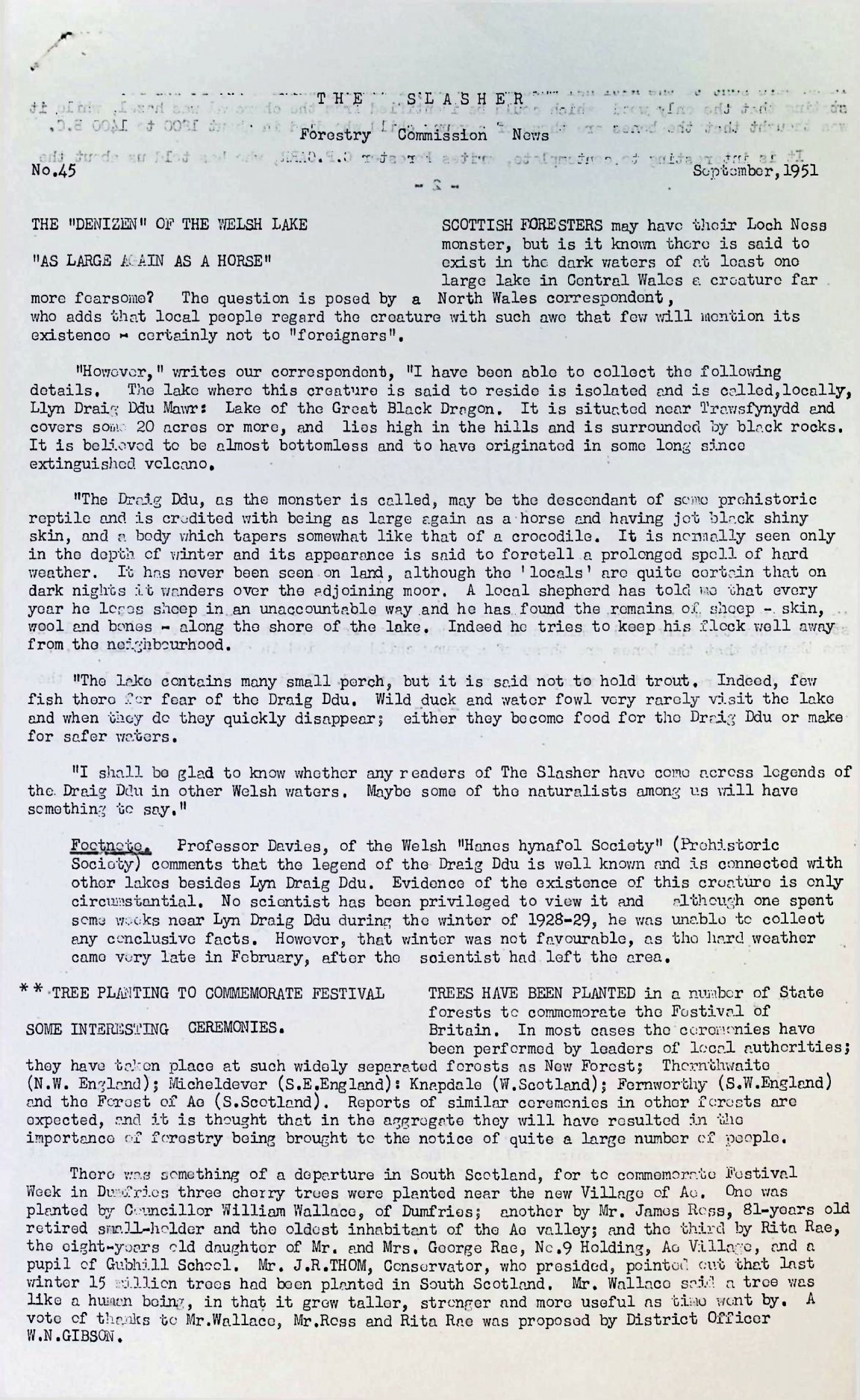
The “Denizen” of the Welsh Lake
Scottish Foresters may have their Loch Noss monster, but is it known there is said to exist in the dark waters of at least one large lake in Central Wales, a creature far more fearsome? The question is posed by a North Wales correspondent, who adds that local people regard the creature with such awe that few will mention its existence certainly not to "foreigners".
"However," writes our correspondent, "I have been able to collect the following details. The lake where this creature is said to reside is isolated and is called locally, Llyn Draig Ddu Mawr: Lake of the Great Black Dragon. It is situated near Trawsfynydd and covers some 20 acres or more, and lies high in the hills and is surrounded by black rocks. It is believed to be almost bottomless and to have originated in some long since extinguished volcano. "The Draig Ddu, as the monster is called, may be the descendant of seme prehistoric reptile and is credited with being as large again as a horse and having jet black shiny skin, and a body which tapers somewhat like that of a crocodile. It is normally seen only in the depth of winter and its appearance is said to foretell a prolonged spell of hard weather. It has never been seen on land, although the 'locals’ are quite certain that on dark nights it wanders over the adjoining moor. A local shepherd has told me that every year he loses sheep in an unaccountable way and he has found the remains of sheepskin, wool and bones along the shore of the lake. Indeed he tries to keep his flock well away from the neighbourhood.
"The lake contains many small perch, but it is said not to hold trout. Indeed, few fish are there for fear of the Draig Ddu. Wild duck and water fowl very rarely visit the lake and when they do they quickly disappear, either they become food for the Draig Ddu or make for safer waters."
Footnote. Professor Davies, of the Welsh "Hanes hynafol Society" (Prehistoric Society) comments that the legend of the Draig Ddu is well known and is connected with other lakes besides Llyn Draig Ddu. Evidence of the existence of this creature is only circumstantial. No scientist has been privileged to view it and although one spent some weeks near Llyn Draig Ddu during the winter of 1928-29, he was unable to collect any conclusive facts. However, that winter was not favourable, as the hard weather came very late in February, after the scientist had left the area.
Tree Planting to Commemorate Festival - Some Interesting Ceremonies.
Trees have been planted in a number of State forests to commemorate the Festival of Britain. In most cases the ceremonies have been performed by leaders of local authorities; they have taken place at such widely separated forests as New Forest; Thornthwaite (N.W. England); Micheldever (S.E. England); Knapdale (W. Scotland); Fernworthy (S.W. England) and the Forest of Ae (S. Scotland). Reports of similar ceremonies in other forests are expected, and it is thought that in the aggregate they will have resulted in the importance of forestry being brought to the notice of quite a large number of people.
There was something of a departure in South Scotland, for to commemorate Festival Week in Dumfries, three cherry trees were planted near the new Village of Ae. One was planted by Councillor William Wallace, of Dumfries; another by Mr James Ross, an 81-year old retired small-holder and the oldest inhabitant of the Ae valley; and the third by Rita Rae, the eight-year old daughter of Mr and Mrs George Rae, No. 9 Holding, Ae Village, and a pupil of Gubhill School.
Mr J.R. Thom, Conservator, who presided, pointed out that last winter 15 million trees had been planted in South Scotland. Mr Wallace said a tree was like a human being, in that it grew taller, stronger and more useful as time went by. A vote of thanks to Mr Wallace, Mr Ross and Rita Rae was proposed by District Officer W.N. Gibson.
What’s Cooking?
Readers will recall correspondence in previous issues of The Slasher in which the edibility of the squirrel was discussed. We have been told that it is still not uncommon for country people to eat hedgehog, the recipe being to roll the creature in clay and bake it, after which the prickles peel off and reveal the soft succulent flesh. "Hedgehog is delicious," we were told when visiting a forest the other day, but unfortunately time permitted but a superficial enquiry.
Note on Bramshill Forest - Visit By Directorate Staff
Bramshill Forest, in the South East England Conservancy, was established in 1922 and covers several good-sized blocks, more than 4,000 acres, the bulk of the area being planted. The forest was visited recently by members of the staff of the office of Director, England, who saw much of interest.
Immediately inside the boundary was seen the site for a new garage and machinery depot, while in the plantations were witnessed some of the nesting boxes which have been erected to encourage greater bird life in the forest, especially of those species which consume large quantities of insects which are harmful to trees.
The process of thinning, and many other operations, were explained to the party by Mr R.H. Smith, the Conservator, who also described the various tree species. Great interest was evinced in the forest nursery, which covers 23 acres and was "created" on the virgin heath in 1948, in answer to an urgent call for a general increase in nursery ground. It was intended that the party should see the conversion depot to witness the preparation of produce for the pitwood, boxwood, pulpwood and boardmill markets, but owing to the fact that the day’s work in the depot had ceased, the visit was deleted from the programme. The party returned to London much the wiser for the tour, which was admirably planned by the Conservancy officers. Those accompanying the Conservator included State Forest Officer J.M. Ross, District Officer L.C. Troupe, Forester N.J. Lingwood and Mr H.W. Gulliver, Chief Clerk.
Increased Aid for Woodland Owners
It is announced that as from 1st October the planting and maintenance grants payable to woodland owners under the Dedication Scheme will be increased from £12 to £14 per acre and from 4s. to 4s.6d. per acre respectively. The new planting grant will be payable in respect of planting in small woods which are not included in the Dedication Scheme.
Under the new Thinning Grant Scheme an owner may apply for a grant of £3 15s. per acre in respect of the thinning of young conifer, broadleaved or mixed woodlands, provided the area to be thinned on any one estate is not less than two acres in one block. Not more than two grants will be paid in respect of the same stand, and if a thinning grant has already been made under the scheme which ends on 30th September, a grant may be claimed under the new scheme for one further thinning only.
A stand, to be eligible for a grant, must contain trees within certain limits of average height (conifers 35 ft., broadleaved 40 ft.) or, alternatively, limits of girth (conifers 4 inches and broadleaved 6 inches, quarter girth at breast height). In mixed stands the predominant species, as between conifers and broadleaved, will determine the limits of height and girth. Incidentally, a recently issued pamphlet entitled State Aid for Woodland Owners has been in great demand; reprinting is in progress and copies of the new issue will soon be available.
A Reader Sees a Bull-Fight
Sir William Taylor, former Director General of the Forestry Commission, writes about his recent visit to watch a bull-fight in Madrid.
Clwyd Forest and the Bronze Aid - Discovery Of Ancient Burial Places
No fewer than eight cairns, ancient burial places of the Bronze Age, have been discovered in the Denbighshire section of Coed Clwyd, the main block of which is situated south and east of Moel Fammau, on the Clwydian Range.
These cairns consist of a circle of stones some three feet wide and set like paving blocks around a pile of rocks. When discovered they had been overgrown with vegetation. Beneath the central rocks, and below ground level, have been found stone-lined graves and from one of these some charcoal and bones were retrieved.
They were sent to the National Museum of Wales, following which a report was received stating that the only wood which could be identified from the charcoal was hazel, while it was thought that the bones are those of a young child who died in about 1800 to 1400 B.C. "It is interesting to contemplate", writes Forester C.P. Carr, who has told us about the link with the distant past.
East Anglian Dialect
In an unassuming but thoroughly interesting little booklet by the Rector of Middleton, which lies between Dunwich and Rendlesham Forests, we have come across some intriguing examples of East Anglian dialect.
For example, hodmeded or dodman means snail; meesen, mice; swidge (drink) of water; biggety, proud; to have the tang - to be lazy; mardle, to gossip; mawkin, a scarecrow; enow, enough; crankly, crooked; quackle, choke; putter, nag; duberous, a saundy (sandy) puss; stammed, astonished; brumping, gathering sticks.
That Love Story of the Trees - Here Is The Solution
The solution to the recent problem is: The young lady of whom I write was very spruce. She was a peach and a plum good one. Her tulips were the colour of a cherry. Her pawpaw was an old crab apple and her mother was far from poplar. The daughter would have had to pine for beaux if she had not been able to carry off the palm in deception, for she was guarded as the apple of their eye.
In love affairs, however, it was plane to see that she was a thorn in their sides. She did not care a fig for their advice. Whenever she cedar chance she would arrange a date for meeting a favoured young man and leave the pear of elderly chestnuts alone.
Down at the beech she let Cypress her hand until yew could easily see which way things were tending. When he asked her father for her, the answer was "Walnut if I know it", and furthermore, the young man was advised to sycamore remote region. Nothing but a dogwood stand such treatment, so the young people eloped and protests were of no avail. That made her parents balsam like the weeping willow.
Egoism Personified
Herewith a copy of a letter from a job-seeker, addressed to the New Forest:
Dear Sir,
Fully and suitably staffed as your organisation may be at the moment, you never know when you will suddenly be faced with the need to find a reliable clerk able to carry responsibility, and to adapt himself quickly to your conditions. Or there may be that little piece of overdue re-organisation that has been waiting to be undertaken by the right type. Either way, no harm can come of having me in for a few minutes' interview, and seeing a rather impressive testimonial that I’ll show you. When may I call, please?
Service Without Sick Leave
Last month we mentioned that Mr R. Carnell of the South West Conservancy, England, had completed 25 years unbroken service with the Department without sick leave.
Now, from New Forest comes news of another impressive record, for Keeper Tom Cutler has served the Crown and the Commission since 1905 (with a break for military service, from 1915-18), without absence through sickness for a total of 46 years.
Dumfries Staff At Cricket
A cricket match between the staff of the Dumfries, S. Scotland, Conservancy Office, and District Officers of the Conservancy was played at Gatehouse, in conjunction with the office outing. After a keen struggle, the technical staff passed the office total with five wickets in hand. The scores were: Office staff, 61 (E.G. Roberts 43, K.W. Wilson 7 for 28): District Officers, 63 for 5 wickets (P.H. Legard 36).
Forester and Gardener
Does good gardening go with good forestry? The people of Peebles, South Scotland, have reason to think so, since Mr T.A. Robbie, Education Officer at Glentress Forester Training School, is a regular exhibitor at Peebles Flower Show. This year he gained numerous awards and was runner-up for the amateur championship.
Transfers
D.A. Mithen, District Officer, Gravetye, SE(E), transferred to Woodchurch, SE(E);
P.H. Manning, District Officer, Cambridge, transferred to Santon Downham, E(E);
T.E. Little, Forester, Slebech, S(W), transferred to Derry Ormond, S(W);
J.W. Telford, Forester, Kielder, NE(E), transferred to Rothbury, NE(E);
G. Stewart, Forester, Durris, E(S), transferred to Montreathmont, E(S);
D. Reid, Forester, Kings, E(E), transferred to High Lodge, Thetford, E(E);
D.A.R. Rayner, Forester, Allerston, NE(E), transferred to Ray, NE(E);
B.A. Olney, Forester, Ennerdale, NW(E), transferred to Kershope, NW(E);
B. Hughes, Forester, Derry Ormond, S(W), transferred to Teifi, S(W);
W. Beattie, Foreman, Inchnacardoch, N(S), transferred to Battan, N(S);
T. Johnstone, Foreman, Rothbury, NE(E), transferred to Allerston;
I.D. Atkinson, Foreman, Thornthwaite, NW(E), transferred to Ennerdale, NW(E);
R.B. Hart, Foreman, Changue, S(S), transferred to Kilgrammie, S(S);
M.J. Wilson, Foreman, Quantocks, SW(E), transferred to Dunster, SW(E);
A.W. Bunch, Clerical Officer, Inverness, transferred to Aberdeen.
Appointments
J.V. Dunn, Foreman, NW(E);
D.J. Moulden, Foreman, E(E);
T.J. Spanton, Foreman, E(E);
M. Heckles, Foreman, NE(E);
P.R. Cant, Foreman, SE(E);
E.T. Snell, Foreman, SE(E);
H.G. Bengough, Assistant Engineer S(W);
W. Gillies, Clerical Officer, Director, Scotland;
F. Warren, Clerical Officer, HQ.;
Miss. I. Mackay, Clerical Officer, N(S);
Miss G.A. Gardiner Clerical Officer, S(S).
Leaving
Three Clerical Officers have left the Commission to emigrate to New Zealand for appointments with the New Zealand Civil Service. They are Miss E.F. Tallon, New Forest; Mr G.A. Stubbings, HQ.; Mr C.M. Niven, HQ.
Marriage
John Jeffers, Forester, Alice Holt, SE(E), married Miss Edna Parratt, a shorthand-typist at the Forest Research Station.
Births
A son was born to Mrs Winchester and Mr P.L. Winchester, District Officer, New Forest.
A daughter, Margaret Jane, was born to Mrs Wood and Mr J.F.B. Wood, Foreman, New Forest.
A son was born to Mrs Awberry and Mr P.P. Awberry, Forester, Bedgebury, SE(E).