Slasher Magazine Summary: Publication No. 44 – August 1951
The scanned images of the Slasher were produced by and courtesy of the Forest Research Data and Information Team staff based at Roslin, where some of the original copies are located. The Forestry England Information Knowledge Management Team and New Forest Heritage made available copies of The Slasher from their collections. Brian Mahony of the FC Retirement Association devised and coordinates the Slasher Project and has been instrumental in locating many missing editions and coordinating the searches to locate all the earlier publication numbers.
The content summary below was again very kindly compiled by Diane Birkett, Bedfordshire. See PDF attachment link below the text summary to view the full document. A total of over 420 issues or publications were produced between January 1948 and the final publication in 2010.
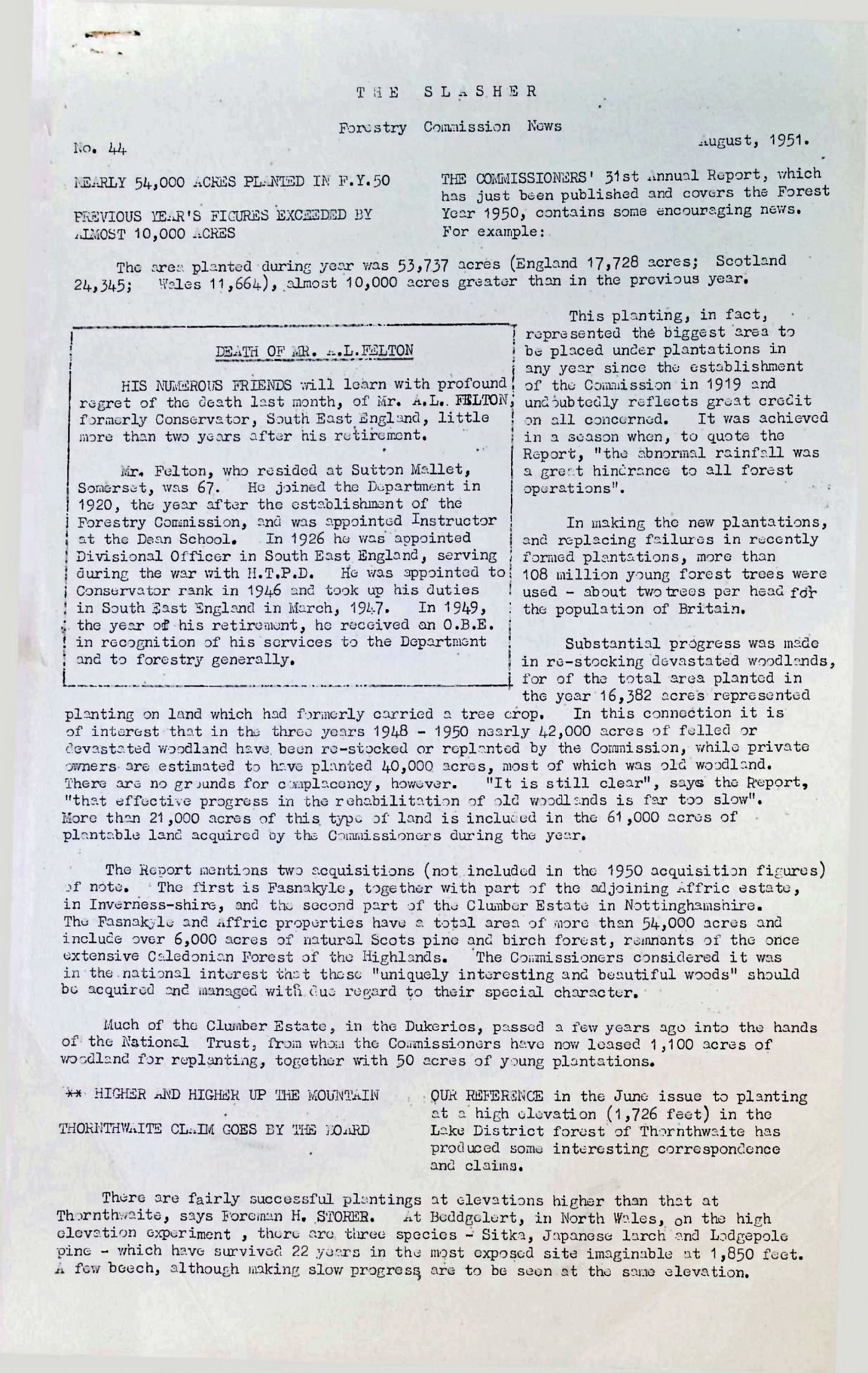
Nearly 54,000 Acres Planted in F.Y.50
The Commissioners' 31st annual Report, which has just been published and covers the Forest Year 1950, contains some encouraging news.
For example, the area planted during the year was 53,737 acres (England 17,728 acres; Scotland 24,345; Wales 11,664), almost 10,000 acres greater than in the previous year.
This planting represented the biggest area to be placed under plantations in any year since the establishment of the Commission in 1919 and undoubtedly reflects great credit on all concerned. It was achieved in a season when, to quote the Report, "the abnormal rainfall was a great hindrance to all forest operations".
In making the new plantations, and replacing failures in recently formed plantations, more than 108 million young forest trees were used - about two trees per head for the population of Britain.
Substantial progress was made in re-stocking devastated woodlands, for of the total area planted in the year, 16,382 acres represented planting on land which had formerly carried a tree crop. In this connection it is of interest that in the three years 1948-1950 nearly 42,000 acres of felled or devastated woodland have been re-stocked or replanted by the Commission, while private owners are estimated to have planted 40,000 acres, most of which was old woodland. There are no grounds for complacency, however. "It is still clear", says the Report, "that effective progress in the rehabilitation of old woodlands is far too slow". More than 21,000 acres of this type of land is included in the 61 ,000 acres of plantable land acquired by the Commissioners during the year.
The Report mentions two acquisitions (not included in the 1950 acquisition figures) of note. The first is Fasnakyle, together with part of the adjoining Affric estate, in Inverness-shire, and the second part of the Clumber Estate in Nottinghamshire.
The Fasnakyle and Affric properties have a total area of more than 54,000 acres and include over 6,000 acres of natural Scots pine and birch forest, remnants of the once extensive Caledonian Forest of the Highlands. The Commissioners considered it was in the national interest that these "uniquely interesting and beautiful woods" should be acquired and managed with due regard to their special character.
Much of the Clumber Estate, in the Dukeries, passed a few years ago into the hands of the National Trust, from whom the Commissioners have now leased 1,100 acres of woodland for replanting, together with 50 acres of young plantations.
School Students and a Festival - Prize Goes To Glentress
Each Summer there takes place at Peebles the Beltane Festival, an event full of pageantry and colour. It includes the Riding of the Marches, sports, dancing, and crowning of a schoolgirl "Queen" and a procession of fancy dress and decorated lorries.
This year, in the last named section, Glentress School succeeded in winning a prize with a humorous tableau depicting the dire consequences of poaching, under the new legislation dealing with fishing. The tableau, which well merited the award, included a realistic gallows and gory executioner's block and axe.
High and Higher Up the Mountain
Our reference in the June issue to planting at a high elevation (1,726 feet) in the Lake District forest of Thornthwaite has produced some interesting correspondence and claims.
There are fairly successful plantings at elevations higher than that at Thornthwaite, says Foreman H. Storer. At Beddgelert, in North Wales, on the high elevation experiment, there are three species - Sitka, Japanese larch and Lodgepole pine - which have survived 22 years in the most exposed site imaginable at 1,850 feet. A few beech, although making slow progress are to be seen at the same elevation.
The compartment adjoining the experiment is planted up to 1,800 feet with Sitka, and practically all the P.50 planting in the area has been at above 1,250 feet.
From another source in North Wales comes the statement that "as the normal planting line in that part of the world is in the region of 1,600 feet, a list of satisfactory plantations formed higher than 1,500 feet would more than fill several issues of The Slasher".
The highest planting in the North Wales Conservancy, says our correspondent, is at Radnor, where plantations are doing reasonably well at 1,900 feet.
Head Forester T.H. Lewis says "In my forest of Mynydd Ddu, in Breconshire, in the South Wales Conservancy, I have plantations of Sitka growing successfully at 1,910 feet. The average height in one compartment, planted in 1935, is 12½ feet; growth has averaged 15 inches per year for the past two years. In another compartment (P.39) the average height is 9½ feet, the average growth being 13 inches annually for the last two years."
Forester Lewis has been good enough to describe the condition of other compartments in his forest, the elevations of which vary from 1,360 feet to 1,870 feet.
A note from the North Wales Conservancy office says that in case there are any other pending challenges to Thornthwaite in F.Y.52 planting at Mynydd Ddu will reach a height of well over 2,000 feet.
Sidelights on the Royal Show - Rabbit Hole Realism
The outdoor display at the Royal Show at Cambridge included, among other exhibits, a plot designed to show rabbit damage to an improperly fenced plantation. So realistic was this that members of the Conservancy staff were entertained by the sight of a dog endeavouring, with gusto, to dig its way into one of the "rabbit holes".
Several novel features were to be seen in the Forestry Commission section. A hut eventually intended for use as a forest office at High Lodge, Thetford, was transformed into a most realistic replica, to two-thirds scale, of a Forester's house, and attracted a great deal of attention.
The 50 ft. flag-pole, formerly a handsome Norway spruce in East Anglia, was sold five minutes after erection.
The indoor exhibit was visited by Her Majesty the Queen and the Princess Royal. The Queen spent some minutes at the "Know Your Trees" device, and in pressing all dozen or so buttons, failed not once correctly to identify the trees of her choice.
A Note on Names and Something About Their Meaning
There may be other views on the subject, but we believe we are right in saying that most surnames fall into four groups.
(a) Patronymics. That is, the Christian name of a man's father, hence (to mention the names of certain member of the Commission):
MacDonald - Son (Mac) of Donald.
Williamson - Son of William.
BOWEN - Short for ab ('Son of', in Welsh), Owain (Welsh spelling of Owen).
(b) Name of home or birthplace of man's ancestors. For example:
Wallington; Martindale; Salisbury.
(c) Ancestor's trade or occupation, or based thereon:
Turner; Taylor; Butcher; Baker; Forrester.
(d) Some personal feature of the ancestor, i.e.:
Brown, implying dark complexion; Redhead; Beard; Small. There are less obvious examples. The meaning of other names which occur among members of the staff may be:
Webster - Scots for a weaver;
Healey - From the old Irish O'heilidh, meaning son of the deer or fleet of foot;
MacIntyre - From the Gaelic mac an t'Saoir, son of the carpenter;
Palmer - the palmer, a pilgrim to the Holy Land;
Nelmes - From the Old English "atten elm" - at the elm (tree);
Saunders - Son of Alexander, from the old nickname Sander or Saunder;
Stocks - he who dwells near the stock (large tree trunk or clump of tree trunks);
Cadman - Son of Caedmon - an old north country name, or may be from cade-man - a maker of cades (casks or barrels);
Chaplin - the chaplain.
The State Forest of Cannock Chase - Formed On Hitherto Unproductive Uplands
The formation of a forest which will eventually restore to Cannock Chase some of the sylvan scenery it possessed in Norman and mediaeval times is described in the seventh booklet in the series which the Commission is producing about the larger State forests. It deals, of course, with the formation of Cannock Chase Forest, which is situated between the county town of Stafford and the busy industrial district around Cannock, Walsall and Wolverhampton.
The forest now occupies 6,000 acres of high open moorlands, which contrast strangely with the fertile agricultural land to the east, north and west, and the mining and manufacturing towns that border closely in the south. Since 1921 the Forestry Commission has established extensive plantations, mostly of the native Scots pine, on these "hitherto unproductive" uplands, and now the first yields of poles and pitprops are becoming available for local use. Most of the plantations vary in age from 14 to 30 years, and in height from 10 to 40 ft.
The plantations, says the booklet, have already begun to supply pitprops to the big coalmines that tap the deeply buried seams of the Cannock coalfield; the coal actually lies below the forest and very little transport is needed to take the props from the point where they have grown to the coal face where they are to be used. Some 55 people are regularly employed in Cannock Chase Forest, a third being the women who undertake the lighter work such as that in the forest tree nursery, or the weeding and brashing of plantations. When the Forestry Commission first began its operations here, these Cannock Chase lands provided little or no regular employment except for two or three gamekeepers.
The Cannock Chase part of Staffordshire is said to have been one of the last Midland districts to be settled by the Anglo-Saxons. Domesday Book, circa 1086, shows that the Chase had passed into the ownership of William the Conqueror. The entry runs: "The King holds Cannock ……… The wood is IV miles wide and III miles long. In the time of King Edward it paid nothing. Now it is worth XX shillings."
The Forestry Commission Tie
The Forestry Commission ties are available from 37 St. Mary Axe, London. E.C.3.
Twenty Five Years Without Sick Leave
We understand that R. Carnell, D.O. SW(E) has completed 25 years unbroken service with the Department without absence through sickness. We hasten to congratulate Mr. Carnell on his record and express the earnest wish that his good health will continue for many years.
Verse of The Last Wolf in Wales - A Goytre Legend
There is an old oak on the edge of Goytre Forest, in South Wales, which is a landmark in the district. According to legend, it was at the foot of this tree that the last wolf in Wales was killed. The legend is attached to the trunk and Forester D.J. Evans has been good enough to send us a copy which is printed in this issue.
Oddities
Our paragraph recording certain oddities which have been noticed by readers has brought forth the following from Glasgow: "Of curious things witnessed, a correspondent writes of a small boy being seen in a local tramcar, sitting with a domestic utensil firmly jammed on his head. The embarrassed mother was taking him to the Infirmary to have the offending article removed."
Transfers
J.F. Osmaston, District Officer, Cambridge, E(E), transferred to Princes Risborough, E(E);
A.W.L. Guile, District Officer, Isle of Wight, New, transferred to Bristol, SW(E);
A.H.H. White, District Officer, York, NE(E), transferred to Bristol, SW(E);
E.R. Francis, Forester, Dalton, NW(E), transferred to Grizedale, NW(E);
R.L. Baird, Forester, Allerston, NE(E), transferred to Harwood, NE(E);
J.M. Riddell, Foreman, Glenrigh, N(S), transferred to Nevis, N(S);
C.J. MacPhee, Foreman, Research, Fort Augustus, transferred to Benmore, W(S);
D.V. Chainey, Clerical Officer, Cardiff, transferred to Bristol.
Appointments
Miss B.E. Wallis, Executive Officer, NE(E);
A.W. Rolfe, Executive Officer, SE(E);
J.F. Black, Clerical Officer, W(S);
M. Mitchell, Clerical Officer, E(S);
P. Grieve, Clerical Officer, S(S);
L.C. Watts, Clerical Officer, SW(E);
J.G. Francis, Clerical Officer, S(W);
G.W. Duthie, Clerical Officer, HQ.
Obituary
Mr A.L. Felton OBE, former Conservator, South East England, has died aged 67, two years after his retirement. He joined the Commission in 1920, a year after its establishment, and was appointed Instructor at the Dean School. In 1926 he became Divisional Officer in South East England. He was appointed to the Conservator rank in 1946 and took up his duties in South East England in March 1947.