Slasher Magazine Summary: Publication No. 6 - June 1948
The scanned images of the Slasher were produced by and courtesy of the Forest Research Data and Information Team staff based at Roslin, where some of the original copies are located. The Forestry England Information Knowledge Management Team and New Forest Heritage made available copies of The Slasher from their collections. Brian Mahony of the FC Retirement Association devised and coordinates the Slasher Project and has been instrumental in locating many missing editions and coordinating the searches to locate all the earlier publication numbers.
The content summary below was again very kindly compiled by Diane Birkett, Bedfordshire. See PDF attachment link below the text summary to view the full document. A total of over 420 issues or publications were produced between January 1948 and the final publication in 2010.
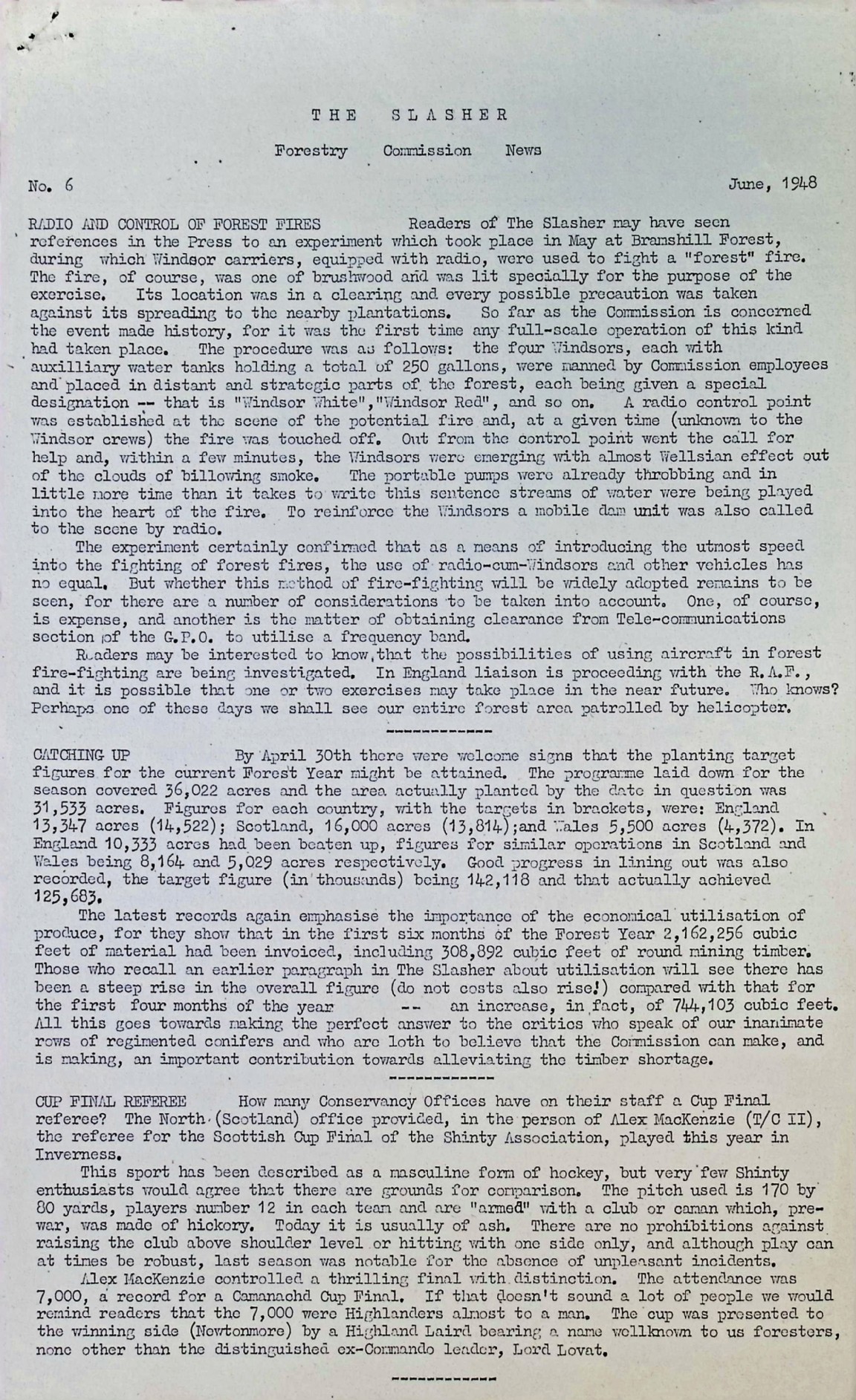
Radio and Control of Forest Fires
An experiment took place in May at Bramshill Forest, during which Windsor carriers, equipped with radio, were used to fight a 'forest' fire. The fire, of course, was one of brushwood and was lit specially for the purpose of the exercise. Its location was in a clearing and every possible precaution was taken against its spreading to the nearby plantations. So far as the Commission is concerned the event made history, for it was the first time any full-scale operation of this kind had taken place. The procedure was as follows: the four Windsors each with auxiliary water tanks holding a total of 250 gallons, were manned by Commission employees and placed in distant and strategic parts of the forest, each being given a special designation - that is "Windsor White", "Windsor Red", and so on. A radio control point was established at the scene of the potential fire and, at a given time (unknown to the Windsor crews) the fire was touched off. Out from the control point went the call for help and, within a few minutes, the Windsors were emerging out of the clouds of billowing smoke. The portable pumps were already throbbing and streams of water were being played into the heart of the fire. To reinforce the Windsors, a mobile dam unit was also called to the scene by radio.
The experiment confirmed that as a means of introducing the utmost speed into the fighting of forest fires, the use of radio-cum-Windsors and other vehicles has no equal. But whether this method of fire-fighting will be widely adopted remains to be seen, for there are a number of considerations to be taken into account. One, of course, is expense, and another is the matter of obtaining clearance from the Tele-communications section of the G.P.O. to utilise a frequency band.
The possibilities of using aircraft in forest fire-fighting are being investigated. Perhaps one of these days we shall see our entire forest area patrolled by helicopter.
Catching Up
By April 30th, the signs are that the planting target figures for the current Forest Year might be attained. The programme laid down for the season covered 36,022 acres and the area actually planted by the date in question was 31,533 acres. Figures for each country, with the targets in brackets, were: England 13,347 acres (14,522); Scotland, 16,000 acres (13,814); and Wales 5,500 acres (4,372). In England 10,333 acres had been beaten up, figures for similar operations in Scotland and Wales being 8,164 and 5,029 acres respectively. Good progress in lining out was also recorded, the target figure (in thousands) being 142,118 and that actually achieved 125,683.
The latest records again emphasise the importance of the economical utilisation of produce, for they show that in the first six months of the Forest Year 2,162,256 cubic feet of material had been invoiced, including 308,892 cubic feet of round mining timber.
Cup Final Referee
Alex MacKenzie (T/C II) of the North (Scotland) office is the referee for the Scottish Cup Final of the Shinty Association, played this year in Inverness. The pitch used for shinty is 170 x 80 yards, and the players (12 in each team), are "armed" with a club or caman, which pre-war was made of hickory, but is usually made of ash now.
There are no prohibitions against raising the club above shoulder level or hitting with one side only, and although play can at times be robust, last season was notable for the absence of unpleasant incidents. Alex MacKenzie controlled a thrilling final with distinction. The attendance was 7,000, a record for a Camanachd Cup Final. If that doesn't sound a lot of people, we would remind readers that the 7,000 were Highlanders almost to a man. The cup was presented to the winning side (Newtonmore) by a Highland Laird bearing a name well known to us foresters, none other than the distinguished ex-Commando leader, Lord Lovat.
Discourse on Flag Poles
According to a newspaper report, an 82 ft Douglas fir is being sent from a port in British Columbia to this country, for use as a flagpole at the Tower of London. A 100 ft pole of the same species, grown in the New Forest, is being prepared for erection at Northerwood House.
Welsh Office Staff Visit a Forest
The office staff of the Welsh Directorate and the North Wales Conservancy paid their first instructional visit to the forest, meeting in the Corris Valley on a sunny Saturday morning last month.
The party of 50 was met by District Officer Butler and Foresters Fraser and Griffiths. Leaving the road the party proceeded through P.30 Douglas plantations where thinning was in progress and viewed an overhead wire ropeway on which poles chained in bundles crossed a deep valley to a dump on the far side. The party ultimately reached the dump by a more tortuous route. Getting back to the road higher up the valley, the party saw the poles being crosscut by Portasaw into pitwood, and they inspected the nearby small transplant nursery. Conservator F.C. Best and Divisional Officer W.A. Cadman maintained an interesting running commentary on the various operations which were seen. The four new Swedish houses evoked considerable interest and not a little envy.
Later the party made for Esgairgeiliog Camp for a picnic lunch on the lawn.
After lunch, the party negotiated a steep road and clambered up a still steeper bank to the foot of another gravity wire ropeway. It was noted that the rope kept the pole-butts well off the ground during their 150 yard journey, while the top foliage, which was left on the stems, acted as a brake.
Back in the coaches, the party set off for Abergynolwyn, passing the beautiful Talyllyn Lake and skirting the rugged grandeur of Cader Idris (2,927 ft.). The fact that at 3pm on a Saturday afternoon there were workers in the 11-acre nursery anxious to demonstrate wheeled hoes and roto-tillers was typical off the kindly thoughtfulness which was encountered everywhere. The visit concluded with an excellent tea, generously provided by the Director at the Braich Goch Hotel.
Transfers
T.H. Woolridge, District Officer, Durris, E(S), transferred to Aberdeen;
H.A. Maxwell, District Officer, Aberdeen, transferred to Banchory, E(S);
G. Forrest, District Officer, Inverness transferred to Office of Director, Scotland, at Edinburgh;
B.C. Selby, District Officer, Chester, NW(E), transferred to York, NE(E);
F.G. Good, District Officer, New Forest, transferred to Bristol, SW(E);
G.A. Goodlet, Foreman, Wauchope, S(S), transferred to Bennan;
J.P. McCrorie, Foreman, Benmore, W(S), transferred to Glenbranter;
A.A. Ward, Clerk of Works, Monaughty, E(S), transferred to N(S);
W.F.G. Webb, Engineer, Shrewsbury, N(W), transferred to Cardiff S(W),
L.B. Gladwell, Assistant Engineer, Dolgellau, N(W), transferred to Shrewsbury.
The Work They Do (No. 5)
Visitors to 25, Savile Row, will find, tucked away in a far corner of Room 104, an unobtrusive section engaged in preparing the accounts of the Commission, which have eventually to be submitted to Parliament. The section is under the supervision of M.P. Shapcott, assisted by A. Beedle and Miss K. Fowler. The work of preparing the Appropriation Account involves the summarising of all the cash accounts received monthly from Directorate and Conservancy offices and combining them with the cash account for Headquarters itself, a copy of the final summary going to the Comptroller and Auditor General, who is Parliament's representative. The section is also responsible for preparing the Annual Trading Account and the Financial Tables included in the Annual Report, which involves assembling and summarising all transfer invoices. The Chairman, Lord Robinson, as Accounting Officer of the Department, is personally responsible for the account required by Parliament, which is produced by the Accounts Section of the Finance Branch.
At Aberystwyth, the Acquisition Section in the Head Office of the Welsh Directorate is in the charge of E.H. Bradford (H.E.O.) and is the special responsibility of Miss J. Horsham (E.O.), who is assisted by R.H. Fisher (C.O.) and by the part-time services of the Drawing Office (V.H. Williams and F. Bryan).
Acquisition work is a never-ending cycle. Even while the approvals from the Commissioners' meetings are being cleared, the Section is hastily collecting a batch of Acquisition Officers’ Reports for the next National Committee meeting.
Unusual Cause of Fire
"Two women were seen burning on this area, but they vanished as soon as our men appeared." So runs the official report of a fire in North Wales. What queer effects high altitude may have on "fire-happy" foresters! To continue in lighter vein. Here is an extract from a report received at one of the Directorates (with actual names omitted, for obvious reasons); I visited X and examined some photographs, together with Mr Y and Mr Z from your office". Both gentlemen, it is understood, were found to be fit and were passed A.1.
Forester G.A. Sharp (Kershope) has sent along a newspaper cutting which tells of a fence 2,023 miles long, having been erected in Australia as a defence against rabbits. There is a report, states Forester Sharp, that with a new Australian patent in wire strainers, one man put up so much of the fence in one day that it took him three days to return for his jacket.
Forest Cameos
District Officer R. Carnell writes about Apethorpe, which is part of what used to be Great Rockingham Forest, which stretched from Stamford to Kettering (about 20 miles) in the county of Northants. High up in the steeples of the churches in this district are small apertures wherein, in olden days, lamps were placed to guide the traveller. Most of the Apethorpe area is hardwood of approximately 30 feet high, although a Douglas fir is 60 feet tall. The oak is notoriously slow-growing. The soil is sticky, heavy clay with deep cracks and fissures appear in dry weather. Blackthorn is abundant and various methods of regeneration have been tried - acorns, seedlings, and transplants, and all three with nurses. The conifer nurses of S.P., N.S. and E.L. are beginning to die at 30 feet.
Social Life at Bristol
Progress is reported on establishing a social club in the South Western Conservancy office at Bristol. Under the chairmanship of F.A.A. Alderton, backed by Secretary G.D.C. Tupman, a tennis club has been formed which meets each Tuesday. Nearly half the staff have enrolled and a permanent hard court has been secured in the Avon Gorge. At first the surrounding precipitous rock-face distracts attention from the play, but few courts can have a more majestic setting. The court, with others, lies between the side of the Gorge and the River Avon, with the Clifton Suspension bridge in the distance. It is hoped that darts and table tennis will play a considerable part in the Club's programme. Several good players were once in the renowned Camp House team.
More About the Chief Clerks’ Course
In April, for the first time, all of the Chief Clerks, together with others from all nineteen of the Commission's offices spent a few days at Northerwood House on a course concerned with Organisation and Method. The course included talks by W.R. Webster (Treasury O and M Division) and H.C. Hepburn (Treasury Training and Education Division).
The course was organised by Controller of Finance, V. Bates, dealing with Accounting, Costing and Auditing, and Deputy Secretary E.C. Shanks, dealing with Organisation, Clerical Methods and Control. An excursion into the New Forest followed.
The Deputy Director General, Mr A.H. Gosling and the Secretary Mr F.W. Hamilton attended for the summing up, the assessment was by Mr F.C. Handford, Chief Clerk, Edinburgh. Also in attendance were E.S.J. Hinds; M.E.W. MacKenzie; C.R.C. Pink; A.D. Palmer; E. Hewitt; L.A. Chaplin; G.H. Clark; H.W. Gulliver; G.F. Taylor; R.P. Coote; T.W. Morris; M. Nicolson; J.P. Lenman; T.H. McGeorge; T. Farmer; W. Mayhew; W. Evans; E.C. Harper; J.G.S. Gillingham; J.R. Ferens; M.P. Shapcott; J.J.V. Summers; and B.R. Davies.
Can You beat It?
In response to a recent article in The Slasher that Fiunary, Argyll is furthest from the railway, T.A. Robbie, Education Officer, Glentress, says Forester Drysdale can go by road to Corran Ferry and then get the train at Ballachulish. He does not need to go to Fort William, 45 miles away from Fiunary. Mr Robbie says Fiunary was in his district until February 1946.
Forester G.C. Hart states that a few seeds of the Acer platanoides were sown in Hemsted Nursery; germination was fair, but one tree excelled and reach 2 ft 1 inch in the first year. In the second year it put on 5 ft 1½ inches and in the third year 4 ft. This maple now stands at 11 ft 2 inches. The butt diameter is 3 inches. The tree is now planted 15 yards outside the nursery on the right hand side of the Mile Drive.
New Director General
At the end of June, Mr W.L. Taylor will relinquish the appointment of Director General of the Commission. He will be succeeded by the Deputy Director General Mr A.H. Gosling.
Mr W.H. Guillebaud, the Commission's Director of Research and Education, will succeed Mr Gosling as Deputy Director General. Mr James MacDonald, Conservator on the staff of the Director of Forestry for Scotland, will become Director of Research and Education.
Mr Taylor will continue to serve as a Forestry Commissioner and for the present will devote the whole of his time to the work of the Commission. He joined the Commission at its inception in 1919 and has served in various capacities in the field, as Assistant Commissioner for England and Wales, and finally as Director General. He was appointed a Forestry Commissioner in 1938.
Mr Gosling has served successively as a Forester, District Officer, Divisional Officer and Assistant Commissioner for Scotland and, before his appointment in May last year as Deputy Director General, was Director of Forestry for Scotland.
Mr Guillebaud joined the Forestry Branch of the Board of Agriculture in 1914, and entered the service of the Commission in 1919 as Research Officer. He was subsequently appointed a Divisional Officer and later served as Chief Research Officer.
Mr James MacDonald joined the Commission in 1924 and for a number of years was engaged on research work, at one time having his headquarters at the Imperial Forestry Institute, Oxford, and participating in the work of the Institute. Later he held the rank of Divisional Officer in East Anglia and in Scotland.
Birth
Born on May 20th to Jean Brown and Frank J. Brown of the Director's Office, England, a daughter (sister for Roger and Peter).