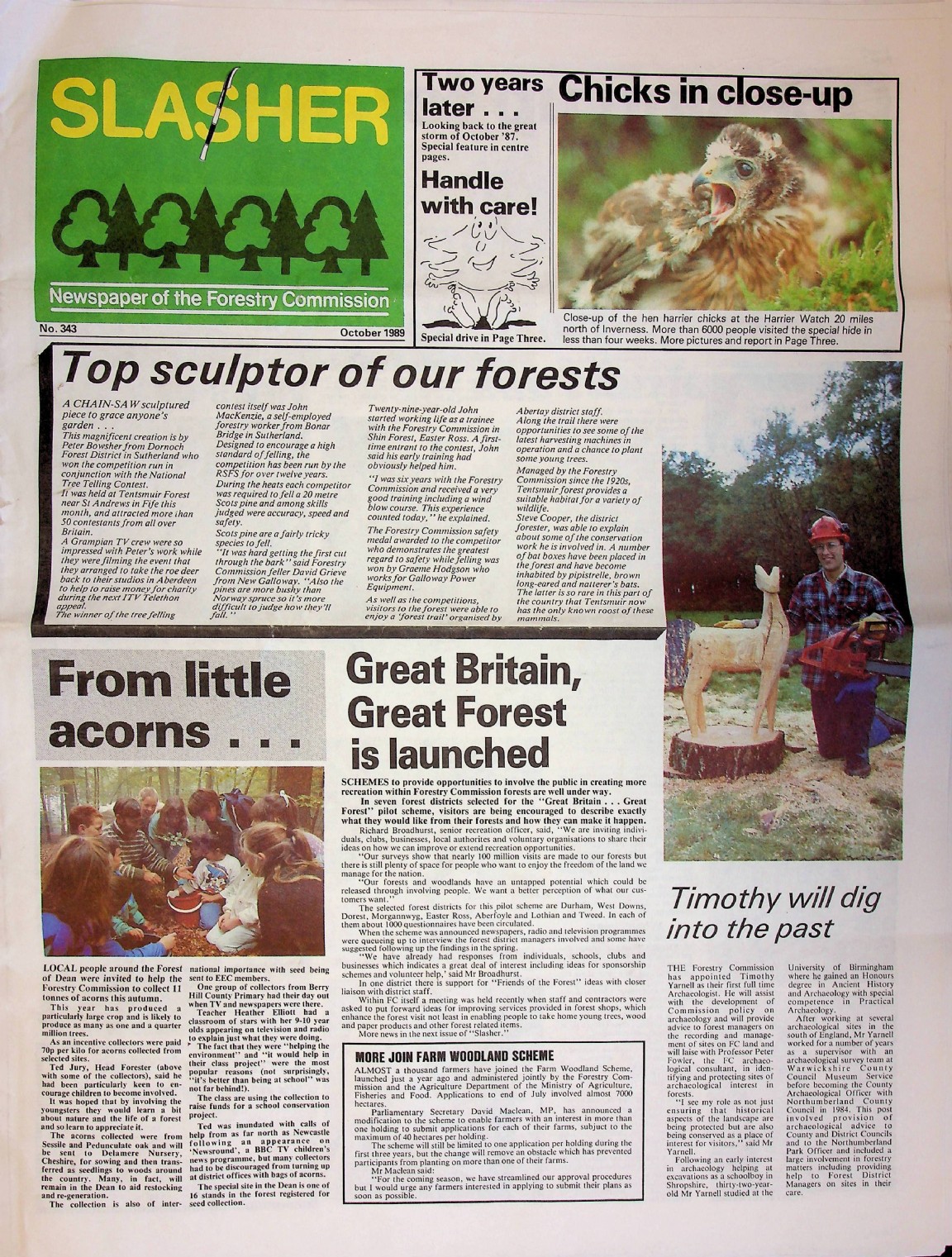
Slasher Magazine Summary: Publication No. 343 - October 1989
The scanned images of the Slasher were produced by and courtesy of the Forest Research library staff based at Alice Holt, Surry, where some of the original copies are located.
The content summary below was very kindly compiled by Diane Birkett, Bedfordshire. See PDF attachment link below the text to view the full document. A total of over 400 issues were produced between 1948 and the final issue in 2009.
Hen Harrier Chicks
A Close-up view of the hen harrier chicks at the Harrier Watch 20 miles north of Inverness. Over 6,000 people visited the special hide in under four weeks. The Commission installed five telescopes plus binoculars in the hide to improve viewing facilities. During the two years of the “Harrier Watch”, over 10,000 people have viewed these birds. Hen Harriers are one of Britain's rarer birds of prey and are considered by the RSPB to be one of only two species of raptors still in decline. With fewer than 400 breeding pairs, they are now less common than Golden Eagles. Mr R. Dunsmore, FD Manager, tells us that at the turn of the century the species had almost been eliminated from mainland Britain. Their strongholds became Orkney and the Outer Hebrides, where there was no tradition of grousemoor management. Some recolonisation took place during the war when keepering was limited, and this allowed the birds to take advantage of the expansion of forestry in the 1950s. The mixture of young conifer plantations and open ground continues to provide suitable safe nesting areas. The male can be polygamous and up to six females have been known to associate with one male during studies in Orkney. From the male’s behaviour pattern at Strathrory, it is likely that he is serving more than one nest this year.
Pictures: (1) Hen harrier chicks. (2) The team who organised another special period to allow visitors to pass through the specially constructed hide, which lies 20 miles north of Inverness. (3) Birdwatchers in the hide.
Top Sculptor of Our Forests
A magnificent sculpture of a roe deer was created with a chainsaw by Peter Bowsher from Dornoch Forest District, who won the competition run in conjunction with the National Tree Felling Contest. The contest, held in Tentsmuir Forest, near St Andrews in Fife, attracted 50 contestants from all over Britain. A Grampian TV crew were so impressed with Peter’s work that they arranged to take the roe deer sculpture to their studios in Aberdeen to help raise money for charity during the next ITV Telethon appeal.
The winner of the tree felling contest was John Mackenzie, a self employed forestry worker from Bonar Bridge in Sutherland. John spent six years learning the trade with the Forestry Commission.
Tentsmuir Forest has been managed by the Forestry Commission since the 1920s and the District Forester Steve Cooper explained some of the conservation work he is involved in. Bat boxes have been placed in the forest and have become inhabited by pipistrelle, brown long-eared and natterer’s bats.
Picture: Peter Bowsher with his roe deer sculpture.
Great Britain, Great Forest is Launched
Opportunities to involve the public in creating more recreation within Forestry Commission forests are under way. In seven forest districts selected for the “Great Britain … Great Forest” pilot scheme, visitors are being encouraged to describe what they would like from their forests. Richard Broadhurst, Senior Recreation Officer said, “We are inviting individuals, clubs, businesses, local authorities and voluntary organisations to share their ideas on how we can improve or extend recreation opportunities. Our surveys show that nearly 100 million visits are made to our forests, but there is still plenty of space for people who want to enjoy the freedom of the land we manage for the nation.”
The selected forest districts for this pilot scheme are Durham, West Downs, Dorset, Morgannwyg, Easter Ross, Aberfoyle and Lothian and Tweed.
From Little Acorns
Local people around the Forest of Dean were invited to help the Forestry Commission to collect 11 tonnes of acorns this autumn. This year has produced a particularly large crop and is likely to produce one and a quarter million trees. As an incentive, collectors were paid 70p per kilo for acorns collected from selected sites. Ted Jury, Head Forester, was particularly keen to encourage children to become involved, so they would learn about nature and the life of a forest. The acorns collected were from Sessile and Pedunculate oak and will be sent to Delamere Nursery, Cheshire, for sowing and then transferred as seedlings to woods around the country. Many will remain in the Dean to aid restocking and regeneration. The collection is also of international importance, with seed being sent to EEC members. One group of collectors from Berry Hill County Primary School had their day out when TV and newspapers were there. Teacher Heather Elliott had a classroom of stars with her 9-10 year olds appearing on television and radio to explain what they were doing. The special site in the Dean is one of 16 stands in the forest registered for seed collection.
Picture: Head Forester Ted Jury with some of the acorn collectors in the Forest of Dean.
More Join Farm Woodland Scheme
Almost a thousand farmers have joined the Farm Woodland Scheme, launched a year ago and administered jointly by the Forestry Commission and the Agriculture Department of the Ministry of Agriculture, Fisheries and Food. Applications to the end of July involved almost 7,000 hectares.
Opening Up for Visitors
There are three new ventures in the Commission's efforts to open up their properties to more people. Included are a wayfaring course at Ordhill on the Black Isle, near Inverness; a new woodland park at the head of the Rhondda Fawr in Wales; a group of disabled people have featured in tests to improve and expand forestry walks in Ross and Cromarty.
The wayfaring course was opened above North Kessock by Sandy Calder, the FC’s Environment Officer for North Scotland, when he cut a tape to allow 40 orienteers through to test the course. They included members of Inverness Orienteering Club who helped the FC to design the course, and a number of Swiss orienteers who were visiting Scotland for the Orienteering Championship at Loch Lomond.
Forestry walks in Ross and Cromarty have been expanded and disabled visitors were invited to “roadtest” two facilities at Lael Forest Garden near Ullapool and Blackmuir Wood at Strathpeffer to gauge the suitability of the paths.
Councillor Dyfrig Hughes, Mayor of Rhondda, formally opened the park in Wales and joined the PF&EO, Colin Bancroft and Morgannwg FDM John Williams in a walk along the special easy-ascent path to a viewpoint of marvellous waterfalls and escarpments. One of the guests even made it to the top in wheelchair, assisted by John Griffiths, Forest Officer III at Morgannwg and colleagues.
Pictures: (1) A wheelchair visitor leads the way in testing out the new facilities near Ullapool and at Strathpeffer. (2) A helping arm for a visitor. (3) A chat by the wayside. (4) Sandy Calder by the new Ord Hill Wayfaring signs. (5) The cutting of the tape is watched by the trail-blazers of Ord Hill. (6) Visitors aiming to complete the new course. (7) A visitor studying the information board. (8) Visitors tracing the course. (9) At the opening of the new-style park in Wales. (10) Councillor Dyfrig Hughes admires the scenery.
Timothy Will Dig Into the Past
The Forestry Commission has appointed Timothy Yarnell as their first full time Archaeologist. He will assist with the development of Commission policy on archaeology and will provide advice to forest managers on the recording and management of sites on FC land. He will liaise with Professor Peter Fowler, the FC archaeological consultant, in identifying and protecting sites of archaeological interest in forests.
Graham Tuley Wins Award
Graham Tuley, Kincardine Forest District Manager, has been awarded Fellowship of the International Union of Societies of Foresters. The award was announced at a meeting in Rotorua, New Zealand and a commemorative plaque was accepted on Mr Tuley’s behalf by Gordon Cowie, Conservator S(S).
3-Year Drive to Curb Plant Stress
A new campaign has been started to highlight how plants can be damaged before they are planted, by careless handling and environmental conditions. A working group was formed in 1982 to look at all matters associated with plant health and quality. The work was organised from the Northern Research Station, first by Paul Tabbush, then by Derek Nelson – Team Leader for the last year. The team pinpoints the main cause of plant death. Some bright ideas incorporated into the campaign have come from district staff. Particularly helpful were Keith Jones (Kielder) and Alec Milne (Lothian and Tweed), whose office came up with the idea of comparing young trees with young children – both are our investment for the future. Richard Toleman (Silviculture) welcomed the campaign and said “We can just as easily kill plants as care for them. Our restocking and new planting programmes are vitally important to support the future demands for Britain’s timber. I hope this campaign will go some way to help us meet these needs by successfully establishing plantations to a high standard.”
The ”Handle Plants With Care” campaign will run through the planting seasons for three years as a gentle reminder to care for our “baby” trees.
Picture: The new “Handle with care” illustration and a request for a name.
European Experts See How It's Done in Perthshire
Twenty three European forestry experts recently spent two days in Mid Scotland studying the Commission's harvesting operations. The group leader, Mr Hanssens, of the European Commission's Directorate General for Science, Research and Development, brought together top foresters from Denmark, France, West Germany, Ireland, Italy, Portugal, Spain, Holland and Greece. Visitors spent a day in Cowal district, where they saw thinning of a site using cablecranes and forwarders. Dr Frangos (the Greek Ministry of Agriculture and Forestry), admitted this was a prime reason for wanting to see the Commission's work. “Britain is unique in Europe in the size of forests that are worked”, he said. One of Dr Frangos’ major headaches in Greece is the problem of fires, where large areas of forest can be destroyed in days, “so it is important to learn different techniques for successful forest management”, he explained.
In Perthshire the group spent a day on site discussing thinning techniques with the District Forester, Mike Cheesewright.
Trials are presently taking place in Perthshire on the use of various forwarders, harvesters and harvesting heads. John Hair of Work Study Branch talked about the problems he had faced trying out the machines and what he had to consider before making recommendations.
Picture: Mike Cheesewright explaining how areas were selected for thinning depending on tree species, wind factor, terrain and soil type.
The Great Windblow … Last Chapter to Be Written - Two Years Later
Details are still emerging two years after the Great Windblow struck on 16th October 1987. A new publication “The 1987 Storm: Impacts and Responses” (FC Bulletin 87) gives more details than has been previously recorded. The publication was edited by A.J. Grayson CBE, former Director of Research, and in the preface, Gwyn Francis pays tribute to the work of the Forest Windblow Action Committee, which was set up by the FC to co-ordinate reports from all sectors of the industry.
The committee helped to establish the resources needed to tackle the unprecedented damage – 15 million trees representing almost 4 million cubic metres of timber. For as Mr Francis writes, “the gale that struck South-east England in the early hours of 16th October 1987, caused the worst damage to trees ever recorded in this country.”
He also refers to the Task Force that was set up at Alice Holt to look at clearance priorities, the availability of harvesting contractors, safety and markets - and records that in its first four months, it handled more than 1,500 individual inquiries. He adds “All parts of the forest industry have shown their resourcefulness and adaptability in dealing with the effects …. much remains to be done and the full story of the work of clearance and restoration will not be told until perhaps 1992.”
The 'Poor Relation' Hits Back
Steve Scott, District Forester, Forest Management, believes Suffolk is like a poor relation when it comes to the coverage received in the aftermath of the Great Storm. He believes it is due to being isolated from the London-based media, so the county was ignored in favour of the Home Counties, where the loss of Six Oaks in Sevenoaks made more news than the most spectacular of windblow areas in the whole country.
Scotland, of course, had been on the tail end of a massive blow in the past, again largely ignored by the media because of its distance from the Capital.
To set the Suffolk restocking into some form of context, in one night over 1,400 hectares, that's about 2,220 football pictures of prime Corsican and Scots pine mature timber was pushed down into one almighty tangle. The article gives further details and statistics of the damage and recovery work required in Suffolk.
Picture: (1) Suffolk: Uncleared windblow on the left, area raked and destumped on the right. (2) The recovery programme begins with large areas of broadleaves being planted.
Remarkable Change
Jim Dewar, Silviculture Division, reports on the aftermath of the storm in the South-East.
Picture: Flashback to autumn 1987 and the aftermath. Over the entire area affected by the storm, about 750,000 cubic metres are normally harvested each year. In the 12 months from October 1987, clearance was at twice the normal rate. By the second anniversary, the following volumes had been cleared: 1,900,000 Conifers blown down, 1,600,000 cleared (84%); 2,000,000 Broadleaves blown down, 1,000,000 cleared (50%); Total: 3,900,000 blown down, 2,600,000 cleared (67%).
Over 200 Back Drive for Fund
Over 200 staff at HQ have promised to support the Civil Service Benevolent Fund after a recruiting drive by the fund’s Miss Marian McGhee. At present, 320 FC staff contribute to the fund, which over the past years has helped 43 staff financially and otherwise, distributing a total of £4,350. One person received a £2,500 contribution towards staying in one of the CSFB residential homes. Currently about 22 per cent of the Civil Service support the fund through regular contributions.
An Old Story
Thetford Forest has revealed evidence that man may have lived in East Anglia 300,000 years earlier than scientists believed. The Stone Age site close to Thetford, was thought to be anything between 40,000 and 200,000 years old, but latest discoveries of artefacts during excavation put it at about 500,000 years old, making it possibly the oldest human occupied site in Britain.
Dedication of Our Resourceful Staff
Norman Day, Weald FD, reports on the effects of the storm on the Weald FD and the clearance procedures, requiring workers on long shifts and their accommodation in residential caravans.
Logs, Logs Galore Set the Scene at Thetford
An area of Thetford Forest, where a site for water storage of pine sawlogs was set up at Lynford following research work in Sweden and Germany, is now covered with logs, made up of windblown timber from the October 1987 storm. They form a four hectare site adjacent to a water filled gravel pit, where gravel was used for road and hard standings. Logs were piled to a height of 3.5 metres and sprinkled with more than 45 mm of water a day through an agricultural irrigation sprinkler system. Additional sprinklers being used to keep up the moisture content. More statistics are given in the article.
Picture: The windblow log store at Thetford.
An Irate Rider Tests Our Patience
Jack Nicholson of South Down reports on the after effects of the storm and the ongoing work in his area. Also the effects on the market prices of timber and a complaint from a horse rider that the woodland track where she had exercised her horse for years, had not been cleared.
Four Deer Killers Foiled by Ranger
An English poaching gang was caught red-handed when police stopped their car on the A712 near Dursalloch, New Galloway and found deer carcasses. The gang of four, all from Bedlington, Northumbria, had been spotted by a Forest Ranger near the Forestry Commission Deer Park, Newton Stewart, Wigtownshire. The were jailed by Stranraer Sheriff Court with sentences ranging from 3-4 months.
The 'Good Health' Team
The tree health survey team have completed their work. Their leader John Innes covered 4,500 miles around sites throughout Britain, covering more than 300 plots.
Picture: Colin Olsson; Steve Brown; Malcolm Scott; Mark Thruston; Ken Williams; Keith Fletcher; Ian McNicol; John Read; Nick Evans; Graham McBryer; John Proudfoot; Dave Diamond; Chris Ross; Ian Craig; Alan Betts and John Innes.
Puzzle of Owls in Tree Hollow
Tony Waddell, Alice Holt, says the April edition of “Slasher” contained a letter and photograph from Mrs Messenger concerning young owls on the ground at the base of a tree. They would have been Tawny owls and that was their ‘nest’. Tawnies normally lay their eggs in a hollow in a tree, or in an old nest of a crow etc., i.e. off the ground. However, they will occasionally lay on the ground in a sheltered spot when their normal sites are unobtainable. This occurs more commonly in Scotland where they will they will nest in heather, especially on an island in a loch, but is quite unusual here in the South of England.
Picture: A ‘nest’ of a Tawny owl at the base of a large birch tree in Hampshire.
Saved - Centuries of Virgin Lands
Protection of more than 1,000 hectares (2,500 acres) of Kielder Forest - recognised internationally as wetlands - has been finalised with the formal signing of a management plan. Following a two-year initiative, the Forestry Commission in conjunction with the Nature Conservancy Council, Northumberland Wildlife Trust, Northumberland National Park and Newcastle University has agreed plans for 20 wetland areas, known as the Border Mires, which contain rare flora and fauna.
Andrew Neustein, FD Conservator, North England said: “The value of these sites lies in their naturalness - but they wouldn't survive without management. This agreement will allow continued protection and opportunities to encourage their growth.”
One of the most important mires is the 409 hectare of Butterburn Flow, one of eight sites designated as an internationally important wetland under the terms of the Ramsar Convention of 1971, and viewed by the NCC as “the most important blanket mire within England.”
Kevin Sharman of the NCC said “Although the sites have been acknowledged as being of scientific importance for over 30 years, until today there has been a lack of a conservation plan.”
Botanists regard the mires as important for their undisturbed plant communities and their rare species such as great sundew, bog sedge and sphagnum varieties, while the areas also support upland bird species.
As part of the immediate conservation work, the FC are blocking drains on mire sites to maintain and restore a high water table. Research will also take place to discover where trees surrounding some of the mires are drawing up the water.
There are at least 40 mires within Kielder, mainly in the South of the forest district. Of the 20 singled out as areas deserving of special attention, two are National Nature Reserves, Eight are Nature Conservation Review sites (Ratcliffe 1977), eleven are Sites of Special Scientific Interest, eight are RAMSAR sites. The RAMSAR convention was drawn up in 1971 to designate internationally important wetlands. These are deemed to be of significance either by virtue of their benefit for wildfowl or wading birds, or for their value in supporting rare plant species or floral communities.
A large variety of wetland plants is found within the site of Border Mires. This includes 13 species of Sphagnum and 9 species of Carex. Certain nationally rare species such as the great sundew (Drosera anglica) and tall bog sedge (Carex magellanica) are also present.
The breeding species of birds includes dunlin, golden plover, curlew, redshank, snipe, red grouse, teal, reed bunting, sedge warbler, meadow pipit and skylark. Hobb’s Flow, a relatively high altitude blanket bog lying at 380 metres, provides habitat for meadow pipit and seven species of wader are known to breed on Butterburn Flow. Grass snakes have been recorded and breeding populations are thought to exist. A rare spider – Eboria caliginose - has also been recorded at Coom Rig Moss.
The mires have a value as natural historic records of vegetation stretching back through geological time. From a boring carried out on Falstone Moss by Dr Blackburn of Newcastle University, it was determined that the peat - some 6 metres deep - started to form after the Ice Age 8,000 years ago.
Pictures: (1) Signing of the Kielder conservation agreement – Andrew Neustein, Conservator Northern England; James Ogilvie, Kielder Management Officer; and Kevin Sharman of the Nature Conservancy Council. (2) James Ogilvie on one of the special sites in the Border Mires. (3) Work already under way blocking drains on the mire sites. (4) A group of officials inspecting some of the rare plant life on one of the mires after the formal signing of the conservation agreement.
History of the Wetlands
Britain's biggest forest, Kielder is noted as one of Europe's largest man made plantations and is unusual in having a high proportion of unplanted ground – about 12,500 hectares out of a total of 62,000 or around 20 per cent.
The Border Mires cover about 1,032 hectares, roughly one eighth of the area managed primarily for conservation purposes.
Soils in the area are generally of a heavy texture and are poorly drained. Surface water gleys predominate in the valley bottoms (200m elevation), merging into peaty gleys on mid slopes, with blanket peat at higher elevations (500m plus). Combined with a relatively high rainfall – 130mm or 50 inches a year – this environment is best suited for fast growing spruce, of which the most important species is Sitka spruce.
While the technology exists today to allow afforestation on many poorly drained sites, this was not the case during the first three decades of Kielder’s growth. Accordingly, those blanket mires too wet to afforest were simply left unplanted.
The inaugural meeting of the Border Mires Management Committee was held in March 1987 and the management plan was formally adopted two years later. Their two principle objectives are to maintain and enhance the mires as relatively undisturbed peatland communities; and to encourage educational and research use where this is compatible. Six policies are contained within the two objectives: -
1. to maintain and where necessary restore a high water table;
2. to maintain natural nutrient and pH status;
3. to minimise physical disturbance except in accordance with approved research recommendations;
4. to monitor species changes;
5. to allow visitors access where it would be unharmful to the site;
6. to allow and encourage appropriate research projects, surveys and investigations.
Work programmed for the immediate future includes a survey of invertebrate fauna to provide a comparative index of conservation value. Longer term research work is attempting to establish the effects of stock grazing on the floral composition of Butterburn Flow, using fenced “enclosures”.
Woods Award
The 240 hectare Miserden Estate, Stroud, Gloucestershire, has won the 1989 Timber Growers Award for Forestry and Woodland Management. The judges including FC Chairman Raymond Johnstone, were impressed by the way the estate encourages access, nature conservation and visits by more than 2,000 schoolchildren each year.
Booked in - New Librarian
Catherine Oldham is the new librarian at Alice Holt.
Picture: Assistant Librarian, Eleanor Harland, Library Assistant, Peter Filewood and Librarian, Catherine Oldham.
After the Fire
After the fire which destroyed part of the roof of York Minster in 1984, woodland owners responded with gifts of oaks for the restoration. The FC supplied two large trees in the New Forest. Five years later, Delamere Nursery has presented oak seedlings which have been passed on to all donors of mature oaks by the Minister’s Dean and Chapter. The Dean has also presented each donor with a commemorative medallion.
Trump Call - Bridge Association
An invitation to join the Civil Service Bridge Association.
Marriage
Colleagues from Ruthin formed a guard of honour with slashers when Menna Evans, Typist at Ruthin, married Ieuan Jones at Llanfair Dyffryn, Clwyd.
Picture: Gordon Griffiths, Alan Harper, Ivor Peters and Ken Jones form the guard of honour for Menna Evans and Ieuan Jones.
Mid Scotland Retirement Association Meetings
Sixty members and spouses of Mid Scotland’s old boys and girls of the Retirement Association met at the David Marshall Lodge, Aberfoyle on 26th September.
There were short talks by Hugh Clayden, PF&EO, and John Baird, Welfare Liaison Officer, followed by a buffet meal, laid on by Mrs Stewart, wife of the warden. There are plans for another gathering next year.
Retired
John Nobbs of Thetford, Suffolk, has retired after 39 years’ service with the Commission. During his career, he was involved in most aspects of forest work.
Picture: John Nobbs with his Long Service certificate.
Hugh Stickland, Forest District Manager, North Lincs, East England, has retired after 42 years’ service with the Commission. After Forestry School, he went to Silviculture (South) working at Kennington Nursery and Wareham, Sherwood, Packington in Warwickshire, North York Moors, Kielder and finally to North Lincs five years ago.
Ron Jones, Forest Craftsman, Forest of Dean, has retired after first joining the Commission in 1938, working in the nursery and on forest management. During the early part of the War, he worked with the home grown timber department. In 1943, he spent a few months in a coalmine before joining the Army in 1944 to spend two years in India. On his return, he worked in the pit, rejoining the Commission in 1948.
Picture: Ron Jones receives his Long Service certificate from Mr J. Everard, Deputy Surveyor. Also in the picture are Mrs Jones and John Anderson, Head Forester, Recreation.
Bill McCook, Forest Craftsman, Moray FD, has retired after 41 years’ service with the Commission in Moray Forest District N(S). He began his career with the Commission at Monaughty, spending many years as a Skidder operator before transferring to forest management.
Picture: Sandy Mackay, Assistant Conservator, North Scotland, presents Bill McCook with a Long Service certificate. Jacqueline Forsyth of Newton Office presented Bill with gifts from colleagues, which included a walking stick.
Goronwy Jones, Forest Craftsman, Newtown FD, has retired after 33 years’ service with the Commission in the Mathrafal area of Newtown Forest District. He started work with the “Llanfair” gang and spent most of his earlier years on establishment work, followed by a spell on harvesting before returning to forest management duties two years ago. Goronwy’s wife Glenys also retired from her job in a Llanfair Caereinion shop on the same day.
Fred Short, has retired after 37 years’ service with the Commission, based at Exeter in Somerset and South Devon FD. He worked on FM, H&M, Road Squad and spent his last six years in the Exeter stakeyard.
Picture: Fred Short presented with a Long Service certificate by Roger Busby, Conservator W(E).
John Bevan, has retired after 40 years’ service with the Commission in the Rheola area, having become skilled in all aspects of forestry work.
Delwyn Hughes, has retired after joining the Commission in the Coed Taf area of South Wales in the 1950s, and worked in Brecon and Rheola Forests as a lorry driver and Forwarder operator.
Picture: John Bevan and Delwyn Hughes were presented with their Long Service certificates by David Hughes, Assistant Conservator (Wales) in Morgannwg Forest Office.
Ralph Williams, Ganger, has retired after 38 years’ service with the Commission, starting working at the old Goror Forest, now part of Clwyd FD. Ralph has the distinction of working a full rotation, having ploughed, fenced, planted, weeded, thinned, extracted and then replanted the same plantation.
Picture: Ralph Williams receiving his Long Service certificate from Peter Hughes.
Pat Marsh, Alice Holt, has retired after 36 years’ service with the Commission. He worked at Watlington, Marlow, Swanton Novers, Lavenham and Heveringham. In 1966 he was transferred into the Ecology Section, Research Division at Alice Holt, moving to Silviculture in 1976.
Picture: Donald Thompson, Calvin Booth, Pat Marsh and Dave Elgy.
Billy Cannon, Harvesting Foreman, Newton Stewart FD, has retired after 42 years’ service with the Commission. He began his forestry career at Daltamie Nursery and ended supervising the felling of some of those same trees four decades later as harvesting foreman.
Picture: Billy Cannon with his wife Moira, and Gordon Cowie, Conservator S(S) who presented Billy’s Long Service certificate, and Jim Hamilton.
Stan Scott, Forest Craftsman, Bellingham, has retired after joining the Commission in 1947. He has done every type of forestry job within Kielder Forest, including fire fighting.
Dave Wright, Ganger, Wykeham Nursery, has retired after 42 years’ service with the Commission. He started at Langdale Forest and after the amalgamation of Langdale and Wykeham Forests, he continued as a Ganger, latterly with responsibility at Wykeham.
Picture: Ann and Dave Wright, Mike Lofthouse, Helen Stephenson, Bill Bartholomew and colleagues from the nursery and North York Moors Forest.
Archie MacFadyen, FM Squad at Kilmichael, Loch Awe FD, has retired after 35 years’ service with the Commission, mostly on tractor driving duties. He worked with many types of tractors on jobs such as timber extraction, Muskeg work, deep draining, ploughing etc. in every forest in the old West Scotland Conservancy. One tractor on which he worked for several years earned him the nickname of “Swipe”, so he became known as Archie Swipe.
Picture: Archie MacFadyen with colleagues and friends.
Obituaries
J.R. Henderson (Jim Henderson), has died after a long illness. He trained at Lynford Hall, Norfolk, and started his career as a junior in the New Forest. After various postings, including 15 years in charge of Brightling Forest, East Sussex, he returned to the New Forest as Chief Forester in 1971, four years before his retirement. He was a Committee member of the Lawrence Society of Art in Devizes, and some of his paintings are exhibited there.
Charlie Smith, Forest Craftsman, Delamere Forest, died suddenly in June. He joined the Commission in 1965 and was involved in all aspects of forestry work, from nursery through to forest management and production to motorway planting and maintenance.
Bill Watkins, former Executive Officer in the Cardiff Office, died in July aged 74. He joined the Forestry Commission in Aberystwyth, working mainly on acquisition and estate work. He transferred to Cardiff in 1967, where he remained until retiring in 1977.
Download Large Version (1.8MB)
Groups: Forestry Commission staff magazines