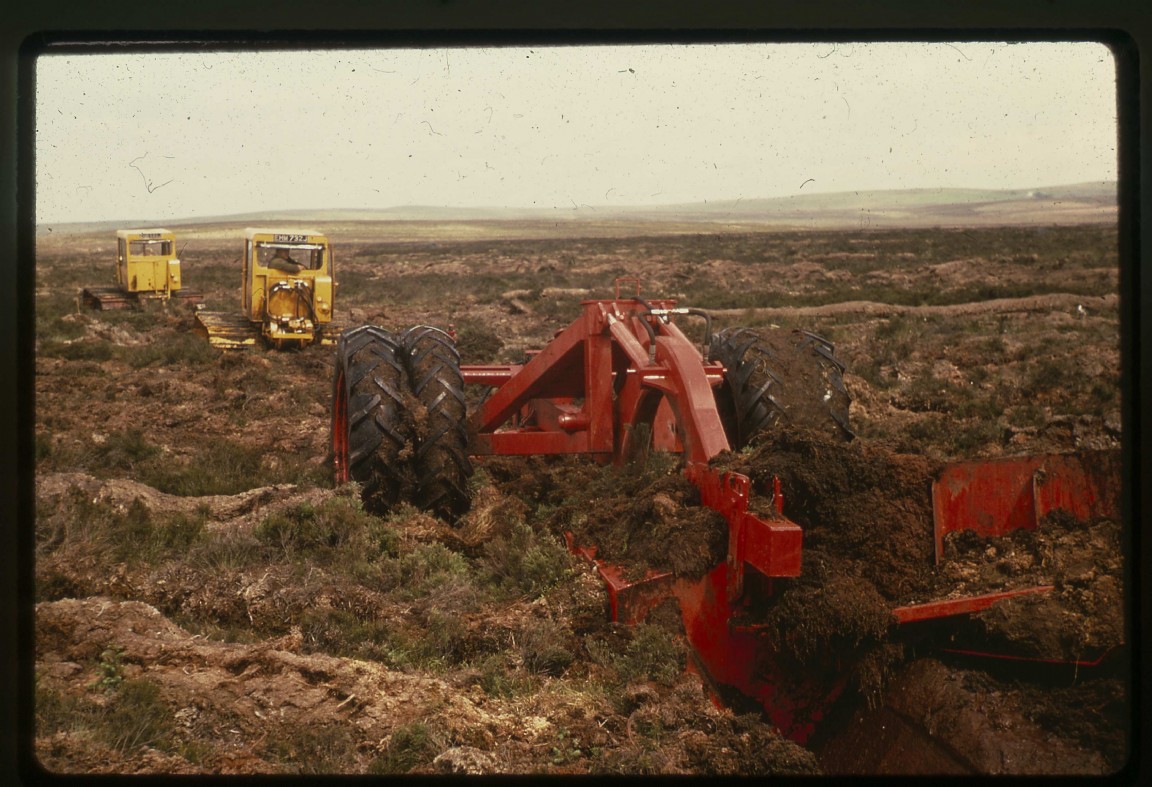
Whitelees Forest - draining with ploughs
Photoslide found in Aberdeenshire District Office with annotation 'Cross draining, very soft, all winch work, Whitelees 1976'
This is a different team from that shown is pictures 273 and 274 although the machine types are the same. In this case the two tractors are again pulling the draining plough by winch cable acoss the ploughing furrows. Both tractors are stopped with anchors on and the rear tractor is winching the plough in. The registration on the lead tractor looks like EHM686J and the one nearest is EHM723J. The driver has a passing likeness to Donny Junor from the Blackisle (a Northern Conservancy employee)but very uncertain as the image quality is not good.
Any iformation on location, tractor types and drivers is very welcome.
Download Large Version (578kB)
Groups: Forestry in Action, Tractors Ploughs and Drainage Machines
Group: Other Vehicles and Machines - 628 pictures
3 Comments
The FC in S(S) had three Bowen 60 tractors reg numbers EHM 596J, EHM 922J and EHM 923J. Comment left on 13 January 2009 at 12:04 by David McQuillan
The 'Humpy' Plough in the picture is ploughing a cross drain. The ridge-and-furrows for tree planting are visible to the left of the Humpy, at right angle to the cross drain. They are ploughed 'single-furrow'.
The plough is attached to the tractor by a hydraulic winch and is producing a 'single-furrow' pattern, throwing the the cut material to the right. Hydraulic ploughs were worse for sinkings than trailed ploughs.
Trailed ploughs worked off wire ropes from the tractor. Trailed ploughs could be raised if they became stuck in the peat, because the wire rope went through a pulley system on the plough and the plough beam could be lifted to get it out of the peat. The tractor and the plough could be unlinked, the tractor driver would let out more wire rope and move forward without the plough. Then he could lift the plough using the winch rope.
They got through lots of wire rope at Whitelee Forest! I was often the Banksman. I always walked behind the plough so that there was never any possibility of being hit or run over by the tractor. The wire rope would often break, then spin forward and hit the tractor from behind. In this circumstance, I would never walk up to the tractor until the driver called for assistance, so as not to get injured. Then I had to knot the ends together! The rope would be frayed, with sharp ends which cut hands.
The banksman also had to guide the wire rope onto the drum at the back of the tractor at the day's end.
The Discs at the front of the plough cut through the vegetation and the 'soil' then the 'boot'(at the back see bottom left)turns the furrow, while the long red bar lifts the vegetation clear of the drain. This was done in spring and summer. At the back-end or in winter, I and the rest of the squad came along with our 'rutters and howks'to clear any vegetation which had fallen back into the drain meanwhile. Comment left on 29 December 2007 at 11:39 by Norman Davidson for Brian Speirs