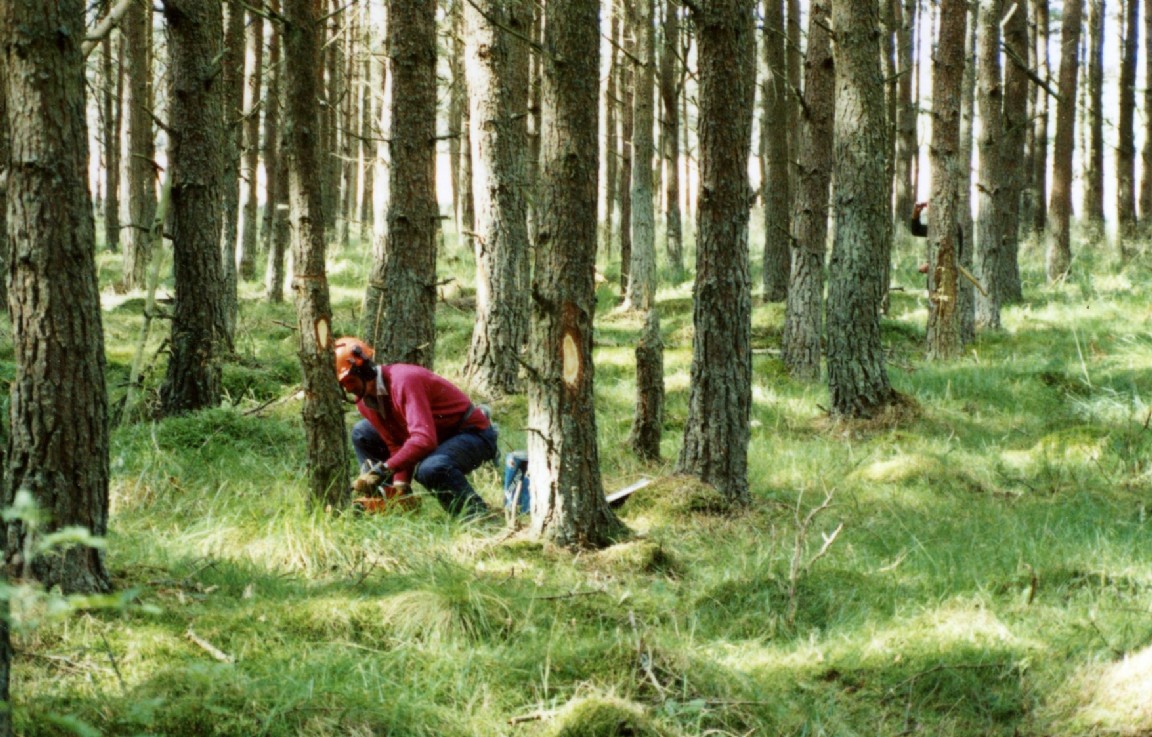
Felling sample trees in Clashindarroch Forest
Photograph courtesy of John Allison, Huntly.
Richard Walker taking down a marked ‘sample tree’ at Raibets Hill, Clashindarroch Forest which will be measured to provide measurement data for the ‘tariff number’ and top height of the tree crop being marked by the Buchan Forest District marking team. The team at that time consisted of Gordon Thom (Ganger), Jimmy Christie, Richard Walker and John Allison.
The tree being felled has a line cut into the bark at about chest height to signify the measuring point of the tree when it was standing. In estimating the volume of trees which are marked for sale the procedure was to measure and record a proportion of them at what was termed Breast Height Diameter: that is the diameter at 1.3 metres (or 4ft 3ins) above ground level. A much smaller proportion of the marked trees were identified as sample trees which in addition to having their BHD recorded, had to be felled and then length and mid point diameter measurements recorded. Depending on the total number of trees expected to be marked in a sale about one in ten trees would have their BHDs recorded and one in one hundred marked trees felled as sample trees.
A marking gang consisted of two or three markers cruising through a wood putting blazes on two sides of trees and shouting ‘mark’ so that the other gang member acting as recorder would add the tree to the tally count. When a ‘mark’ shout coincided with a BHD measurement sample fraction the recorder would shout ‘measure’ and the marker had to take his special girth tape and accurately measure it at standard Breast Height. The measurement was shouted to the recorder for his records. When ever a ‘mark’ shout coincided with a felled sample tree fraction the recorder shouted ‘sample’ and the marker had in addition to the passing on the measurement, mark the measurement point on the bark with a timber scribe and also inscribe the sample tree number on the stem. He would also hang some tapes or spray paint to make it stand out so that it could be found later. The recorder would also make some notes on location.
At some point not too far into the future a team of two markers would break off and start felling and measuring up the sample trees hoping that in the first instance they could be easily found and secondly when cut could be easily taken down (in unbrashed Sitka spruce both sometimes very difficult).
The whole procedure, rules, tables and guidance on measurement of standing timber is covered in detail in Forest Mensuration Handbook Forestry Commission Booklet No 39 compiled by G J Hamilton M Sc
Download Large Version (489kB)
Groups: Forestry Areas, Forestry in Action, Forestry Records, Booklets and Reports, Northeast Scotland , Tools, equipment and clothing
3 Comments
Benmore forest had many compartments where there could be ten different species within 20 yards. Each species had to be counted and recorded separately, which meant different pages for each one. Add in pouring rain, midges, novices who couldn't tell the difference between a larch and a spruce never mind different species of pine and larch, and the job could degenerate into a screaming match when you discovered that the entries for the last hour were meaningless rubbish. Sometimes you just had to accept that maybe nobody would notice if the tallies were less than honest representations of the crop to be felled. I was never pulled up so I must have got away with it. Comment left on 03 July 2020 at 14:11 by Andy MacNicol
My back and knees would not manage that now! Comment left on 28 June 2020 at 19:35 by Richard walker