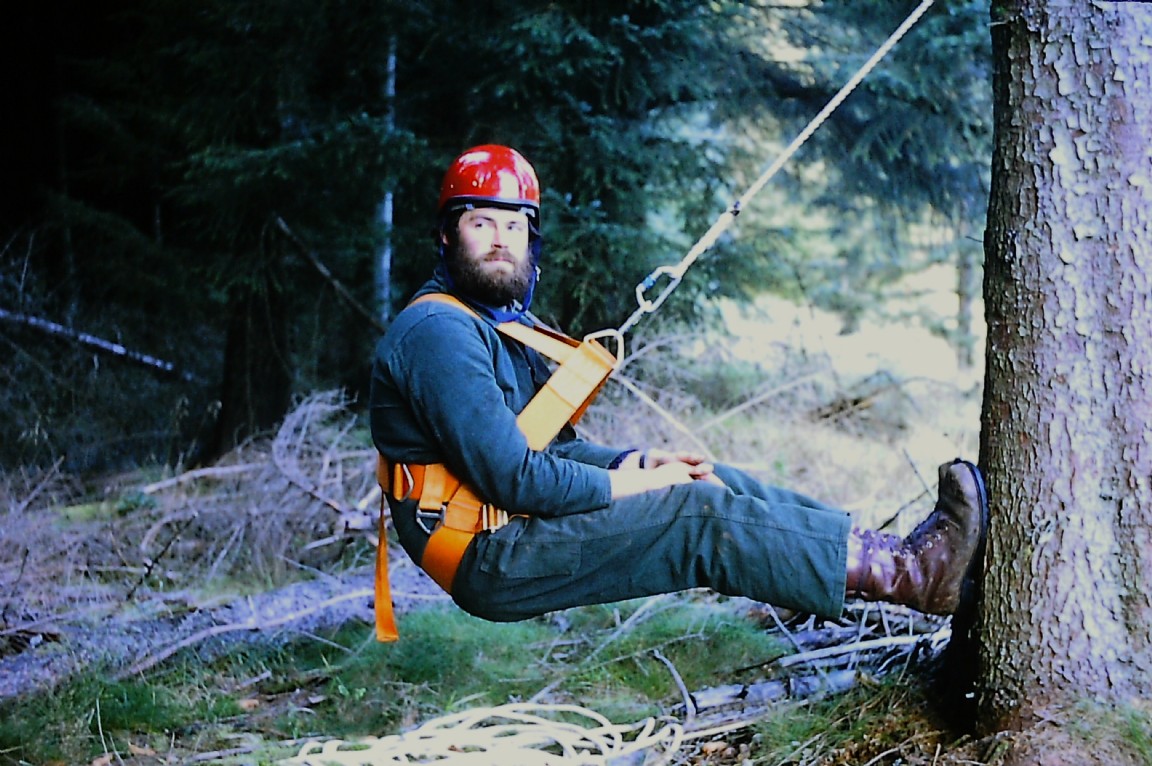
Tree climbing course in Dunkeld area – Mike Aldridge
The images are courtesy of Mike Aldridge, Inverness and features Bill Rayner, the forester in the harness.
Bill Rayner, Perthshire, takes up the tale:
“The date would be between July and October in 1986, I think, and the venue was on the lower road through Craigvinean, Dunkeld, near to where the bottom of the championship downhill mountain bike run finishes, after its descent from the top of Craigvinean. Mike Aldridge was the trainer from Inverness Training Branch and Jimmy Lyon was his junior trainer, assisting with a 3 day tree climbing course for Forest Research and local Forest District staff.
I do not remember all the trainees. I had taken up the post of Research Forester at Perth, Silviculture (North) outstation in August 1985 and required my climbing ticket for the upcoming climbing season, when myself and the squad would be collecting foliar samples from a range of fertiliser trials sites across Central Scotland, for analysis and planning possible future treatments. Malcolm Crosby, who at the time was the Forester at Tummel, was another attendee. Why? I am not sure. Sandy Bowren and Callum ? (stays in Ardgay) from Lairg, Silviculture (North) outstation, attended, as they were going to be starting to sample some of the fertiliser trial plots on deep peat in Sutherland and Caithness, of Sitka spruce (SS) and Lodgepole pine species (LP).
At the end of the course we were paired, so as to demonstrate our competency at rescuing an unconscious climber from the tree canopy, swapping over the roles of casualty and rescuer. I am not sure with whom Malcolm was paired? However, the prusik knot, or a prusik descender were used by the rescuer to control the rate of their descent from the crown of the tree, once the casualty had been detached from their climbing rope and their harness attached to the rescuer's harness. The problem with the prusik descender, was that to activate the braking effect of it's cam upon the descending rope, you had to release the lever from your grip, sensitively! Now bearing in mind that two of the climbing harness straps pass either side of the inside of your crutch, you can understand the need for sensitivity in controlling the rate of the descent. Malcolm was the rescuer and a little nervous, but had successfully transferred his casualty and started his descent. With the extra weight of the casualty they both were descending faster than anticipated and in spite of shouted instruction from Mike Aldridge to "Let go the !*****! lever!", Malcolm gripped it tighter in panic! With his casualty less than a meter and a half above the ground and with all of us now shouting, Malcolm finally let go the lever. Nylon rope has a degree of elasticity and both casualty and Malcolm were suddenly arrested and then continued to bounce in their harnesses. At the bottom of each bounce Malcolm squeaked, as the two crotch straps had become displaced and were pincering his "Crown jewels"! Needless to say there was much mirth and ribald commentary from the rest of us. It also served as a very clear reminder in later years not to panic and make the reflex reaction of gripping the prusik descender lever tighter!”
Please see the attached PDF link below for another view of the Richmond Williams Tree Climbing Harness on Bill’s back.