Tulliallan Bothy layout, bothy life and forestry work
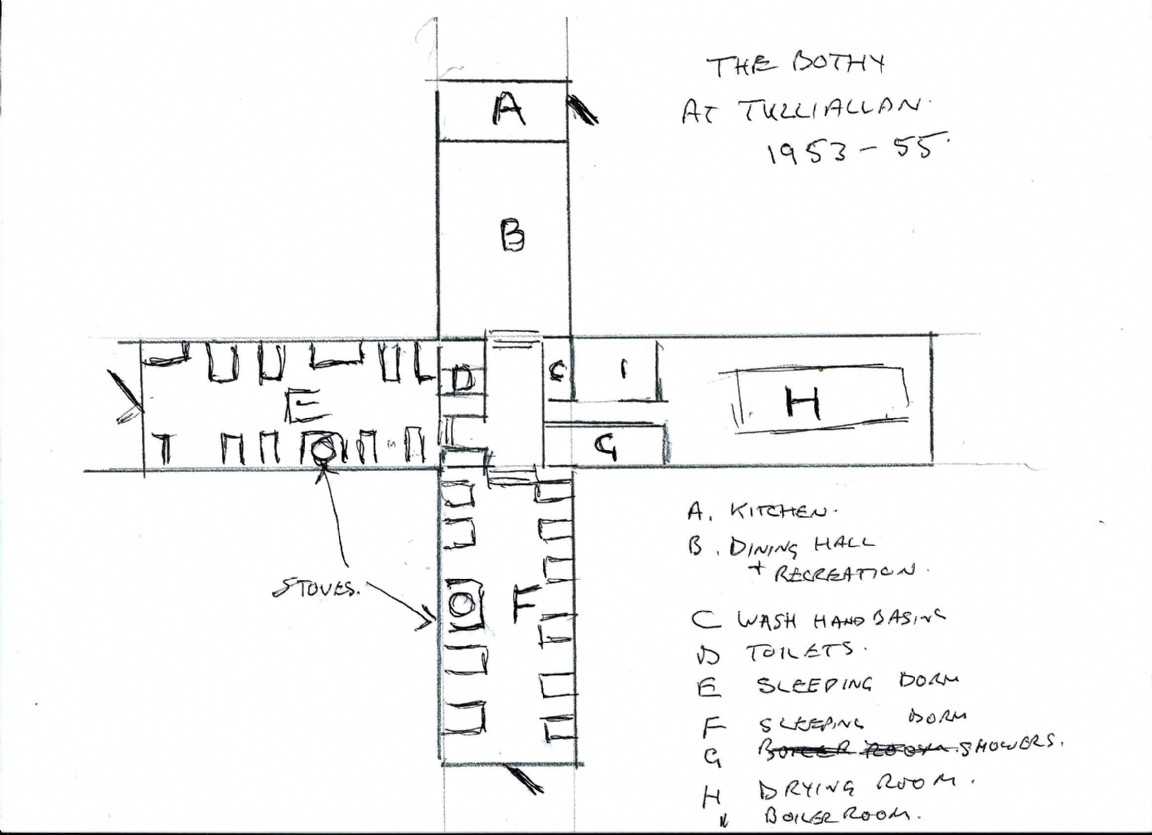
John (Butch) Murray has drawn the layout of the Forestry Commission Tulliallan Hostel (Bothy) and written an account of his memorable experience in arriving and living there for just over a year or so before being called up.
This content moderator has to apologise to John for the very late (many years!) entry of his story onto the website. Sorry John.
"I left school at the age of 16 and had a desire to work in the Great Outdoors and so thought of the Forestry Commission. I went to HQ in Glasgow for an interview and was told I could get a job at Tulliallan Nursery in Fife. Not far from Kincardine on Forth. The only Tulliallan I could find was a castle and supposed that is where I should report. My parents drove me over to Fife and we found the Head Foresters House and were somewhat gobsmacked when he showed us the Bothy where I was to stay.
My mother was horrified at the prospect and seemingly cried all the way home concerned about her little boy. I then was given a bed space in one of the huts and told that the gang would be home shortly and Dinner would be served at 6 pm after they got cleaned up. What a rowdy mob they turned out to be and the questions flowed back and forth. However they all seemed a real bunch and I was made welcome.
There was another Hut next to ours and our cooks and bottle washers Jock McRae and his wife “Ma” lived there. Jock would wake us up at 06.00 and slam on the radio with loud music. It was a scramble to get washed and dressed ready for breakfast. Always a bowl of Porridge followed by a fry up or kippers. Jock had already made up “chits” (Sandwiches) for us - one of meat and one of cheese. Also two slices of bread and butter. We usually filled these with what breakfast we could or jam which became a universal item of exchange. I always had a supply of homemade which went down well. We all drank tea and as we had left our thermos flasks out overnight they were all topped up to last through the day.
The lorry would turn up at 07.30 to take us the few miles by road to Devilla Forest where we spent most of our working days. Our Head Forester at Tulliallan was Arthur Simpson and his Foreman was Bill Martin. At Devilla our Boss under Forester was Donald McGregor but our Ganger was Alex Smellie and it was he that we saw most of and worked under his supervision. He had been trained at Glentress and told us many stories of what life had been like just after the war there. Most of our work at Devilla was weeding the seed beds in the Nurseries but it was also where we were let loose with brashing saws to hack our way through the pine and Norway spruce plantations. If we were too rowdy and undisciplined we were set to work brashing Sitka Spruce whose needles got everywhere up backsides and tucked into our navels. They were bloody tortuous and we hated them.
Back at Tulliallan we joined forces with the men and spent hours weeding seed beds. We all made wooden boxes with a padded seat on them and then shuffled up and down between the beds pulling out the weeds that sprouted amongst the trees. Our wages were fantastic and on Friday, as pay day, we got the princely sum of 59 shillings a week - just over £2.00 out of which we had to pay 19 shillings a week for board and lodging. If we stayed at the hostel for the weekend we had to pay an extra 5 shillings. I went home as often as I could and after my bus fare I was left with just enough to buy 10 cigarettes. We often got the chance of doing overtime in the evenings weeding seed beds and for this we could get an extra £1.00. So if we had enough energy we could up our wages by working every evening and so make an extra £5.00 a week.
For entertainment we had the radio and played cards but if not working we would walk down to Kincardine and spent the evening in the Merkat Café drinking Coke and playing the Juke box. We were also lucky in being not far from Alloa and Dunfermline where we could go to the cinema or the Swimming baths.
The hostel or Bothy as we called it was a collection of 4 wooden huts joined together in the form of a cross. Two of the huts were our living quarters, 10 lads in each and we had a bed, a locker and a wardrobe with a piece of carpet by the bed. The walls were often soon covered with pinups and our source of heating was a single Stove which was rather inadequate to say the least. If we banked it up full of Coke (always a plentiful supply) for the night we almost died of asphyxiation from the fumes but if we filled it with wood it went out just after midnight. One of the other huts was the kitchen and dining hall while the other was the drying room, always an essential and also the showers. This also housed the boiler which was coke fired while the big black range in the kitchen was coal fired. The small hallway between the huts contained the toilets and wash basins. Looking back now after all these years it seemed like a very Spartan existence. Fights were infrequent as most of the 20 of us got on well together.
Apart from the Nursery work we almost planted the whole of the Tulliallan moor over the next two years mainly with pine, Scots and Lodgepole, but Norway and Sitka Spruce in the wetter parts and at the Rig head end we drained what we called the Okinpinoke Swamp prior to planting. This whole area was ploughed with a crawler tractor. We did the planting as piecework and got paid 1 shilling and sixpence for every hundred trees planted. On good open ground we could plant 1,000 a day but on rough uncleared grounds it was often half that number. Even so at an extra 10 shillings a day this gave us over £5.00 a week extra sometimes even as much as £10.00 per week. This annoyed the men as we worked harder and so they moaned to the Union and we got our pay halved.
If and when the ground was being ploughed, we had tractor men from Lochgilphead. Our caterpillar driver was driver Tam McLennan - one of a family of the dad and three sons from Lochgilphead who all did the ploughing before planting. These tractor men were all nicknamed after the four winds. Some of us got the job of helping by walking beside the tractor and when the big ploughshare on the Ranson Plough hit an immovable boulder we had to replace the Shear pin that coupled the plough to the tractor when it gave way.
During the early winter months we spent the days in the nursery picking seedlings for transplanting. This was sore work and very cold as we spent all day on our knees picking seedlings out of the frozen ground. For this we again did it as piece work and got paid 5 shillings per thousand. We grovelled in the freezing soil with our bare fingers and having picked 50 we then put them in a clump with some earth over the roots and having then picked 50 more the whole bunch was put in a box. We earned good money at this often getting as much as an extra £10 a week. Again this displeased the men and again our rate of pay was halved. So much for Unions, ours was the TGW and in our minds was named “THE GREEDY WASTERS’’.
I stayed at Tulliallan until national service and when I came back after two years in the Royal Navy I found that the boys had all been moved to Strathyre and so I rejoined them there. But that’s another story. I can remember most of the boys that shared my life in Fife. They were Tom Syme, Brian Burrell, John Thompson, Mike Andrews, Joe Meechan, Josie Cullen, John Robb, John Kennet and Dave Harrower. In the other hut were Tommy Lothian, Eric Robertson, Alex Manson, Ian McCrone, Eddie McNeil, David (Pedro) Balfour, John Hynd, and three more.
While living in the bothies there was often a real rumpus when one of the Hurts mob would place a huge divot on the chimney and smoke the other lads out. Of course this was reversed as soon as possible, stupid and dangerous but a lot of fun. The other great diversion were Initiations. These consisted mainly of the new guy being stripped and covered with boot polish and dubbing as well as a coating of ashes from the fires. This was followed by mainly cold showers to get as much all washed off. Okay in summer but not at all pleasant in winter. Apart from this nightly nonsense more could take place at lunch time while at work. My own initiation here was to be debagged and my trousers and pants thrown up a small tree which I had to climb, in bare buttocks, and while doing this the gang cut the tree down, me and all. This was a highly popular method of introduction to Forest working. But was severely frowned on by the Gangers".
Download Large Version (284kB)
Groups: Buildings in Forests