John Abernethy Dickson 1915-94 – Director General of Forestry Commission
John Abernethy Dickson 1915-94 – was Director General of Forestry Commission and Director Economic Forestry (Scotland), Chairman Forest Thinnings.
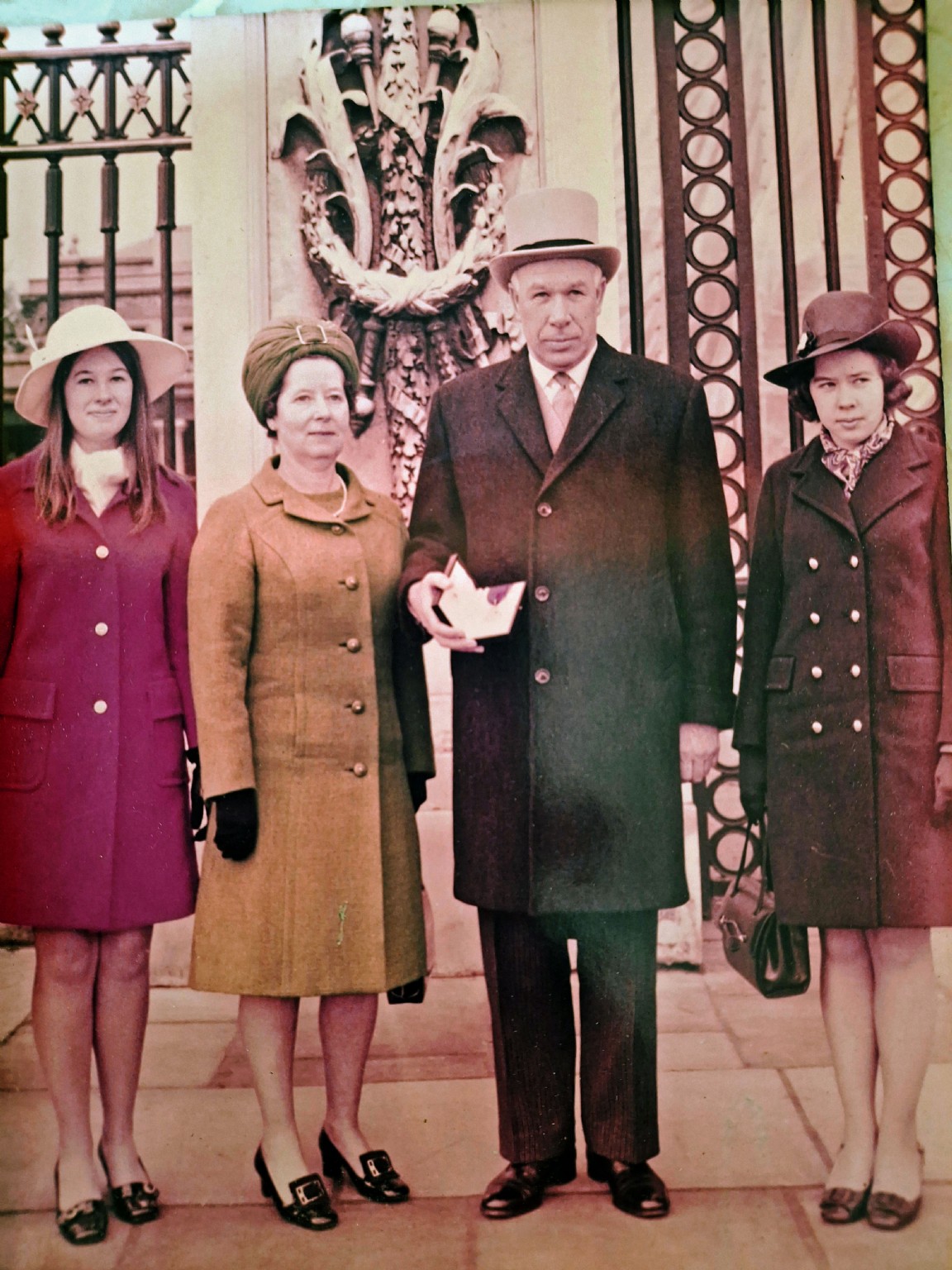
The information and photographs were provided by John’s daughter, Anne Dickson, but the main article below was sourced from the ‘Independent’ newspaper archive from 1994 (the year of John’s death) and quotes an obituary written by Tam Dalyell, the prominent Scottish Member of Parliament during those years. The main photograph is the family gathering following the presentation of CB medal at Buckingham Palace. The people are from the left:
Elizabeth Dickson – younger daughter
Helen Dickson
John Dickson
Anne Dickson – elder daughter
“Obituary: John Dickson By Tam Dalyell
Wednesday 04 May 1994 00:02 BST
John Abernethy Dickson, civil servant, conservator of forestry: born Udny, Aberdeenshire 19 September 1915; Director-General and Deputy Chairman, Forestry Commission 1968-76; CB 1970; Director, Economic Forestry (Scotland) 1977-84; director, Forest Thinnings Ltd 1979-86, chairman 1981-86; married 1942 Helen Jardine (two daughters); died Edinburgh 20 March 1994.
OVER THE PAST year widespread dismay, across the political spectrum, and not least in great land-owning circles, has forced the Government to put on ice any proposals to privatise or dismantle the Forestry Commission. That the Forestry Commission has achieved untouchable status, bordering on the institutionally sacred, is largely due to a previous generation of dedicated, professional Tree Men, who devoted their working lives to the commission. Prominent among them was John Dickson, Director-General in the crucial years from 1968 to 1976, when a friendly Labour government was succeeded by a Conservative government asking legitimate questions about a nationalised industry.
Under the energetic chairmanship of John Parker, MP for Dagenham and father of the House of Commons, the forestry group of MPs went on a number of visits to the forests of Britain. Dickson would accompany us himself as guide and forest scholar as well as host. As, perforce, a connoisseur of briefers of politicians, I would put Dickson in the First Class Honours division. There was little, if anything, either about trees or about the rather different subjects of timber production and the timber market that he did not know intimately. Dickson could answer all questions in his precise, authoritative, Buchan-based twang. A handsome man with a twinkle in his eye, he was a superb presenter of fact, an ambassador for forestry.
Dickson was born in Udny, Aberdeenshire, and spent his childhood among the trees of the Dee and the Don with their matchless colours in spring and autumn. He told me that he decided to become a tree man at the advanced age of six. After primary school in Old Meldrum, and secondary school at the rigorous Robert Gordon's College, he went to the local university. Fortunately, Aberdeen at that time was not only a serious science-providing university but also one of the few which offered a postgraduate degree in forestry. Even more fortunate was the fact that Aberdeen benefited from the inspirational presence of Sir John Boyd Orr (later Lord Boyd Orr), and those who surrounded him at the Rowett Research Institute. Three decades later Dickson was to repay his educational debts to Aberdeenshire by giving, as Director General of the Forestry Commission, strong support, justifiably, to the MacAuley Institute of Soil Research. Winning the much-coveted Sutherland Gold Medal in 1938, Dickson joined the Forestry Commission.
On the outbreak of the Second World War, he was ordered to join the Ministry of Supply home-grown timber production department rather than to go into the forces. He told me that he had been embarrassed by this as a fit young man but was told that it was in the British interest to meet wartime needs by providing as much timber as possible from British forests. During his time in the Ministry of Supply he learnt many of the skills which enabled him to deal so effectively with governments when he reached senior position later in life.
In 1946 he left the Civil Service to rejoin the Forestry Commission. Ten years later he was promoted as Conservator of Forests in the north of Scotland, based in Inverness, a position he occupied for seven years. If you travel past Beauly in directions north you will see all around you the mature monuments to Dickson's extraordinary energy in getting planting done 40 years ago. In 1963 he was again promoted to Director of Forestry for Scotland. He took infinite trouble to show me and interest me, a new MP, in the work that he and his colleagues were undertaking to plant huge acreages of trees on seemingly infertile and useless land. I suppose it is a criticism that in those years he was a protagonist of maximum production, which meant the serried rows of conifers. On the other hand he was extremely keen that, where planting took place near industrial communities and run-down mining villages, the people of the villages should regard the plantations as their own and develop a protective attitude towards them. I shall always remember him meeting the representatives of the communities of Fauldhouse and Stoneyburn in my constituency when coalmines were closing, to persuade them of the potential importance of woodland and forest for their young people planted on marshland.
In 1968 he was promoted to succeed the late Sir Henry Beresford Peirse as Director-General after a successful tenure of the new post of Forestry Commissioner with responsibility for timber harvesting and marketing. Dickson displayed a passionate belief in the promotion of the interests of British forestry in general and the efficiency and cost- effectiveness of the Forestry Commission in particular. His colleagues tell me that it was Dickson above all others who transformed a rather do-good organisation into one of the best and financially one of the most tightly managed agencies of government.
He also made it his business, in Scotland and in London, to develop good professional and personal relations with forestry-owning landlords. He co-operated with them in an effort to modernise the somewhat antique British saw-milling industry. He persuaded the commission to change the largely manual methods of wood harvesting into sophisticated mechanisation processes. By doing this he was one of the founders of the prosperous industry which we know today.
Those of us who have been interested in the rain forests have reason to be grateful for Dickson's work as chairman of the Commonwealth Forestry Association. He led the British delegation to the World Forestry Congress in Buenos Aires in 1972 and presided over the Oxford Conference on Forestry in 1974. Between 1968 and 1976, he was chairman of the Standing Committee on Commonwealth Forestry and became Vice-President of the Commonwealth Forestry Association in 1975. His particular contribution stemmed from his expertise in forest thinnings and his realisation that it not only mattered how much rare tropical timber was extracted from a forest, but how much damage was done in the process of that extraction by heavy machinery.
I vividly remember him arguing that, in many parts of South-East Asia and Burma, the best possible machine for timber extraction which had been developed by man was the Asian elephant. Today those with foresight would take the same view. Twenty years ago it was an opinion that was almost derided but then those who heard Dickson state a case knew better than to deride anything that he said on his home ground; he was indeed a world expert.”
To add a little to the above moving and fulsome tribute by Tam Dalyell some additional information on the John Dickson’s early years fills in more of his early life story. John was the youngest of five children born to parents John and Williamina Dickson at Udny in rural Aberdeenshire. John Abernethy Dickson senior served in the Great War joining up with the Princess Louise’s Argyll and Sutherland Highlanders. While as a gunner in the Royal Garrison Artillery he lost his life in France in August 1918 leaving Williamina to bring up all the children. Being gifted academically young John attended initially Cultercullen (Udny) and then Stoneywood (Dyce area) primary school and was accepted into the prestigious Robert Gordon’s College, Aberdeen, for his secondary education. Thereafter it was on to Aberdeen University where John undertook a forestry degree course and was presented with the John Sutherland Gold Medal for the highest achievement and graduated with MA and BSc degrees. Much later in life (in 1969) Aberdeen University conferred on John an honorary Doctor of Laws (LL.D) honouring his achievements in forestry administration.
No doubt after graduating John applied to join the Forestry Commission and enrol into the lower ranks of District Officer grade but recruitment was dependent on vacancies and the periodic timing of selection boards. Undaunted John applied for a job as a forest worker in the Gatehouse-of-Fleet forest nursery in south Scotland. While there and being an avid golfer John joined the local golf club and seeking a playing partner met up with Helen Jardine who also played golf and was similarly searching for a playing colleague. On the outbreak of war he was instructed to join the Home Grown Timber Production Department (HGTPD) in Aberdeen, possibly as a junior District Officer, and to assist with the vital supply of timber from local forests for the war effort. There are reports that John was involved in the Grantown-on-Spey area while in Aberdeen. The Aberdeen HGTPD control area may have been divided up into several different zones such as Moray and Speyside and also Deeside and Angus with District Officers responsible for organising all the logistics in each. In Moray and Speyside John would have had the opportunity to study closely at various camps the Canadian Timber Corp’s timber production and sawmilling conversion systems. The Canadians were significantly more advanced and mechanised than their Scottish counterparts at this point in time.
In 1942 John and Helen were married in Dumfries and subsequently set up home in Aberdeen where their first child, Anne, was born. John was also allocated some nightly Home Guard and Warden duties in Aberdeen and much to the concern of Helen was detailed at times to go to Woolmanhill, climb a high tower and sit there, no doubt watching for enemy aircraft or pinpointing burning bomb damage areas in the city.
After the war John was posted as a District Officer to the Forestry Commission district office at Ardross, near Alness, then in 1949 to Munlochy in the Black Isle followed by another move in 1950 into the Conservancy Office in Inverness. Promotion followed in 1953 when he was appointed as one of the two Divisional Officers in Inverness, each covering about half of the Conservancy while a third Divisional Officer covered all the land and building procurement processes. It was in this period that there second daughter, Elizabeth, was born. Just three years later in 1956, following the retirement of James Fraser, he achieved the rank of Conservator of North Scotland Conservancy, a position he held until 1963 and was, according to his daughter Anne, one of the happiest periods of his life.
On retiring from the Forestry Commission in 1976, as described by Tam Dalyell, he held a number of positions as director and chairman in private forestry companies but it seems that he had retired completely by 1987 and focussed on tending to his large garden in Edinburgh growing vegetables and fruit trees. He was very committed to and proud of his Scottish heritage and also possessed good practical skills in painting, decorating, joinery and general maintenance work. He erected a large summer house in the garden and ensured the family home was always very well maintained. John Abernethy Dickson died in Edinburgh on 20 March 1994 aged 78.
Please see the image of the CB medal in the PDF link below.
Download Large Version (1.2MB)
Groups: Groups of people