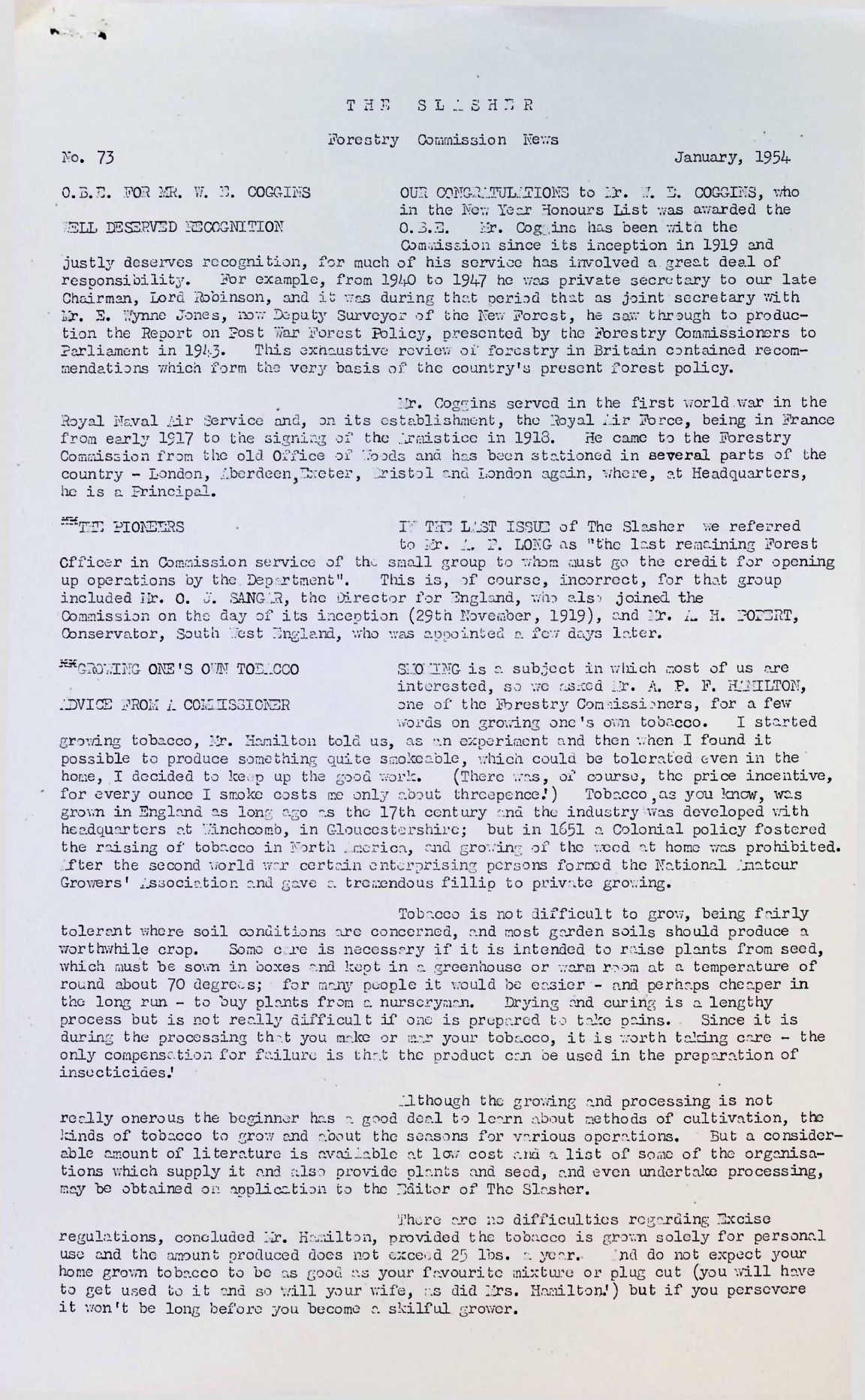
Slasher Magazine Summary: Publication No. 73 – January 1954
The scanned images of the Slasher were produced by and courtesy of the Forest Research Data and Information Team staff based at Roslin, where some of the original copies are located. The Forestry England Information Knowledge Management Team and New Forest Heritage made available copies of The Slasher from their collections. Brian Mahony of the FC Retirement Association devised and coordinates the Slasher Project and has been instrumental in locating many missing editions and coordinating the searches to locate all the earlier publication numbers.
The content summary below was again very kindly compiled by Diane Birkett, Bedfordshire. See PDF attachment link below the text summary to view the full document. A total of over 420 issues or publications were produced between January 1948 and the final publication in 2010.
Honours
Mr W.E. Coggins was awarded the O.B.E. in the New Year Honours List. Mr Coggins has been with the Commission since its inception in 1919. From 1940 to 1947 he was private secretary to our late Chairman, Lord Robinson, and it was during that period that as joint secretary with Mr E. Wynne Jones, now Deputy Surveyor of the New Forest, he saw through to production the Report on Post War Forest Policy presented by the Forestry Commissioners to Parliament in 1943. This exhaustive review of forestry in Britain contained recommendations which form the basis of the country's present forest policy. Mr Coggins served in the First World War in the Royal Naval Air Service and, on its establishment, the Royal Air Force, being in France from early 1917 to the signing of the Armistice in 1918. He came to the Forestry Commission from the old Office of Woods and has been stationed in several parts of the country - London, Aberdeen Exeter, Bristol and London again, where, at Headquarters, he is a Principal.
The Pioneers
With the mention last month of Mr A.P. Long as one of the last remaining Forest Officers in Commission service of the small group to whom must go the credit for opening up operations by the Department, also in the group are Mr O.J. Sangar, Director for England, who also joined the Commission on the day of its inception (29th November, 1919) and Mr A.H. Popert, Conservator, South West England, who was appointed a few days later.
Growing One's Own Tobacco - Advice From a Commissioner
Smoking is a subject in which most of us are interested, so we asked Mr A.P.F. Hamilton, one of the Forestry Commissioners, for a few words on growing one's own tobacco. Mr Hamilton told us "I started growing tobacco as an experiment and then when I found it possible to produce something quite smokeable, which could be tolerated even in the home, I decided to keep up the good work. There was, of course, the price incentive, for every ounce I smoke costs me only about threepence. Tobacco as you know, was grown in England as long ago as the 17th century and the industry was developed with headquarters at Winchcomb, in Gloucestershire, but in 1651 a Colonial policy fostered the raising of tobacco in North America, and growing it at home was prohibited. After the second world war certain enterprising persons formed the National Amateur Growers' Association.
"Tobacco is not difficult to grow, being fairly tolerant where soil conditions are concerned, and most garden soils should produce a worthwhile crop. Some care is necessary if it is intended to raise plants from seed, which must be sown in boxes and kept in a greenhouse or warm room at a temperature of round about 70 degrees; for many people it would be easier - and perhaps cheaper in the long run - to buy plants from a nurseryman.
Drying and curing is a lengthy process but is not really difficult. Care is needed since it is during the processing that you make or mar your tobacco. The only compensation for failure is that the product can be used in the preparation of insecticides. Although the growing and processing is not really onerous, the beginner has a good deal to learn about methods of cultivation, the kinds of tobacco to grow and about the seasons for various operations.
"There are no difficulties regarding Excise regulations", concluded Mr Hamilton, "provided the tobacco is grown solely for personal use and the amount produced does not exceed 25 lbs. a year. Do not expect your home grown tobacco to be as good as your favourite mixture or plug cut (you will have to get used to it and so will your wife, (as did Mrs Hamilton!) but if you persevere it won't be long before you become a skilful grower."
Exam Success - Praise for Five C.O.s
Five of our Clerical Officers were successful in the limited competition for Executive Officers, held last August. The written part of the examination was taken by 2,001 candidates, of whom 433 were interviewed in order to fill 125 places.
Mr R.D. McLean, West Scotland Conservancy, distinguished himself and brought credit to the Department by gaining the top position in the written examination and by being placed second in the final results. Mr P.J. Watson, North Wales, also did exceptionally well, for he tied with a non Forestry Commission candidate in gaining highest marks in the oral side of the competition and was sixth in the final placings. Three other officers who came through with flying colours were R. Garwood and G.C. Beard (Headquarters) and J.G. Armstrong, South Scotland.
From Clocaenog to Woolmer - More About Monuments
There is further news of the Clocaenog monument, to which we referred in last month's issue. Mr H.G. Smith, an Executive Officer in the North Wales Conservancy Office, writes to say that there is no question of the monument being obscured from public view, for it stands on an unplanted prominence. He says he saw it the other day and it has recently received some attention and the stone blocks have been pointed. The inscriptions are still easily read. An oak trunk, very weathered, is nearby and may have been hauled to the site to serve as a seat. The monument is well visited by the public and is easily reached by a 400-yards long path from the motor road.
A correspondent mentions another monument of a stone beneath an oak in Woolmer Forest, South East England. The commemorative plaque on this monument records that in 1859 Her Majesty Queen Victoria, with the Prince Consort and the Princess Royal, reviewed the troops encamped at Woolmer and, in the shade of the said oak tree, partook of refreshments. The monument and plaque were provided by the Bramshott Parish Council to mark the Coronation of King Edward VII in 1902.
Christmas Parties - Blood and Thunder at HQ
Blood and thunder and the goodwill of a Christmas party, you might think, go ill together. But not so at Savile Row, where the annual celebrations were attended by a large crowd of colleagues, relatives and friends. Highlight of the programme was a playlet entitled 'Death', as humorous a 'spine-chiller' as we have seen for many a moon. Everything was in character, from the 'corpse' to the Dracula-like butler and the sinister thumb mark on a well-prepared programme. To Eric Tinson and Arthur Carvosso went the credit for writing the play and to the following for performing it: Geoffrey Seal (Death, the butler); Jean Allen (Barbara Vere de Vere); Dorothy Frost (Lady Vere de Vere); John Audy (Barbara's fianc้); Ernest Springall (Samuel de Quincy); Fred Druitt (Sheerluck Jones); and Bill Wilbraham (Bones). Finally, special praise for Miss J.F. Terry, who produced. Sketches by Bill Wilbraham, songs by Joe Steele, competitions and dancing made up the programme. Among those present were the Director General, Mr A.H. Gosling and Mrs Gosling, and the Secretary, Mr H.A. Turner and Mrs Turner.
About 150 attended the annual party of the North Wales Conservancy staff at Shrewsbury. Among them were the Conservator, Mr F.C. Best; S.F.O. Mr J.R. Hampson and Mrs Hampson; and Chief Clerk Mr K. Mayhew and Mrs Mayhew. District Officers and Foresters and their wives were also present in strength. The event was ably organised by the Social and Sports club.
At the Aberystwyth annual staff dinner, a toast to guests was proposed by Mr E.R. Lewis, Chief Clerk, and responded to by Mr P. Miles, who also proposed "The Forestry Commission staff", to which the Director for Wales, Mr A.P. Long, replied. Outstanding entertainment took the form of a 60-minute revue entitled "SyIvaticacophony", produced by Mr H.J. Pope; the artistes were Mrs M.O. Corfield, Mrs E. Jones, Mrs E. Owen, the Misses M.E. Jones, G. Jones, and R. Jones, and Messrs. A Butt, Pope, D.C. Fisher and V.H. Williams. Prizes were won by Mrs M. Roscoe, Mrs Burgess, Miss D. Edwards and Mrs Kitchin.
An Old Friend Again - Loch Ness Monster Sighted
The Loch Ness monster has been seen again, states our Inverness correspondent, this time by five employees of a wood merchant who were working in Farigaig Forest, one of our units which flanks the loch. The men claim to have seen the monster on and off for about 10 minutes, while it was disporting itself in Urquhart Castle bay, and described it as "looking like a huge horse at the front"; apparently a great splashing, about 20 feet behind, indicated the tail.
Our old friend the denizen of Loch Ness, has, of course, been featured on a previous occasion in The Slasher and we named a number of our employees who, over a long period of time, have seen him. "The Loch Ness monster story, "says our correspondent, "certainly seems to have some substance behind it and I believe quite a number of people who have seen it won't admit the fact for fear of ridicule. There are three of our units bordering Loch Ness - Farigaig, Craig nan Eun and Inchnacardoch - and perhaps some of our workers there who have not hitherto been named have also seen the monster.
The Invalid Voices His Thanks
While on a recent course at Northerwood House, Clerical Officer R.R. Davies, of the Cardiff office, was taken ill and removed to hospital. Colleagues on the course sent him fruit and good wishes, but unfortunately he does not know their names (his illness occurred very soon after he arrived at Northerwood) and he is thus unable to send them each a personal note of thanks. Hence his request for a little space in The Slasher, in which his appreciation may be placed on record. This is gladly given.
Another Coincidence
Last month we included a paragraph about coincidences. Here, as a follow-up, is an account of an incident involving Mr Bill Wilbraham, of Headquarters. The other night, on the occasion of the Christmas party at Savile Row, he stood in the corridor for a few moments and chatted with a recently appointed commissionaire. Suddenly there dawned the light of recognition; the two men had last met 20 years before at Aldershot, where they were on the same physical training course.
Poor Alice Holt Was Hanged - But Who Was She?
We were intrigued, the other day, to read a letter in a well known journal on the subject of public executions, for there, in a list of unfortunate ladies who have paid the penalty for some indiscretion or other, was the name Alice Holt. According to the letter, poor Alice Holt was publicly hanged in 1863.
Of course our interest really springs from the fact that our Forest Research Station is commonly known as Alice Holt Lodge - 'Alice Holt' in this case, in all probability came from the Anglo-Saxon 'Aelfsiges Holt', or Wood. Nevertheless, it is not surprising, our macabre thirst being whetted, that we should like to know more of the ill-fated woman Alice Holt. We believe, by the way, that it is now 85 years since the last public execution took place in this country.
A Day In The Life Of An Education Officer
It was suggested to us recently that a short series of 'popular misconceptions' might provide some diversion for our readers. Anyway, here is a contribution by an Education Officer who prefers to remain anonymous.
The field District Officer's conception of a day in the life of an Education Officer in charge of one of our Forester Training Schools: "Good morning, gentlemen. Today I would like to discuss the silvicultural characteristics of the Sessile and Pedunculate Oak. An interesting treatise has been prepared by Bunch and McAnderson and they refer on page 10, if you will turn to it, to the habit of the species, etc. That will do, gentlemen. Next week we will visit an area of oak on a private estate, where the hospitality of the owner will compensate for the shocking state of the plantations."
The Actual day
"Yes, Matron, what is it? What! One of the cooks leaving? She can get one half day's leave for every month she's been here. And she gets the proportional lodging allowance for those days with pay. Is the lodging allowance worked out for a six or seven-day week? I'm not sure, look up CAEC/53. It's in file 3.3. No, it's not, that's plumbing. Reminds me, Matron, did we get the plumber to trace the smell in the lecture room? Well, if the water's to be turned off, we'd better warn the men not to use any until six o'clock.
"But we have to order those through the Ministry of Works, it's cheaper, and they're stamped Government property. Yes, I know one can't always wait, but try.
"What discount are we getting from the grocer - that's quite good, but why can't we get the same from the butcher? Write to the other butcher and see what terms he can offer. Alright, Matron, thank you. Yes, Smith, what is it? Brown's cut himself, has he? Well, 'ard luck, where? Well, 'arder luck. Did you take him to the Doctor? Good. Three stitches, eh, I'll come up and see him. Better let Matron know. (Phone rings.) Yes, hullo? Oh, it's you. Haven't they been shown how to do it - they either know how to weed or they don't. Show them some Poa annua and at least they'll feel they are being taught something - Yes, Matron, fresh dressings for Brown's leg? In the first aid box; oh, empty is it, waiting for refills, but we ordered those months ago. I see, no refills issued until October. So we must wait until the end of the Forest Year before we can cut ourselves. All right. And by the way, see the plumber on your way out and ask him if he's mended the leak in the dormitory.
"Yes, come in, Wilson. A visit to an area of natural regeneration, certainly. We could arrange to go next week. Dash it, but I can't. I've got to arrange the fitting of the linoleum in the dining room. No, the Matron can't do it, because she's interviewing another cook that day ---------"
And so on, all day, until forestry becomes just a faded memory.
Newcomers
Executive Officer P.E. Nicholas to Research;
Clerical Officer W. Watkins to D(W);
Clerical Officer M.E. Loader to New;
Clerical Officer G.L. Round to H.Q.;
Clerical Officer J.E. Norman to E(E);
Clerical Officer N. Hammond to SW(E);
Clerical Officer Miss I.G. Reid to N(S);
Clerical Officer H.S. Mackay to N(S);
Clerical Officer S. Mackintosh to N(S);
Clerical Officer C.I. Trew to S(W).
Transfers
District Officer G.D. Keighley from Shrewsbury to Oswestry, N(W);
District Officer D. Mackay from Bourne, E(E) to Carlton Scroop, E(E);
Forester B.R.G. Hammond from Wexcombe, SW(E) to Moccas and Aconbury, SW(E);
Foreman W. Rose from Ardgartan, W(S) to Strathyre, W(S);
Clerk of Works F.W.B. Lemmon from Brechfa, S(W) to Coed Morgannwg, S(W);
Executive Officer E.G. Parker from York to Lyndhurst;
Executive Officer R. Palmer from Edinburgh to York.
Mr F.C. Hummel, Mensuration Officer at the Forest Research Station, has been seconded to the Government of Cyprus. He has been granted the degree of Doctor of Philosophy (ph. D.) by Oxford University, for his thesis on "The Volume - Basal Area Line", a study in forest mensuration which deals with volume tables and
tariff tables.
Engagement
Mr G.C. Beard and Miss Jean Allen, both of Headquarters have become engaged.
Births
The birth of a son to Forester R.B. Hart, Kilgrammie Forest, South Scotland and Mrs Hart.
The birth of a son to Forester G. Adams, Cleveland Forest, North East England and Mrs A
Please see the PDF link below to view all the pages.