Slasher Magazine Summary: Publication No. 62 – February 1953
The scanned images of the Slasher were produced by and courtesy of the Forest Research Data and Information Team staff based at Roslin, where some of the original copies are located. The Forestry England Information Knowledge Management Team and New Forest Heritage made available copies of The Slasher from their collections. Brian Mahony of the FC Retirement Association devised and coordinates the Slasher Project and has been instrumental in locating many missing editions and coordinating the searches to locate all the earlier publication numbers.
The content summary below was again very kindly compiled by Diane Birkett, Bedfordshire. See PDF attachment link below the text summary to view the full document. A total of over 420 issues or publications were produced between January 1948 and the final publication in 2010.
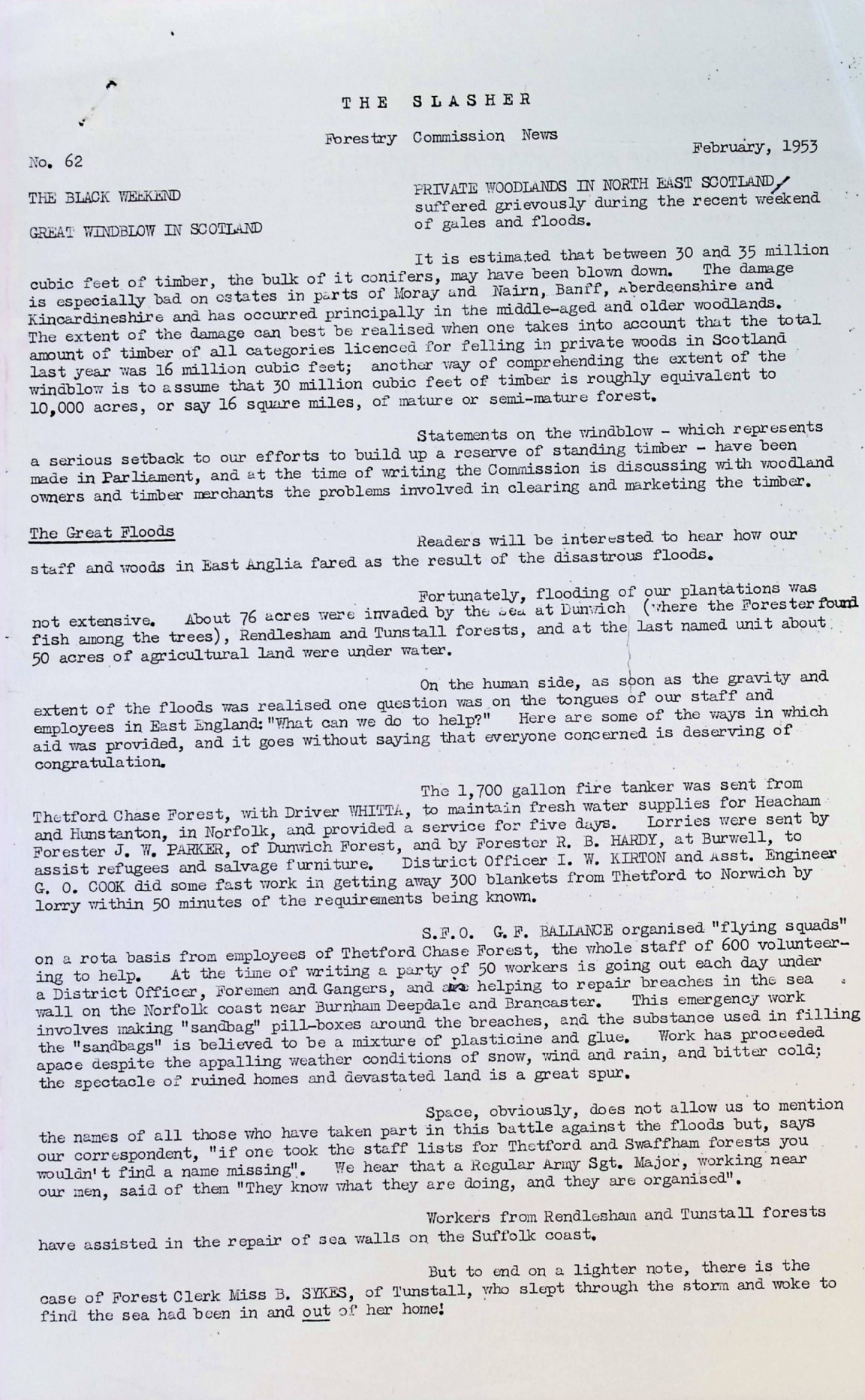
The Black Weekend - Great Windblow in Scotland
Private Woodlands In North East Scotland suffered grievously during the recent weekend of gales and floods. It is estimated that between 30 and 35 million cubic feet of timber, the bulk of it conifers, may have blown down. The damage is especially bad on estates in parts of Moray and Nairn, Banff, Aberdeenshire and Kincardineshire and has occurred principally in the middle-aged and older woodlands. The extent of the damage can best be realised when one takes into account that the total amount of timber, of all categories licenced for felling in private woods in Scotland last year was 16 million cubic feet. Another way of comprehending the extent of the windblow is to assume that 30 million cubic feet of timber is roughly equivalent to 10,000 acres or say 16 square miles of mature or semi mature forest. Statements have been made in Parliament on the wind blow, which represents a serious set back in our efforts to build up a reserve of the standing timber.
The Great Floods
Flooding of our plantations was not extensive. About 76 acres were invaded by the sea at Dunwich, where the Forester found fish among the trees. Rendlesham and Tunstall forests were affected. At Tunstall about 50 acres of agricultural land were under water.
The 1,700 gallon fire tanker was sent from Thetford Chase Forest with Driver Whitta, to maintain fresh water supplies for Heacham and Hunstanton in Norfolk providing a service for five days. Lorries were sent by Forester J.W. Parker of Dunwich Forest and Forester R.B. Hardy at Burwell to assist refugees and salvage furniture. District officer I.W. Kirton and Assistant Engineer G.O. Cook got 300 blankets from Thetford to Norwich by lorry within 50 minutes of the requirements being known.
S.F.O. G.F. Ballance organised "flying squads" on a rota basis from employees at Thetford Chase Forest, the whole staff of 600 volunteering to help. A party of 50 workers is going out each day under a District Officer, Foreman and Gangers, and is helping to repair breaches in the seawall on the Norfolk coast near Burnham Deepdale and Brancaster. This emergency work involves making "sandbag" pillboxes around the breeches and the substance used in filling the "sandbags" is believed to be a mixture of plasticine and glue. Work has proceeded apace despite the appalling weather conditions of snow, wind, rain and bitter cold. The spectacle of ruined homes and devastated land is a great spur.
Everyone on the staff lists for Thetford and Swaffham forests volunteered to help. Workers from Rendlesham and Tunstall forests have assisted in the repair of seawalls on the Suffolk coast. On a lighter note, there is the case of Forest Clerk Miss B. Sykes of Tunstall, who slept through the storm and woke to find the sea had been in and out of her home.
Late Reports of Parties
The North West England Conservancy annual party in the Accounts Branch office was attended by about 60 people. Dancing and games were enjoyed, and Mrs Dorothy Swynnerton and her helpers organised the buffet and Mr Jack Pritchard was the Master of Ceremonies. Conservator Mr A.H.H. Ross, was unable to attend, but in his absence Mr W.J. Raven (Land Agent) thanked the organisers.
The annual party of the South Wales Conservancy office was organised by the ladies of the Typing Pool and was acclaimed as a great success. Conservator, Mr W.D. Russell and Mrs Russell were present.
In York, a party with dancing, games and a buffet was organised by a committee chaired by Mr B.C. Selby (Acquisition Officer), for members of the North East England Conservancy office.
Everlasting Snow - Some Scottish Claims
Mr A.J. Birrell, Executive Officer, Inverness, names locations where snow is reckoned to remain all year round. These are in one of the gullies on the north face of Ben Nevis; and Braeriach, in the Cairngorms, in a gully on the Larig Ghru side. Seton Gordon, in one of his books, says the Ben Nevis snow has been known to disappear about September, but snow is seen in the Braeriach snowfield at any season.
District Officer G.F. Savage, North Scotland, writes "It might be worth recording that Birrell and I had a 'glissade' of about 200 feet down a snow slope in a corrie on the north face of Creag Meagaidh (3,700 feet), during August Bank Holiday weekend, 1951. I don't know if this snow survived until the winter. The snow cornice in Coire Lochan, on Cairngorm, defeated the predictions of local people by completely disappearing by the end of September in the same year. In June, 1951, I climbed a sheltered gully on Antealloch for several hundred feet; the snow was more than 8 ft. deep".
Mr F.S. Henderson, Executive Officer, Inverness, writes, "If you want to talk of depth, there is a Glencoe corrie which is said to hold snow 70 feet deep in winter".
In the same article in December, we spoke of Scotland's "boast" of Arctic animals - the mountain hare and the stoat. Forester D.W. Keens, Dalton Forest, North West England, writes: "In 1951, at Cotgrave Forest in Nottinghamshire, the Warrener, Mr T. Brumpton trapped at least three white stoats. I have observed a white stoat as far south as Ampthill Forest, Bedfordshire, and this was no rare occurrence. Regarding the demand for the pelts, as far as I can observe, having studied a recent price list, the furriers are not paying any more for the ermine than for the brown pelt".
Favourite Poems - Yardley Oak and To The Wayfarer
Readers have sent in their favourite quotations on forestry. Mr H.E.H. Drake, formerly in the Finance Branch at Headquarters, sent the following short extract from William Cowper's "Yardley Oak", written in 1791. Cowper once lived at Olney, in Buckinghamshire, which is quite near to our forest of Yardley Chase. No doubt, in his walks, he came upon one oak in particular which impressed and inspired him.
Yardley Oak
Of treeship, first a seedling, hid in grass;
Then twig; then sapling; and, as century rolled
Slow after century, a giant-bulk
Of girth enormous, with moss cushioned root
Up-heaved above the soil, and sides embossed
With prominent wens globose - till at the last
The rottenness, which time is charged to inflict
On other mighty ones, found also thee.
Forester R.J. Jennings, of St. Asaph Forest, North Wales, sent the following poem. We believe it may be seen prominently displayed in a Continental forest.
To the Wayfarer
Ye who pass by and would raise your hand against me, hearken ere you harm me.
I am the heat of your hearth on the cold winter nights, the friendly shade screening
You from summer sun, and my fruits are refreshing draughts, quenching your thirst as you journey on.
I am the beam that holds your house, the board of your table,
The bed on which you lie, the timber that builds your boat.
I am the handle of your hoe, the door of your homestead,
The wood of your cradle, and the shell of your coffin.
I am the bread of kindness and the flower of beauty.
Ye who pass by, listen to my prayer: harm me not.
Down in the Mine - A New Experience For Our Edinburgh Staff
Twenty five members of staff of the Scottish Directorate Office, Edinburgh, including eight ladies, were guests of the National Coal Board. Suitably attired and equipped with helmets and lamps, they descended the 720ft shaft of the Woolmet Colliery, Portobello, Midlothian, to see how coal is raised.
A walk of a mile and a quarter down varying gradients, and during which they were at times bent almost double, brought them to a coal seam which will eventually be worked some 1,000 feet below ground level. Then followed a "Commando Course" crawl along the three foot coal face for a distance of about 100 yards. After two hours, the parties returned to the pit shaft, wet kneed, dirty and much more appreciative of the hitherto despised "nutty slack". The pithead baths and canteen facilities were welcomed after the somewhat strenuous evening.
Staff of the same office visited the offices of the Scottish Daily Mail. One imagines a newspaper office as nothing but hustle and bustle, writes our correspondent, but that must be the Hollywood version. We found everything most orderly and peaceful in the precincts of the Mail offices. In fact, looking in on the Night Editor and his staff, one encountered calm and cups of tea. But behind the facade a great deal was moving, as we discovered during the two hour tour of all sections from the wire room, in which news is received, to the actual printing machines.
Nature Notes - Bats in Mid Winter
Head forester G.F. Beasley, of Kielder, North East England, records an experience of bats. He writes, "At about two o'clock the other afternoon, I saw, near Kielder Castle, what appeared to be a queer bird. On closer inspection I found it to be a bat. The weather was very mild, rather dull and damp, with an air temperature of about 52 degrees, and many gnats were flying about. Later the same afternoon, near Ravenshill, about a mile from the Castle, I saw another bat fluttering around, apparently catching gnats. Although it may not be a rare occurrence in the South and South West of England, it was decidedly uncommon for bats to be seen at Kielder in daylight and in mid winter".
A white squirrel, with pink eyes, was shot at Gravetye Forest, South East England, the second in 16 years.
Returning to the office of the Welsh Directorate, Aberystwyth, Clerical Officer A.R. Burgess noticed a sea-bird floundering on the beach. He caught it and discovered that its wings and tail were badly coated with oil. Subsequently, Executive Officer H.J. Pope identified it as a razorbill, and handed it over to the local R.S.P.C.A. inspector.
Newcomers
District Officer R.M. Hewitt to Dean;
District Officer D.R. Johnston to SE(E);
District Officer D.J. Cooper to SE(E);
District Officer J.N. Kennedy to E(E);
District Officer R. Lines to Research;
District Officer J.R. Fletcher to NW(E);
Executive Officer Miss M.R. Armstrong to Headquarters;
Clerical Officer D.E. Hinde to N(W);
Clerical Officer Mrs. M.A. Lewis to SW(E);
Executive Officer K.W. Carter (returned from H.M. Forces) to D(E);
Executive Officer E.G. Parker (returned from H.M. Forces) to NE(E);
Clerical Officer C.W. Simmonds (returned from H.M. Forces) to Headquarters;
Clerical Officer E.J. Carter (returned from H.M. Forces) to E(E).
Transfers
Forester J. Lomas from Coed-y-Brenin, North Wales, on secondment to the Liverpool Corporation at the Lake Vyrnwy joint afforestation scheme;
District Officer P.J. Langley from Bellingham, NE(E) to York, NE(E);
District Officer B. Walbank from Aberystwyth to Gwydyr, N(W);
District Officer J.H. James from Monmouth, S(W), to Tintern, S(W);
Forester G.A. Sharp from Kershope, NW(E) to York NE(E);
Forester J.R.A. Frater from Kilcoy, N(S) to Clack Liath, N(S);
Forester T.A. Jane from Lydford, SW(E) to Bruton, SW(E);
Forester A.A.C. Simpson from Strathyre, W(S) to Saddell, W(S);
Forester D.M. Ross from Kessock, N(S) to Kilcoy N(S);
Forester D.F.D. Black from North Strome, N(S) to Kessock N(S);
Forester R.S. Brown from Longart, N(S) to North Strome;
Forester A. MacKenzie from Slattadale, N(S) to Longart N(S);
Forester D.H. Walsh from Shifnal, NW(E) to Grizedale, NW(E);
Forester P.P. Awbery from Bedgebury, SE(E) to Maresfield, SE(E);
Foreman R. M. Edward from Wauchope, S(S) to Brownmoor, S(S);
Foreman D.K. Fraser from Research, Tulliallan to Research, Bush Nursery;
Foreman J.T. Studley from St. Gwynno, S(W) to Llanddowror, S(W);
Foreman J. Cooper from Mildmay, SE(E) to Southwater, SE(E);
Executive Officer H.P. Wilbraham from D(E) to Headquarters.
Retired
Mr L.A. Newton, Conservator on the staff of Director, Scotland, who has been responsible for Acquisitions and Private Woodlands, has retired after 33 years with the Forestry Commission. During a presentation, Director, Sir Henry Beresford-Peirse, referred to Mr Newton's great service to the Commission, particularly the part played by him in making the Dedication Scheme a success in Scotland.
Please see the PDF link below to read the news letter.