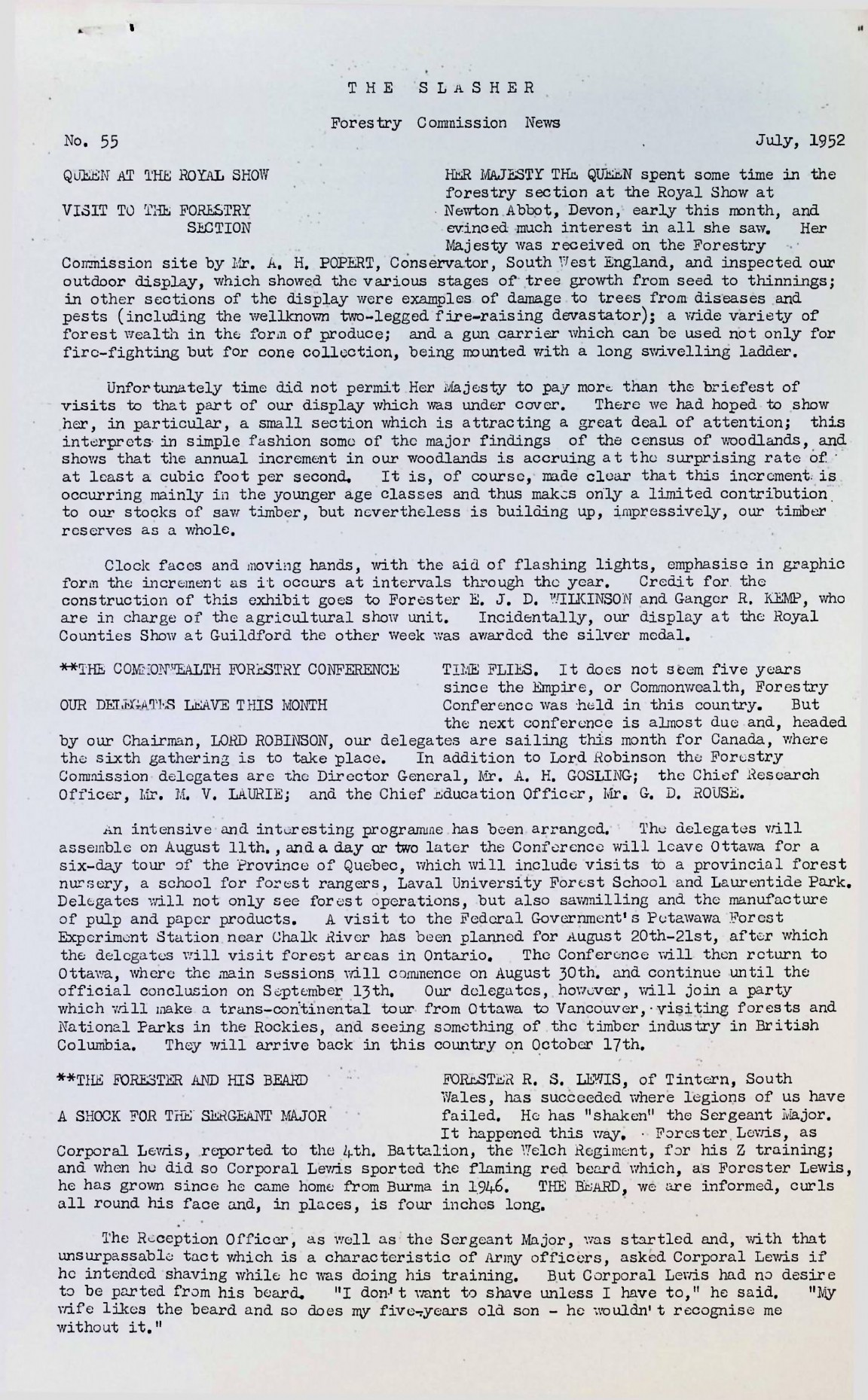
Slasher Magazine Summary: Publication No. 55 – July 1952
The scanned images of the Slasher were produced by and courtesy of the Forest Research Data and Information Team staff based at Roslin, where some of the original copies are located. The Forestry England Information Knowledge Management Team and New Forest Heritage made available copies of The Slasher from their collections. Brian Mahony of the FC Retirement Association devised and coordinates the Slasher Project and has been instrumental in locating many missing editions and coordinating the searches to locate all the earlier publication numbers.
The content summary below was again very kindly compiled by Diane Birkett, Bedfordshire. See PDF attachment link below the text summary to view the full document. A total of over 420 issues or publications were produced between January 1948 and the final publication in 2010.
Queen at the Royal Show - Visit to the Forestry Section
Her Majesty the Queen visited the forestry section at the Royal Show at Newton Abbot, Devon early this month. Accompanied by Mr A.H. Popert, Conservator of South West England, she inspected the outdoor display, which showed the various stages of tree growth from seed to thinnings; in other sections of the display were examples of damage to trees from diseases and pests (including the well-known two-legged fire-raising devastator); a wide variety of forest wealth in the form of produce; and a gun carrier which can be used not only for fire-fighting but for cone collection, being mounted with a long swivelling ladder.
The Commission's display showed some of the major findings of the census of woodlands, and shows that the annual increment in our woodlands is accruing at the rate of at least a cubic foot per second. It is, of course, made clear that this increment, is occurring mainly in the younger age classes and thus makes only a limited contribution to our stocks of saw timber, but nevertheless is building up our timber reserves as a whole. Clock faces and moving hands, with the aid of flashing lights, emphasise in graphic form the increment as it occurs at intervals through the year. Credit for the construction of this exhibit goes to Forester E.J.D. Wilkinson and Ganger R. Kemp who are in charge of the agricultural show unit.
Our display at the Royal Counties Show at Guildford recently was awarded the silver medal.
The Commonwealth Forestry Conference - Our Delegates Leave This Month
It has been five years since the Empire, or Commonwealth, Forestry Conference was held in this country. The next conference is almost due and, headed by our Chairman, Lord Robinson, our delegates are sailing this month for Canada, where the sixth gathering is to take place.
Forestry Commission delegates are Lord Robinson; Director General Mr A.H. Gosling; Chief Research Officer Mr M.V. Laurie; and Chief Education Officer, Mr G.D. Rouse. The delegates will assemble on August 11th and a day or two later, the Conference will leave Ottawa for a six-day tour of the Province of Quebec, which will include visits to a provincial forest nursery, a school for forest rangers, Laval University Forest School and Laurentide Park. Delegates will see forest operations, sawmilling and the manufacture of pulp and paper products. A visit to the Federal Government's Petawawa Forest Experiment Station near Chalk River is planned for August 20th - 21st after which the delegates will visit forest areas in Ontario. The Conference will return to Ottawa, where the main sessions will commence on August 30th and continue until the official conclusion on September 13th. However, our delegates will join a party which will make a trans-continental tour from Ottawa to Vancouver visiting forests and National Parks in the Rockies, and seeing something of the timber industry in British Columbia. They will arrive back in this country on October 17th.
The Forester and His Beard - A Shock for the Sergeant Major
Forester R.S. Lewis of Tintern, South Wales, has succeeded where legions of us have failed. He has "shaken" the Sergeant Major. Forester Lewis, as Corporal Lewis, reported to the 4th Battalion, the Welch Regiment, for his Z training sported the flaming red beard which, as Forester Lewis, he has grown since he came home from Burma in 1946. The beard curls all round his face and in places, is four inches long. The Reception Officer and the Sergeant Major were startled and, with that unsurpassable tact which is characteristic of Army officers, asked Corporal Lewis if he intended shaving while he was doing his training. But Corporal Lewis had no desire to be parted from his beard, "I don't want to shave unless I have to," he said. "My wife likes the beard and so does my five year old son - he wouldn't recognise me without it."
Following a conference among the officers, Corporal Lewis not only retained his beard but, it is thought, became the only bearded man in the British Army.
Bird Watching on the Farne Islands - Forester's Memorable Experience
A contribution from Forester W.L. McCavish of Redesdale, North East England, on his bird watching visit to the Farne Islands, a small rocky group two and a half miles off the Northumbrian coast: -
These islands are a bird sanctuary and Brownsman Island, was closed to the public so that a few pairs of the rare Roseate Tern might be left to nest undisturbed.
We started from the little fishing port of Seahouses, making by launch for Brownsman Island in order to pick up the official birdwatcher and our permits to land on the various islands.
We later crossed a narrow channel to Staples isle, and there crept over the seaweed-strewn rocks to that famous point known to most bird lovers as The Pinnacles. Here there were hundreds of Guillemots, standing with that awkward stance that is so characteristic. Many were fondling a single egg, pushing it between their legs, and sitting on it in a semi-upright position. They laid their eggs on the bare rocks and ledges, and we marvelled that the eggs remained on the precarious ledges without rolling off, and that each bird should know its own egg. Scores of Green Cormorants, or Shags, as they are termed, were sitting on their nests of piled up seaweed, and the parent birds were by no means friendly. Very impressive were the dainty little Kittiwakes which sat on nests spaced about nine inches apart, built on ledges and of sea grasses.
Also nesting on this isle were the Fulmars, whose graceful flight was a pleasure to behold; there were also Razorbills, Gannets, Sandwich Tern, Common Tern, Herring Gull, Oyster Catchers, and the noisy little Puffins that honeycomb the isle with burrows in which they make their nests, making it difficult to walk, lest one should sink through the earth's surface, and destroy the nest below.
As a diversion from bird watching we cruised around Longstone Isle, and were rewarded with a good view of the seals that abound and breed on this island; we saw at least a hundred, some basking on the rocks until we were within 30 yards of them, and then sliding unceremoniously into the water. We next landed on Lindis Farne, which is famous for its Arctic Terns. Their nests were constructed of seaweed on the drier parts of the beach. The male bird fed the hen, as she sat on the nest, with sand eels from four inches to 12 inches in length.
This island is also renowned for its Eider Ducks, which were nesting everywhere - in old walks and ruins, and even in the birdwatcher's back yard. They were very tame, and the older birds took no exception to being stroked. They looked ragged, however, for they line their nests, which hold clutches of between eight and 12 eggs, with down from their own breasts. It was grand to watch the newly hatched ducklings waddling with their mothers down to the rocky pools for their first swim, but, sad to relate, most of the drakes took no outward interest in their families and congregated in one corner of the island as though enjoying an evening at their club.
Our last visit was to the old Monastery and chapel on Lindis Farne, and this revived for us the story of Grace Darling. I cast my eye over the rocks, which must have seemed so much more sinister to those who served in sail, to see the remains of some of those long-forgotten ships, and I thought how cruel, yet how lovely, were these islands.
Footnote: Forester McCavish adds, he is sure that District Officer Spencer, at present in the South East England Conservancy, will be interested to know that his host and hostess for the day were the District Officer's parents, Mr and Mrs J. Spencer, of Greenhaugh Hall, Tarset.
Recruitment to the Schools
After references in the Press and on the Radio for the Commission's Forester Training Schools, the Commission's Education Branch reports on an increase in enquiries from the normal 15-20 per week to 145. The Education Branch replies with copies of the booklet "Forestry as a Career" and the Schools' prospectus.
Among the enquiries was an applicant who wrote enclosing a list of irrelevant personal details and embellished his letter with printed stamps bearing the figure of Hercules and the motto "Sacred Thy Body even as The Soul".
Another enquirer, a schoolboy, asked how he could become a Forestry Commissioner, and yet another applicant mentioned he was over 7 feet tall.
The Kielder Invasion
An engine and seven coaches drew into Kielder Station, Northumberland, on a Sunday recently.
On board were 150 ramblers, arriving to explore Kielder Forest at the height of the fire danger period.
The ramblers were divided into five parties and with each party went a Forestry Commission guide to ensure that no fires were lit, that gates were shut, and that no one got lost. The train was a special one run in conjunction with the Ramblers’ Association, to stations in the area of the North Tyne.
Table Tennis Star
Further achievements for Paul Brook, Executive Officer at Headquarters include playing in the semi-finals of the men's doubles in the English championships; selection for the Surrey County team; and the winning, with his partner, of the North West Kent mixed doubles title, beating three current English international pairings in the process.
An Educational Outing - Visit to Two Forests
Staff of the South West England Conservancy Office recently paid an educational visit to Dunster and Brendon forests. State Forest Officer J.B. Stocks, Conservancy Engineer L.B. Gladwell, District Officer D.N. Williams and Foresters T.C. Bowdler and S. Chapman contributed to the success of the visit. Besides conducting the party, they arranged for demonstrations of the major forest activities including a demonstration of fire fighting.
What Does the Dewpond Depend On? - A Forester's Query
Forester W. Deal of East England, asks if any reader of The Slasher can tell him how a dewpond is constructed.
He writes: "On Thetford Chase, in East England, which was once nearly all wild breckland, there are a considerable number of dewponds, the largest being about 50 feet long by 25 feet wide. Even at the end of a long period of drought, they are still full of clear water and it is alleged that the moisture from the atmosphere is, in some way, attracted to them.
"Of one thing, I am certain - they are not fed by springs. On such a wide expanse of open heath and forest, with few rivers or watering places, these dewponds fulfil a vital need in the maintenance of bird and animal life. I am told that they were made for the owners of the one-time private estates by a firm in Norwich, mainly to provide drinking water for the game birds. It is believed that the beds of these ponds are laid with a mixture of chalk and straw, but no one seems to know the secret of their construction. I should be very interested to have the answer, and also to hear whether there are dewponds in any other parts of the country."
Newcomers
District Officer A.L. Bennett to E(S);
Executive Officer J.B. Collins to Office of Director, England;
Clerical Officer T.G. Bland to Cambridge;
Clerical Officer C. Anderson to Aberdeen;
Clerical Officer Mrs. I.M. Fleming to Inverness.
Mr W.M. Cormack becomes the Controller of Finance on 1st August, succeeding Mr Victor Bates, who retired through ill-health. Mr Cormack qualified as a Chartered Accountant in 1937, and had some years commercial experience before going to the Ministry of Supply in 1940. He is at present Assistant Director of the Royal Ordnance Factory Accounts in that Department.
Transfers
District Officer G.K. Murray from Speymouth, E(S) to Glasgow;
Forester W. Arnott from Clipstone, NW(E) to Bramshill, SE(E);
Forester W.T. Waters from Research, Alice Holt to Research, Cambridge;
Forester J.F. Scott from Slaley, NE(E) to Leithope, S(S);
Forester W.A. Evans from St. Gwynno, S(W) to Dunraven, S(W);
Forester D.E. Earl from Research, Orpington to Research, Alice Holt;
Forester F.J. Vickery from Bramshill to Mildmay, SE(E);
Forester P. Wood from New Forest to Oakamoor, NW(E);
Foreman A.E. Coates from Research, Wallington to Research, Cambridge;
Foreman E.A. Howell from Research, Usk to Research, Alice Holt;
Foreman D. Holder from Thetford, E(E) to Rendlesham, E(E);
Foreman A.H.D. Pyper from Kirroughtree, S(S) to Carrick, S(S);
Foreman M.P. Scott from Leanachan, N(S) to Inverinate, N(S);
Foreman R.J. Reid from Slebech, S(W) to Brechfa, S(W);
Clerical Officer F.A. Draper from H.Q. to Woking;
Clerical Officer B.T.D. Ward from H.Q. to Chester.
Marriages
Executive Officer Miss P.J. Bennett of North East England received a presentation to mark the occasions of her marriage.
Miss E.M. Bond of New Forest received a presentation by the Deputy Surveyor, Mr E. Wynne Jones on behalf of her colleagues on her marriage to Mr John Ruffell.
Births
To District Officer S. Forrester of North East England and Mrs Forrester, the birth of a son.
To District Officer P.J. Langley of North East England and Mrs Langley, the birth of a son.
To Accounts Officer G.A. Hickleton of North East England and Mrs Hickleton, the birth of a daughter.
Obituaries
Mr T. Morris, former Chief Clerk in the Dean has died. He had a wide circle of friends made during almost a lifetime of service in the Dean and he continued to visit the local office regularly for a chat after he retired in 1950.
W.J. Andryejewski, Ganger, Thetford Forest, tragically died when he was struck by a train while wheeling his bicycle over Santon crossing on his way to report for fire patrol duty. He had used the level crossing every day and at the inquest it was suggested that noise made by low-flying aircraft may have taken his attention away from the track and resulted in his not hearing the oncoming train. The inquest verdict was "death from misadventure."