Slasher Magazine Summary: Publication No. 53 – May 1952
The scanned images of the Slasher were produced by and courtesy of the Forest Research Data and Information Team staff based at Roslin, where some of the original copies are located. The Forestry England Information Knowledge Management Team and New Forest Heritage made available copies of The Slasher from their collections. Brian Mahony of the FC Retirement Association devised and coordinates the Slasher Project and has been instrumental in locating many missing editions and coordinating the searches to locate all the earlier publication numbers.
The content summary below was again very kindly compiled by Diane Birkett, Bedfordshire. See PDF attachment link below the text summary to view the full document. A total of over 420 issues or publications were produced between January 1948 and the final publication in 2010.
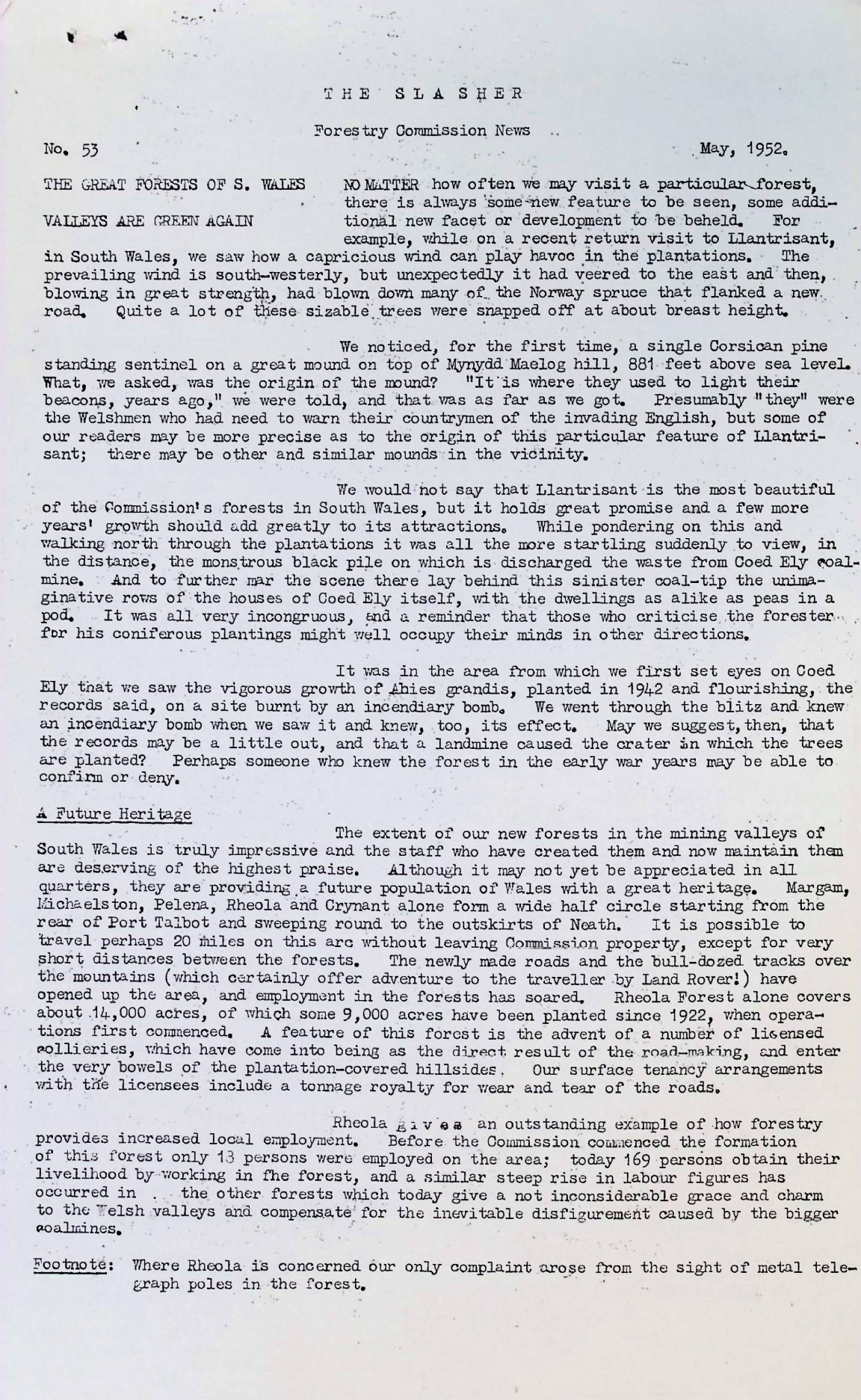
The Great Forests of South Wales - Valleys are Green Again
An article on the forests of South Wales including the havoc caused by the wind on the plantations of Llantrisant; the possible origin of Mynydd Maelog Hill; Coed Ely and the Abies grandis planted in 1942; Margam; Michaelston; Pelena; Rheola; Crynant.
Forest's 1,200 Tons of Timber a Week - Thetford Chase Described in New Booklet
A new booklet in the "Britain's Forests" series has been published which describes the forest of Thetford Chase. Situated in the Breckland district of East Anglia, it is the largest area of the Commission's plantations. With agricultural and other land, it extends to over 48,000 acres - more than 70 square miles around the towns of Thetford and Brandon, on the borders of Norfolk and Suffolk. It has been built up in 30 years on soils which have generally been regarded as "too poor for agriculture". The planting of Thetford Chase was begun in 1922, and there are now 33,000 acres of thriving plantations, mainly of pines, but including a fair proportion of beech, oak, larch and Douglas fir.
Nearly 600 people are employed in tending the forest and harvesting the timber crops, though the peak of production still lies ahead. Many miles of new roads have been driven through the young woods, and a new village has been built around the old church of Santon Downham to house the growing number of workers.
The original loose surface sands are no longer shifting, the better ground is under agriculture with sheltering belts of Scots pine, and the poorer ground carries the new forest plantations.
Lorries take the felled trees from Thetford Forest to the central Produce Depot just north of Brandon Station. Here, on 24 acres of land, a staff of about 75 deals with the conversion of the stems of the trees. The thinnest poles and the tops of the larger ones, are despatched to a wallboard factory; larger material for pulping is sent to a papermill in Kent. Much of the material is cut into pit props and sent to mines in the Midlands. Quantities of small, straight poles are sent to the pea-growing district of the Eastern Counties to make the tripods on which the crop is dried, and other poles are sold for scaffolding and other uses. A great deal of the smaller material is converted into fencing posts. Most of the poles are obtained by thinning young plantations only 20 to 30 years old, but some of the logs brought in are large enough for sawing into box boards. The proportion of logs large enough for the sawmills will increase, until ultimately the main output of Thetford Chase will be softwood timber suitable for house building and similar constructional work, boxes of all kinds, railway sleepers etc.
Birds and Bird Boxes - Good Use Made of "Pre-Fabs"
Every year since taking over at Ampthill Forest, in the East England Conservancy, Forester L.D. Ingram has put out a few more nesting boxes of varied construction for any species of bird that he thought might take to our "pre-fabs". Last summer he put out a specially designed large box to see if he could get a pair of wood owls or barn owls to nest in it for there had always been a pair of each about and he could never locate a nest. When passing the box during the fairly recent blizzard, Forester Ingram saw it contained two eggs and two newly hatched wood owls. Other birds nesting in Forester Ingram's boxes to date are: Blue, coal and great tits; house sparrow; wren; robins; spotted flycatcher; nuthatch; song thrush; blackbird.
Medallion in the Heart of a Tree - Strange Find in West Scotland
During the felling of some old beech trees at Barcaldine Forest, in the West Scotland Conservancy, a workman discovered a bronze medallion in the heart of a tree, a few feet from the butt. The Curator of the Archaeology Department of Glasgow Museum has reported that it commemorates David La Touche, a member of the famous banking family of Northern Ireland, who, apparently was the son of a refugee Huguenot who fought with William of Orange at the Battle of the Boyne. One side of the medallion bears the image of David La Touche and the other a group of allegorical figures, one of whom is a blind goddess holding the Scales of Justice. The inscription so far as can be made out, is Qui Dene Panea Meleus Dispensavit, which has been translated as "What he amassed with credit, he gave with distinction."
More About Cycling to Work - The Executive Officer's Marathon
Following last month's article on the longest daily journey to and from work, Clerical Officer W.C. Evans of the South Wales Conservancy, cycles a total of 24 miles each day from Monday to Friday. He does the 6 mile journey from Dinas Powys to the Cardiff Office four times daily and he goes home to lunch.
Forester R.P. Woollard, now in charge of Swanton Forest, in the East England Conservancy, once had a tedious daily "pilgrimage". At the time he was working in the nursery at Micheldever Forest, in South-East England, this is how he got to and from his work: Bishopstoke to Eastleigh by bus (1 mile); Eastleigh to Winchester by train (7 miles); Winchester to Micheldever by bicycle (9 miles); total daily return journey, 34 miles.
In 1939 Executive Officer J.L. Reid, of the Cardiff Office, cycled from Aberdeen to Gravesend, a distance of 580 miles, in five and a half days. He claims it was "easy going", but he lost 7 lbs. in weight.
Forest in Three Counties
Following an article in the March issue which listed counties without a Forestry Commission forest, a correspondent in the Cardiff Office states: "In the South Wales Conservancy, we have a forest - Hay - which is situated in three counties, Breconshire, Herefordshire and Radnorshire. Of these three counties, Brecon is the only one within the administrative boundary of this Conservancy, Radnorshire being covered by North Wales and Herefordshire by South West England."
We don’t think this three-county location claim is unique. What about Clipstone Forest in the North West England Conservancy, for instance?
Honour For Hockey Player - May Take Part in Olympic Games
District Officer W.A. Lindsay-Smith, who is stationed at Bettws-y-Coed, in the North Wales Conservancy, and plays hockey for Wales, has been invited as one of 22 hockey players to go to Lilleshall to take part in the final selection of 16 players to represent Great Britain in this year's Olympic Games at Helsinki. He recently married Miss Eirwin Lloyd Jones of Ruthin.
Some Quaint Words
Some quaint words on a list of stores (A64) are: SLIPE (a sledge, with iron runners used on land unsuitable for wheeled vehicles); DWANG (chain or cable, especially useful for securing a load of timber on a lorry); GRAIP (a fork, e.g. a potato graip.); WHIPPLETREE sometimes known as SWINGLETREE (the part of a horse harness which prevents the traces from twisting).
Buzzards
Following last month's report that Foreman A.G. John of Chepstow, had seen of a flock of nine buzzards, Sir William Taylor writes to say that on one occasion, when walking near Llandovery, he saw eleven buzzards in the air together. "It was a memorable sight", says Sir William.
Whence the White Stag? - Unusual Visitor to Wyre
Occasionally a white stag has been seen in the vicinity of Wyre Forest, in the South West England Conservancy, and instructions have been given that should it be encountered during any deer shoots, it must be spared. There has been much speculation as to the origin of this stag, and it was once thought that it may have come from a herd of white deer at Brockhampton Park in the Cotswolds. District Officer I.F. MacIver informs us, however, that during a visit to Spetchley Park, near Worcester, he learned that there are two herds of deer on that estate - one white and the other red; it is probable, therefore, that our white stag may be a "sport".
Newcomers
Executive Officer Miss V.E. Williams to D(E);
Executive Officer Mrs. I. Clelland to W(S);
Clerical Officer Miss M.D.E. Williams to Dean;
Clerical Officer Miss F.E. Catto to E(S);
Clerical Officer Miss G.M. Rogers to Research;
Clerical Officer Miss D.J. Cox to NW(E);
Clerical Officer A.D. McKenzie to D(S);
Clerical Officer D.A. Connell to H.Q.
Transfers
Forester George Broomfield from New Forest to take charge of a hardwood area NE(E);
District Officer F.W. Lindsay from Farnham, SE(E) to Woking, SE(E);
District Officer G.A. Dey from Auchenblae, E(S) to Laurencekirk, E(S);
District Officer A.W.L. Guile from Isle of Wight, New, to Bristol, SW(E);
Forester T.G. Saunders from Tintern, S(W) to Monmouth, S(W);
Foreman H.G. Muggleton from Kings, E(E) to Thetford Chase, E(E);
Foreman J. Soppit from Blackcraig, E(S) to Strathord, E(S);
Foreman H. MacBeth from Millbuie, N(S) to Strathnairn, N(S);
Clerk of Works A.A. Ward from South Strome, N(S) to Queens, N(S);
Clerk of Works D.L. Bayne from Loch Ard, W(S) to Kershope NW(E);
Executive Officer Miss D.M. Frost from D(E) to H.Q.;
Clerical Officer G. Morgan from H.Q. to Cardiff, S(W).
Leaver
F.D. Lawson, Cost Accountant at Headquarters since May, 1948 has left the Commission.
Marriages
Forester W.G. Williams, Cwmeinion Forest, North Wales, married Miss G.M. Evans, of Eglwysfach, Cardigan.
Land Agent S.A. Simmonds, New Forest, married Miss Molly Miller.
Birth
A daughter, Jane was born to Forester G.E. Waygood, Chepstow Park and Mrs Waygood.
Obituary
Ganger G.H. Llewellyn, Llanover Forest, South Wales, who joined the Commission in 1938 has died suddenly, aged 52.