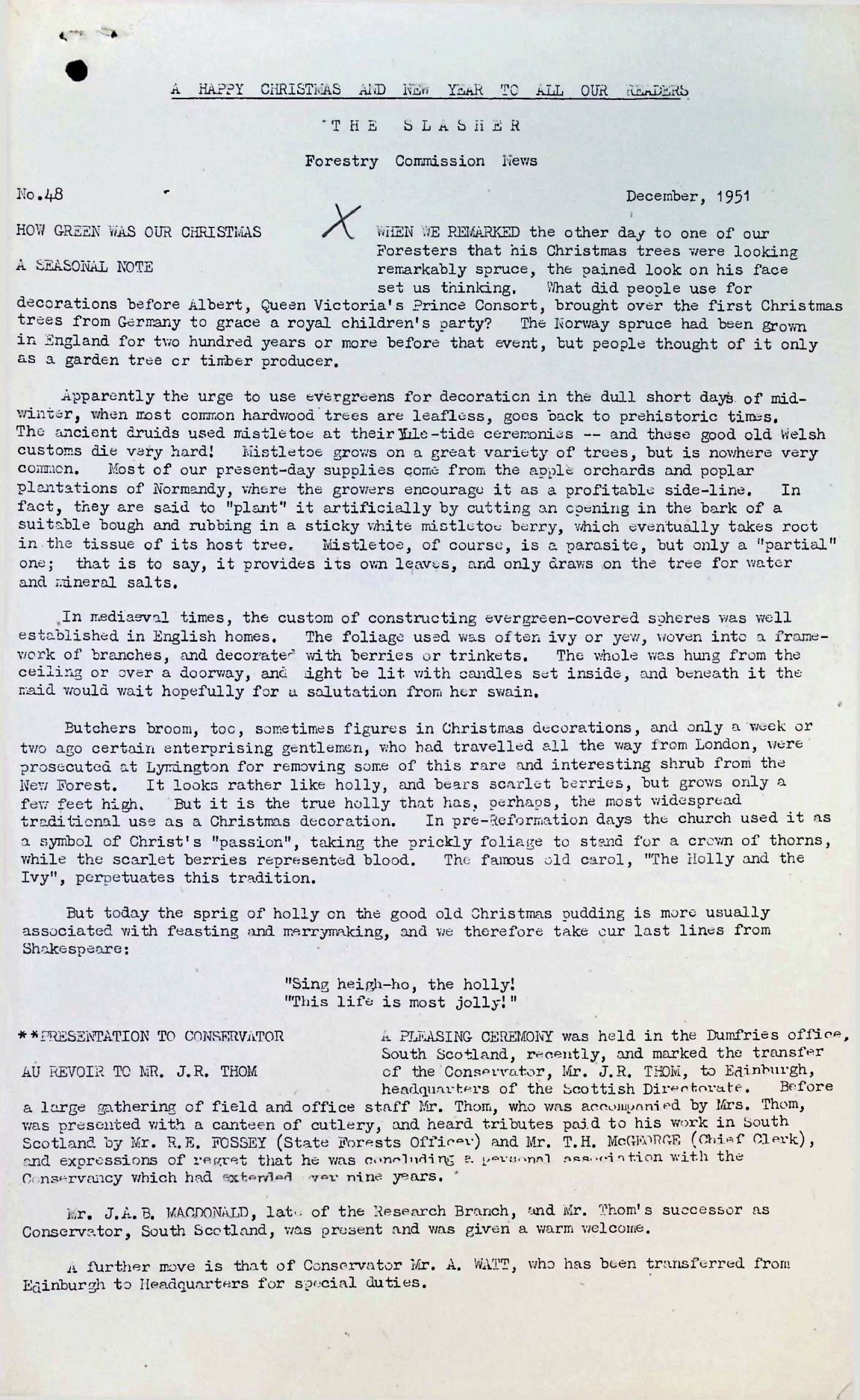
Slasher Magazine Summary: Publication No. 48 - December 1951
The scanned images of the Slasher were produced by and courtesy of the Forest Research Data and Information Team staff based at Roslin, where some of the original copies are located. The Forestry England Information Knowledge Management Team and New Forest Heritage made available copies of The Slasher from their collections. Brian Mahony of the FC Retirement Association devised and coordinates the Slasher Project and has been instrumental in locating many missing editions and coordinating the searches to locate all the earlier publication numbers.
The content summary below was again very kindly compiled by Diane Birkett, Bedfordshire. See PDF attachment link below the text summary to view the full document. A total of over 420 issues or publications were produced between January 1948 and the final publication in 2010.
How Green Was Our Christmas - A Seasonal Note
When we remarked the other day to one of our Foresters that his Christmas trees were looking remarkably spruce, the pained look on his face set us thinking. What did people use for decorations before Albert, Queen Victoria's Prince Consort, brought over the first Christmas trees from Germany to grace a royal children's party?
The Norway spruce had been grown in England for two hundred years or more before that event, but people thought of it only as a garden tree or timber producer.
Apparently the urge to use evergreens for decoration in the dull short days, of mid winter, when most common hardwood trees are leafless, goes back to prehistoric times.
The ancient druids used mistletoe at their Yule-tide ceremonies - and these good old Welsh customs die very hard! Mistletoe grows on a great variety of trees, but is nowhere very common. Most of our present-day supplies come from the apple orchards and poplar plantations of Normandy, where the growers encourage it as a profitable side-line. In fact, they are said to "plant'' it artificially by cutting an opening in the bark of a suitable bough and rubbing in a sticky white mistletoe berry, which eventually takes root in the tissue of its host tree. Mistletoe, of course, is a parasite, but only a "partial" one; that is to say, it provides its own leaves, and only draws on the tree for water and mineral salts.
In mediaeval times, the custom of constructing evergreen-covered spheres was well established in English homes. The foliage used was often ivy or yew, woven into a frame work of branches, and decorated with berries or trinkets. The whole was hung from the ceiling or over a doorway, and might be lit with candles set inside, and beneath it the maid would wait hopefully for a salutation from her swain.
Butchers broom, too, sometimes figures in Christmas decorations, and only a week or two ago certain enterprising gentlemen, who had travelled all the way from London, were prosecuted at Lymington for removing some of this rare and interesting shrub from the New Forest. It looks rather like holly, and bears scarlet berries, but grows only a few feet high. But it is the true holly that has, perhaps, the most widespread traditional use as a Christmas decoration. In pre-Reformation days, the church used it as a symbol of Christ's "passion", taking the prickly foliage to stand for a crown of thorns, while the scarlet berries represented blood. The famous old carol, "The Holly and the Ivy", perpetuates this tradition.
But today the sprig of holly on the good old Christmas pudding is more usually associated with feasting and merrymaking, and we therefore take our last lines from Shakespeare; "Sing heigh-ho, the holly! "This life is most jolly!"
Forest Worker and Mannequin - Meet Joan, The Model
Its a far cry from the forest to the mannequin parade, but to 21-year old Joan Tanner, of Cannock Chase (North West England Conservancy) the journey presents no obstacles. Joan, an attractive brunette, has worked in the nursery and woods of Cannock Chase since she was 15, but fashion modelling is her hobby, and on occasions in Birmingham she displays all kinds of clothes from beach wear to glamorous evening dress. She considers that her forestry work helps her to keep her figure - she is six feet tall - in trim. She has turned down an offer of employment as a professional mannequin at a tempting salary, and makes no secret of the fact that forestry is work she loves.
Bull-Fighting As One Reader Saw It
More details of bull-fighting and horses.
Verses by Forester C.D. Hollington of Cynwyd, North Wales.
You Are Old, Robert William
"You are old, Robert William," the trainee said,
"And your pension is almost in sight --
And yet you're obsessed by a consummate dread;
Do you think, at your age, it is right?"
"In my youth, when at school," the forester said,
"Without leave I stayed out late at night,
And I failed to return certain tools to the shed -
I'm not sure they've forgotten it - quite."
"You are old", said the youth, "one would hardly suppose
That your legs were as sturdy as ever;
Yet you kicked our new foreman right out of the door -
What made you so awfully clever?"
"In my youth," said Bob William, "I used a great spade,
Heart shaped, with one edge like a knife,
And the muscular strength it gave to my legs
Has lasted the rest of my life".
"You are old," said the youth, "As I mentioned before.
You are steadily losing your sight;
Yet you stand on your head to look under the door,
Do you think, at your age, it is right?"
"Forest Workers should be up the hill in the trees",
Replied Bob, "To commence work at eight,
So they crawl past my door on their hands and their knees,
And I peep out - to see who is late".
"You are old, Robert William", the trainee said,
"And your hair has become very white.
And yet you incessantly jump out of bed
Shouting Fire! in the dead of the night."
"In my youth", said Bob William, "A great forest fire
Gave rise to a dreadful commotion;
I started that fire, was first on the spot,
And that's how I got my promotion."
Presentation
A presentation was made in the Dumfries Office, South Scotland, to Conservator J.R. Thom on his transfer to Edinburgh, Headquarters of the Scottish Directorate. His successor, Mr. J.A.B. MacDonald, late of the Research Branch, attended the presentation.
Best Wishes For a Speedy Recovery
Best wishes for a speedy recovery to H.E.O. John Harper, of Headquarters, who at the time of writing is in hospital.
The Feathered Forester
The following reference to the jay, made in the correspondence columns of a Sunday newspaper and believed to be quoted from Professor Bier's book "Die Seele", may be of interest: -
"The jay carries away the acorns, one in his beak, the rest in his crop, and sticks them into the soil, or especially into pine needle carpets. He reforests evenly over the whole area at correct planting distances - sometimes in rows. He is the founder of our deciduous forests or, where they do not exist, he could be, if man would let him alone.
Of course, the jay sows the oak in order to consume its fruits - here showing a reciprocal action between plant and animal. In going about the building up of woods according to plan, no creature outside mankind approaches the jay. He even surpasses the human forester."
Transfers
Mr A. Watt, Conservator, Edinburgh, transferred to Headquarters for special duties.
H. Searle, District Officer, Princes Risborough, transferred to Santon Downham, E(E);
J.M. Bruce, Forester, Brandon, E(E), transferred to Gwydyr, N(W);
R.B. Gilson, Forester, Hope, NE(E) transferred to Wintringham, NE(E);
C.H. Heavener, Forester, Gwydyr School, transferred to Princes Risborough;
T.E. Daglish, Forester, Kielder, NE(E), transferred to Hamsterley, NE(E);
G.S. Dudley, Forester, Neroche, SW(E), transferred to Honiton, SW(E);
W.H. Morrill Forester, Allerston, NE(E), (Research), transferred to Hope, NE(E);
W.E. Dye, Forester, Duror, W(S), transferred to Fearnoch, W(S);
C.F. Featherstone, Forester, Allerston, NE(E), transferred to Ampleforth, NE(E);
P.H. Ainsworth, Forester, Kielder, NE(E), transferred to Knaresborough, NE(E);
J.A. Hendrie, Forester, Watlington, E(E), transferred to Kesteven, E(E);
T. Bewick, Forester, Hamsterley, transferred to Slaley, NE(E);
R.E. Young, Forester, Rosedale, NE(E), transferred to Kielder NE(E);
J.P. McRorie, Forester, Ardgartan, W(S), transferred to Glenrickard, W(S);
A.J. Tackney, Forester, Bodmin, SW(E), transferred to Halwill, SW(E);
E.H. Storer, Foremen, Beddgelert, N(W), transferred to Gwydyr;
R. Schofield, Foremen, Fineshade, E(E), transferred to Watlington E(E);
J.H. Watters, Assistant Engineer, Aberystwyth, transferred to Cardiff, S(W);
T. Cuthbert, Clerk of Works, Smales, NE(E), transferred to Rothbury, NE(E);
R.C. Meech, Clerk of Works, Coed-y-Brenin, N(W), transferred to Halwill, SW(E);
Appointments
J.D. Leefe, District Officer, Education;
R.G. Cathie, District Officer, E(S);
D.H. Wallace, District Officer to Director, Wales;
P.A.W. Overell, District Officer to Director, Wales;
J.A. Spencer, District Officer to Director, Wales;
F.W. Lindsay, District Officer, SE(E);
A.J. Spencer, District Officer, SE(E);
J.F. McGarva, District Officer, W(S) ;
T.C. Mitchell, District Officer, NE(E);
J. Kellie, District Officer, SW(E);
F.M. Macrae, District Officer, N(S);
C.W. Yeatman District Officer to Research;
E.M. Black, Assistant Engineer to Director, Scotland;
J.W. Mogford, Executive Officer, NW(E);
K.A. Netherwood, Clerical Officer, E(E);
E.B. Kimberley, Clerical Officer, SW(E);
T.M. Manser, Clerical Officer, N(W);
J.G. Barnes, Clerical Officer, New Forest.
Retired
W.H. Hamilton (Bill Hamilton), S.E.O. Headquarters, is retiring at the end of the month after joining the Commission in 1919. He served in the Finance Branch until 1939. In recent years he has been responsible for the purchase and distribution of seed.
Births
A daughter was born to Mrs Davies and Mr A.I. Davies, Head Forester, Clocaenog, North Wales.
A son was born to Mrs Peaty and Mr G.E. Peaty, District Officer of North Wales.
A daughter was born to Mrs Latham and Mr F.C.B. Latham, Executive Officer, Aberystwyth.
Obituary
D.S. Spraggan, District Officer, South Conservancy, Scotland, has died. After employment in private estate forestry he joined the Forestry Commission in 1920 as a Foreman at Glentress, South Scotland. He was promoted Forester the following year and in 1925 was transferred to Ardgartan, West Scotland. He became a District Officer in 1931 with a base at Stromeferry, North Scotland, later undertaking duties at Inverness for nearly three years from 1940. He was subsequently stationed at Fort Augustus and then, in July, 1949, he was transferred to the South Conservancy and placed in charge of a group of Border forests, making his home in Walkerburn, Peeblesshire. Despite ill-health, he worked until a fortnight before his death.