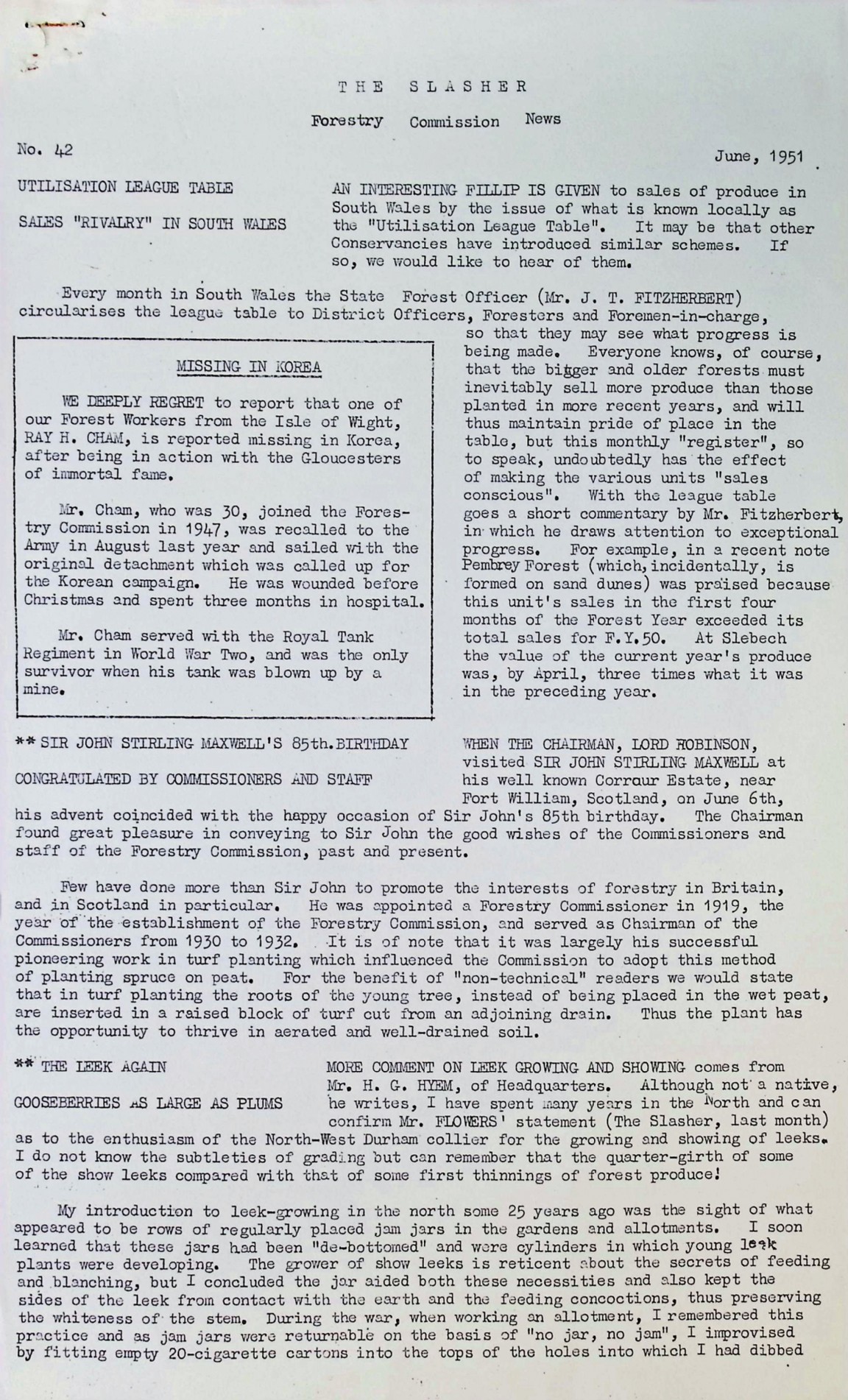
Slasher Magazine Summary: Publication No. 42 – June 1951
The scanned images of the Slasher were produced by and courtesy of the Forest Research Data and Information Team staff based at Roslin, where some of the original copies are located. The Forestry England Information Knowledge Management Team and New Forest Heritage made available copies of The Slasher from their collections. Brian Mahony of the FC Retirement Association devised and coordinates the Slasher Project and has been instrumental in locating many missing editions and coordinating the searches to locate all the earlier publication numbers.
The content summary below was again very kindly compiled by Diane Birkett, Bedfordshire. See PDF attachment link below the text summary to view the full document. A total of over 420 issues or publications were produced between January 1948 and the final publication in 2010.
Utilisation League Table
An interesting fillip is given to sales of produce in South Wales by the issue of what is known locally as the "Utilisation League Table". It may be that other Conservancies have introduced similar schemes. Every month in South Wales the State Forest Officer, Mr J.T. Fitzherbert, circularises the league table to District Officers, Foresters and Foremen-in-charge, so that they may see what progress is being made. Everyone knows, of course, that the bigger and older forests must inevitably sell more produce than those planted in more recent years, and will thus maintain pride of place in the table, but this monthly "register", undoubtedly has the effect of making the various units "sales conscious". With the league table goes a short commentary by Mr Fitzherbert, in which he draws attention to exceptional progress. For example, in a recent note Pembrey Forest, which, incidentally, is formed on sand dunes, was praised because this unit's sales in the first four months of the Forest Year exceeded its total sales for F.Y.50. At Slebech, the value of the current year's produce was, by April, three times what it was in the preceding year.
Missing in Korea
We deeply regret to report that one of our Forest Workers from the Isle of Wight, Ray H. Cham, is reported missing in Korea, after being in action with the Gloucesters of immortal fame. Mr Cham, aged 30, joined the Forestry Commission in 1947, was recalled to the Army in August last year and sailed with the original detachment which was called up for the Korean campaign. He was wounded before Christmas and spent three months in hospital.
Mr. Cham served with the Royal Tank Regiment in World War Two, and was the only survivor when his tank was blown up by a mine.
Sir John Stirling Maxwell’s 85th Birthday
"When the Chairman, Lord Robinson, visited Sir John Stirling Maxwell at his well known Corrour Estate, near Fort William, Scotland, on June 6th, his advent coincided with Sir John's 85th birthday.
Few have done more than Sir John to promote the interests of forestry in Britain, especially in Scotland. He was appointed a Forestry Commissioner in 1919, the year of the establishment of the Forestry Commission, and served as Chairman of the Commissioners from 1930 to 1932. It is of note that it was largely his successful pioneering work in turf planting which influenced the Commission to adopt this method of planting spruce on peat. For the benefit of "non-technical" readers we would state that in turf planting the roots of the young tree, instead of being placed in the wet peat, are inserted in a raised block of turf cut from an adjoining drain. Thus the plant has the opportunity to thrive in aerated and well-drained soil.
The Leek Again - Gooseberries as Large as Plums
More comment on leek growing and showing comes from Mr H.G. Hyem, of Headquarters. Although not a native, he has spent many years in the North and can confirm Mr Flowers' statement (The Slasher, last month) as to the enthusiasm of the North West Durham collier for the growing and showing of leeks. He can remember that the quarter-girth of some of the show leeks compared with that of some first thinnings of forest produce.
He writes, "My introduction to leek-growing in the north some 25 years ago was the sight of what appeared to be rows of regularly placed jam jars in the gardens and allotments. I soon learned that these jars had been "de-bottomed" and were cylinders in which young leek plants were developing. The grower of show leeks is reticent about the secrets of feeding and blanching, but I concluded the jar aided both these necessities and also kept the sides of the leek from contact with the earth and the feeding concoctions, thus preserving the whiteness of the stem. During the war, when working an allotment, I remembered this practice and as jam jars were returnable on the basis of "no jar, no jam", I improvised by fitting empty 20-cigarette cartons into the tops of the holes into which I had dibbed my leeks. Mine grew much larger than those of my neighbours, but were not comparable with the monster leeks grown in Durham.
"I can confirm what Mr Flowers has said about gooseberries; I have seen some as large as Victoria plums. One of these giant varieties bears the name of a local village, Winlaton. Near the date of a gooseberry show I saw that growers would protect their fruit by tying a small paper bag round each selected berry while still on the bush.
I was given to understand that the show berries were fed by capillary action from bowls of some sweetened liquid, but could never obtain confirmation or denial of this. Another local speciality was giant pansies, many of which attained the size of the palm of a man's hand."
On Top of the World - Trees Which Grow 1,726 ft Above Sea Level
In which forests do our plantations stand highest above sea level? On the very exposed Hospital Fell, in Thornthwaite Forest, in the English Lake District, trees are growing at the surprising height of 1,726 feet above sea level. Can you beat it?
We shall be pleased to publish details of any claims by foresters or others who believe they know of successful planting at any higher level. In fact, we shall be glad to hear of any forest with woods growing satisfactorily at a greater height than 1,500 feet. For the record, please include, if possible, the number of the compartment and a note of its position on the map, the year of planting, and the kind of tree. This will show which species can thrive at dizzy heights; and even if your wood is not the highest of all, it may hold a record for its particular species.
Down in the Forest - Office Staff See The Plantations
Following a series of lectures, the staff of the Glasgow Office, West Scotland Conservancy, recently visited Ardgartan, Glenbranter and Strathlachlan forests. The party travelled by bus via "the bonny banks of Loch Lomond" and on arrival at the first named forest were shown round by the Conservator, Mr J.E. James, and District Officer S.M. Petrie.
A packed lunch was partaken at Glenbranter Camp, after which a visit was made to the new Swedish houses, a new forest road and the mechanical repair depot. In Glenbranter Forest, extraction by ropeway was demonstrated and witnessed with great interest, so much so that most of the party climbed the hill to see the operating winch.
At Strathlachlan, the division of land between forestry and agriculture was explained by District Officer Petrie. The return journey was made via Helensburgh, where there was a halt for tea.
The Persistent Robins
This is the story of Mr and Mrs Robin, who just wouldn't give up building their home despite trials and tribulations which would make human difficulties pale into insignificance.
Forester T.E. Little tells us that Tractor Driver W.W. Howitt, of Slebech Forest, South Wales, discovered the foundations of a robins' nest between the tractor radiator and guard grid. These foundations he removed on three consecutive mornings; then the weekend intervened, and on Monday morning it was found that the building had begun all over again. It was therefore decided to reward the robins' persistency by permitting them to carry on with the good work, but because the tractor was out each day, building hours were restricted to 5pm to 8am the following morning. Nevertheless, the nest is now complete and the local staff is awaiting further developments with great interest.
Thoughts on Soil Erosion
Divisional Officer G.E. Godwin, North Wales, writes apropos our recent story of the wise Indian who deplored the misuse of the land. "I am reminded of another incident," writes Mr Godwin. "This was in Dakota, when large-scale cultivation and neglect of precautions against erosion led to dust-bowls and the loss of large areas of farmland. In the early days, when the first white man drew the first furrow with his plough, he was watched by an Indian, who turned away with the cryptic comment: "Wrong side up".
A New National Forest Park - Fourth To Be Formed in Scotland
Another National Forest Park is to be formed by the Department in Scotland, this time in the Loch Ard area, in The Trossachs, where we hold some 37,000 acres. This will be the fourth National Forest Park to be established north of the Border, those already formed being Argyll, Glen Trool and Glen More. The actual boundaries have not been defined yet, but it is hoped that definition will take place in the near future and that a start will be possible on the provision of the usual facilities. The normal procedure is for the Commission, in developing National Forest Parks, to improve roads and footpaths, provide camping sites and co-operate with such bodies as the Youth Hostels Association in providing accommodation.
On Logs For Firewood
Here is an old traditional rhyme which, it is thought, originated in Yorkshire.
Firewood Logs
Beechwood fires are bright and clear
If the logs are kept a year;
Chestnut is only good they say
If for long its laid away.
Birch and Fir logs burn too fast,
Blaze up bright and do not last.
It is by the Irish said
Hawthorn bakes the sweetest bread,
Elmwood burns like churchyard mould,
Even the very flames are cold.
Poplar gives a bitter smoke
Fills your eyes and makes you choke;
Applewood will fill your room
With an incense-like perfume;
Oaken logs, if dry and old
Keep away the winter's cold.
But Ash wet, or ash dry -
A King shall warm his slippers by.
Honour for Glentress Footballers
The football team at Glentress Forester Training School was in the news again recently by virtue of the fact that two of its stalwarts, J. Christie and W. Duggie were selected to play for Peeblesshire Amateur League in an interleague game. Both players gave a good account of themselves.
Big Trees at Eggesford
Forester E.C. Kibble, of Eggesford, South West England, has sent us some details of big trees in his forest. At Eggesford, he says, there is a Douglas fir which is 100 ft. tall, has a girth of 22 feet and a volume of 1,100 cu. ft. - 800 cu. ft. in the stem and 300 in the branches. One branch has a girth of 9 ft. 2 inches.
There are two other large trees at Eggesford. One, a Douglas, is 120 feet tall and has a girth of 16 feet; the other, a Sitka spruce, is 100 feet tall and has a girth of 11 feet 6 inches. Among the younger trees in the forest are some good Sitka, one of which, planted in 1922, is 102 feet tall; its girth is 4 feet 8 ins.
The Double Rainbow
When flying a sailplane on the Clwyd hills opposite Clocaenog Forest, North Wales, recently, Chief Research Officer M.V. Laurie had an impressive and unforgettable experience. "I had been reporting various data over a portable wireless," writes Mr Laurie, "to a party of meteorologists who were studying the structure of air currents over mountains, and had my head down in the cockpit, reading the instruments, when I was suddenly enveloped in a hail storm. I switched on my blind-flying instruments but momentarily lost control; after a 'sticky' moment or two, while I was being swept over the hill, I regained normal flight and set off towards what I reckoned was the edge of the storm.
"After some seven minutes flying in the turbulent gloom of the storm, I burst out of the side of it into the light of the evening sun. The scene was magnificent. The storm behind me was a great concave blue-black wall towering to an overhanging cornice some 15,000 feet overhead, and trailing white skirts below me near the ground. Against this background was the most brilliant double rainbow I have ever seen, forming two complete circles - completely circular rainbows can, of course, only be seen from the air. I had great pleasure in describing this magnificent scene over the radio to the poor 'met' people who were huddling over their theodolites in the thick of the storm some five miles away."
The Lamb and the Tractor
Here is an interesting story from South Wales. We make no attempt to answer the question which it posed, but the biologists among us may have something to say. Forester J.D. Watson, of Irfon Forest, writes: "While driving a tractor to the mountain top here, I had the unusual experience of being chased by a two to three-day-old lamb. Despite my gesticulations and those of my assistant, D.R. George, it caught us up; I stopped the tractor, whereupon the lamb sought to put its head under the rear of the machine and, in so doing, it became sullied with black grease. It allowed me to pick it up, and I pointed it towards its mother, who was some 50 yards away. The lamb, however, simply refused to leave the tractor, turning back to us again and again, and bleating incessantly. It was not until the mother raised sufficient courage to come closer that the lamb went reluctantly to her, looking longingly back at us as it did so.
"Do you think that as our tractor made quite a number of journeys along this particular route, there may have been some pre-natal influence, causing a kink in the small animal's mind?"
Honour
Head Forester W.G. Gray, who has received the British Empire Medal for outstanding work, appeared before the Forestry Commissioners during their May meeting to receive their congratulations. Head Forester Gray is in charge of Kennington Nursery, Oxford.
Presentation
In the Cardiff office recently, a presentation took place to Mr W.R. Doherty, Executive Officer, who has been transferred to Headquarters.
Transfers
E.S.B. Chapman, District Officer, Cambridge, transferred to Bourne, E(E);
J.F. Osmaston, District Officer, Parkend, Dean, transferred to Cambridge;
J.C. Harrison, District Officer, Cambridge, transferred to Santon Downham, E(E);
I. Brett, District Officer, Santon Downham, transferred to Beeston Regis, E(E);
F.J. Williams, Forester, Rheola, S(W), transferred to Draethen, S(W);
H.C. Field, Forester, Brandon, E(E), transferred to Swaffham, E(E);
F.A.L. Hytch, Forester, Dovey Corris, N(W), transferred to Glyngroes, N(W);
E. Fawcett, Forester, Slaley, NE(E), transferred to Londesborough, NE(E);
B. Keeler, Forester, Swaffham, transferred to Brandon;
A. Maxwell, Foreman, Twiglees, S(S), transferred to Ae, S(S);
C.S. Brown, Foreman, Hamsterley, NE(E), transferred to Tunstall, E(E).
D. J. Tickell, Assistant Engineer, York, transferred to Smales, NE(E).
E. Gower, H.E.O., Chester, transferred to Aberystwyth.
Appointments
D. G. Young, Foreman, S(S);
E.D. Blundell, E.O., S(W);
R. Rendle, E.O., Director, England;
G. A. Hickleston, E.O., NE(E);
H. Lloyd, Clerical Officer, N(W);
Mrs. G.E. Loveday, Clerical Officer, E(E);
E. Critchley, Clerical Officer, H.Q.;
Miss M.I. Newman, Clerical Officer, New;
Miss F. J. Osland, Clerical Officer, SW(E);
G. Stone, Clerical Officer, SW(E);
Mrs. D.J. Biggs, Clerical Officer, S(W).
Obituary
The death has occurred in tragic circumstances of Student Ronald Murray, a 23-year old student at Benmore Forester Training School, who died in Dunoon Hospital following an accident in which his motorcycle collided with a car in the vicinity of the School. He was the son of Forester R.G. Murray, of Eredine, Inverliever, Loch Awe, to whom we express our deepest sympathy. Ronald Murray, who had served in the Fleet Air Arm, had been employed in his father's forest. His passing is therefore keenly felt and deeply deplored not only by fellow students but by a wide circle of other friends.