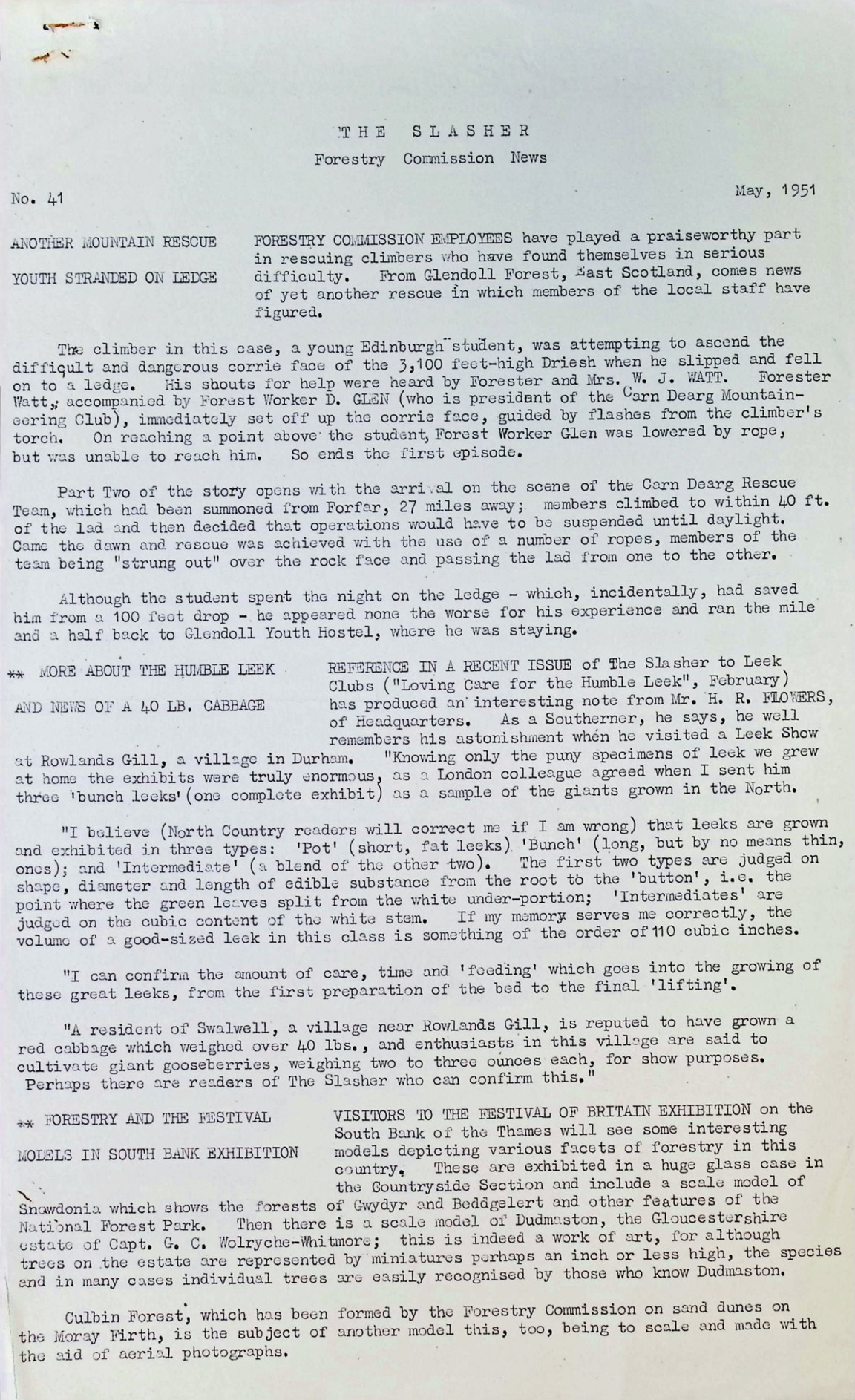
Slasher Magazine Summary: Publication No. 41 – May 1951
The scanned images of the Slasher were produced by and courtesy of the Forest Research Data and Information Team staff based at Roslin, where some of the original copies are located. The Forestry England Information Knowledge Management Team and New Forest Heritage made available copies of The Slasher from their collections. Brian Mahony of the FC Retirement Association devised and coordinates the Slasher Project and has been instrumental in locating many missing editions and coordinating the searches to locate all the earlier publication numbers.
The content summary below was again very kindly compiled by Diane Birkett, Bedfordshire. See PDF attachment link below the text summary to view the full document. A total of over 420 issues or publications were produced between January 1948 and the final publication in 2010.
Another Mountain Rescue
Forestry Commission employees have played a praiseworthy part in rescuing climbers who have found themselves in serious difficulty. From Glendoll Forest, East Scotland, comes news of yet another rescue in which members of the local staff have figured.
The climber in this case, a young Edinburgh student, was attempting to ascend the difficult and dangerous corrie face of the 3,100 feet high Driesh, when he slipped and fell onto a ledge. His shouts for help were heard by Forester and Mrs W.J. Watt. Forester Watt, accompanied by Forest Worker D. Glen (who is president of the Carn Dearg Mountaineering Club), immediately set off up the corrie face, guided by flashes from the climber's torch. On reaching a point above the student, Forest Worker Glen was lowered by rope, but was unable to reach him. So ends the first episode.
Part Two of the story opens with the arrival on the scene of the Carn Dearg Rescue Team, which had been summoned from Forfar, 27 miles away. Members climbed to within 40 ft of the lad and then decided that operations would have to be suspended until daylight. Came the dawn and rescue was achieved with the use of a number of ropes, members of the team being "strung out" over the rock face and passing the lad from one to the other.
Although the student spent the night on the ledge - which, incidentally, had saved him from a 100 feet drop - he appeared none the worse for his experience and ran the mile and a half back to Glendoll Youth Hostel, where he was staying.
More About the Humble Leek and a Cabbage
Reference in a recent issue of the Slasher to Leek Clubs ("Loving Care for the Humble Leek", February) has produced an interesting note from Mr H.R. Flowers, of Headquarters. As a Southerner, he says, he well remembers his astonishment when he visited a Leek Show at Rowlands Gill, a village in Durham. "Knowing only the puny specimens of leek we grew at home, the exhibits were truly enormous, as a London colleague agreed when I sent him three bunch leeks' (one complete exhibit) as a sample of the giants grown in the North.
"I believe (North Country readers will correct me if I am wrong) that leeks are grown and exhibited in three types: 'Pot' (short, fat leeks) 'Bunch' (long, but by no means thin, ones); and 'Intermediate' (a blend of the other two). The first two types are judged on shape, diameter and length of edible substance from the root to the 'button', i.e. the point where the green leaves split from the white under-portion; 'Intermediates are judged on the cubic content of the white stem. If my memory serves me correctly, the volume of a good-sized leek in this class is something of the order of 110 cubic inches.
"I can confirm the amount of care, time and 'feeding' which goes into the growing of these great leeks, from the first preparation of the bed to the final lifting.
"A resident of Swalwell, a village near Rowlands Gill, is reputed to have grown a red cabbage which weighed over 40 lbs., and enthusiasts in this village are said to cultivate giant gooseberries, weighing two to three ounces each, for show purposes."
Forestry and the Festival - Models in the South Bank Exhibition
Visitors to the festival of Britain exhibition on the South Bank of the Thames will see some interesting models depicting various facets of forestry in this country. These are exhibited in a huge glass case in the Countryside Section and include a scale model of Snowdonia which shows the forests of Gwydyr and Beddgelert and other features of the National Forest Park. Then there is a scale model of Dudmaston, the Gloucestershire estate of Capt. G.C. Wolryche-Whitmore; this is indeed a work of art, for although trees on the estate are represented by miniatures perhaps an inch or less high, the species, and in many cases individual trees, are easily recognised by those who know Dudmaston.
Culbin Forest, which has been formed by the Forestry Commission on sand dunes on the Moray Firth, is the subject of another model, this too being to scale and made with the aid of aerial photographs.
Kielder Forest, in Northumberland, and the forest village to be, are also depicted, together with a model forest tree nursery based on a section of Tair Onen, in South Wales. There are some intriguing models of an extraction scene, a sawmill, and a coalmine and paper mill.
Popularising the Poplar - International Commission's Meetings
The Department has been host to the International Poplar Commission, some 40 delegations from 13 overseas countries meeting here from April 25th to May 2nd.
The event meant a great deal of work for staff at the Forest Research Station, particularly for Forest Pathologist T.R. Peace, who organised the conference sessions and tour, and Chief Clerk E.C. Harper, who saw that the 'billeting' and other needs of the delegates were cared for.
This was the fifth meeting of the International Poplar Commission, earlier conferences having been held in France, Italy, Belgium and Holland, and Switzerland. Poplar is becoming increasingly important as a timber tree, due largely to the needs of the match-making industry; these annual meetings and tours permit an exchange of information on methods of cultivation and utilisation of poplar, and on poplar research, while the botanical classification of poplar is studied. This is necessary because of the great number of species and hybrids which are in commercial use.
In Britain the cultivation of poplar has not yet become general, but planting is being encouraged by the aid of grants. Delegates, however, saw enough of interest to make the tour well worth while, and among the Forestry Commission establishments visited were the Forest Research Station near Farnham, Surrey; the Research nursery at Rendlesham; Lynford Hall Forester Training School; the Poplar Garden in Yardley Chase Forest, near Northampton; and Kennington Nursery. The actual conference sessions were held in the Imperial Forestry Institute, Oxford.
The Woodland Census
A great deal has already been written about the Census of Woodlands which the Department undertook in 1947-49. A Summary Report of the Census has now been published in the form of a handy booklet priced at 6d. This booklet gives some interesting 'behind the scenes' information; for example, some idea of the magnitude of the task of surveying the woodlands of Britain (all woodlands of five acres and over were dealt with) can be gained from the fact that the number of separate stand cards used in the tabulations was just over 308,000.
The Census had two main objectives - to ascertain the size of the country’s forest estate and to map and classify it; and to obtain an estimate of the timber volume and increment of the woods, information which is essential to the purpose of regulating future felling. The private woodlands were covered by surveyors (male and female) who were specially recruited and trained, an average of 40 being employed throughout the Census. Every block of woodland was visited, sub-divided as necessary into its component stands of uniform type as regards age, species, etc., the stand boundaries mapped and the particulars recorded on field forms devised so as to involve the minimum of writing. The data from these forms were later coded and transferred to punched cards for mechanical sorting and tabulation.
The Census disclosed a total area of actual and potential woodland in Britain of 3,448,362 acres. Small woods of under five acres are estimated to amount to 187,000 acres, bringing the grand total to 5.64 million acres, this being equivalent to about 6.5 per cent of the total land surface. This means that by comparison, Britain has the smallest forest area of almost any country in Europe; small and well populated countries such as Denmark (9.3 per cent) and Belgium (18.4 per cent) have a higher proportion of land under woodlands.
The Summary Report focusses attention on the great area of woodland which unhappily must be classified as felled, devastated or scrub.
Oddities: The Girl at the Tube Station
What is the oddest thing you have ever seen, or your quaintest experience? The other day, standing nonchalantly outside a Tube station in London, we saw a pretty, immaculately clad girl. Her clothes were fashionable and obviously expensive, and her nylons were sheer luxury - but she wore no shoes.
Not long ago, one of our Officers saw a man walking with a stick across Victoria Station, carrying a wooden leg under his arm; and another member of the Commission staff noticed a man crossing Piccadilly Circus with a grey African parrot perched on his shoulder.
The Forest Showpiece - Reminder of Wartime Timber Needs
Many have gazed with admiration at a magnificent stand of European larch mixed with oak and beech, at Whitestone, Tintern, South Wales; few know how fortunate is the Commission to have the larch as part of this forest show-piece.
Here is the story. During the war the Conservator was asked to provide the authorities with poles from 36 trees, each pole being at least 90 ft. long and 14 inches square at the butt, for use in the construction .of a temporary crossing over the Severn should Gloucester Bridge, which is vital to road communications to South Wales, be blitzed. It was proposed that the poles should be kept by the bridge so that no time would be lost in the event of a replacement being necessary. Thus 12 of the larch at Whitestone, and others at Highmeadow and in The Dean, were marked for felling; but, happily, a compromise was effected whereby the trees remained standing on the guarantee of the Conservator that, on request, he would have them at Gloucester within 24 hours of receiving an 'S.O.S.'
And so the stately larches remain at Whitestone as a reminder of what might have been, and as silent testimony to the great need of timber in war.
Help For Fire Victims
Forestry Commission Employees in North Wales contributed more than £134 to the Fire Relief Fund opened on behalf of victims of the recent fire at Glyn-ceiriog, Denbighshire. Readers will recall that in this blaze one of our Forest Workers lost his cottage and all his belongings, and his father-in-law lost his life. The home of another Forest Worker was also gutted.
In addition to subscriptions sent through the fund the victims also benefitted from cheques sent by Lord Robinson from the Chairman’s Fund.
The Biggest Officer in the Commission?
Who is the biggest Officer or employee in the Forestry Commission? District Officer J.H. James, of South Wales, is 6ft. 4½ ins. tall, 44 inches round the chest, and weighs 18 stone 3 lb. District Officer James, incidentally, is a rugby enthusiast, and has played for the R.A.F. and Bangor.
Another Nature Note – The Kite and the Buzzard
While on the summit of the new Cwm Irfon Forest, near Llanwntyd Wells, Breconshire, District Officer C. West and Forester J.D. Watson were recently able to study the kite at close range, "It was a clear day", writes District Officer West, "and we were 1,600 ft. up. The bird came close enough for us to have an absolutely detailed view of its distinctly reddish and much-forked tail, and dark stripes underneath. We were remarking that the kite is more graceful than the buzzard when one of the latter species came into
view, circling nearer and nearer to the kite. Then, for a full three minutes, we watched the two birds and were able to study their contrasting features - the buzzard, with its rounder wing-tips, looking a little clumsy by comparison with the 'streamlined' kite.
"This is, of course, kite country", ends District Officer West, "but I never expected to obtain such an excellent view. Such moments remain in the memory and are compensation when one sighs for the 'easier-trod' forests of south and south east England!"
Shades of Sir Isaak Walton!
Not long ago we described how a certain Forester's dog retrieved fish caught by its master. We mentioned the landing of one fish in particular, "a good sewin", And now several readers have asked us what a sewin is. It is a fish "of the salmon tribe" (Salmo Cambricus) or, in other words, a bull trout which is to be found in Welsh waters.
Have You Made a Will - A Tip From Establishments Section
The following suggestion emanates from Establishments Section at Headquarters: If you have not already made a Will, then you should do so without delay.
In the event of death, the existence of a Will makes things much easier for a man's legal personal representative (usually his wife), for the formalities involved in settling the estate are automatically speeded up. Yet if there is no will, and monies in excess of £100 are due from the Department to, say, the widow, then she has to obtain Probate or Letters of Administration (or, in Scotland, similar documents), before the cash can be paid over. The Establishment Section suggests that each one of us should see that "our house is in order," and so obviate at least some worry and distress which might unfortunately one day be the lot of the legal personal representative.
Presentations
Braving the inclement weather, the staff and students of Glentress Forester Training School were recently to be seen facing the camera. The photograph was to mark the occasion of a presentation to Mr N.W. Tulloch, who has been appointed Chief Instructor at Lynford Hall School, East Anglia. Mr Tulloch was at Glentress from its opening shortly after the war, and will be missed by many friends.
A presentation has been made to Mr Walter Evans on the occasion of his transfer from Cardiff to Headquarters.
Footnote on T. Penny
In our last issue, we stated that Mr T. Penny was promoted to Forester in 1928. The date should have been 1938. We regret the slip, more especially as, this month, we had intended virtuously and possibly a little smugly to close with: "INFORMATION" is the dissemination of fact with tact.
Transfers
D. Grant, District Officer, E(E), transferred to Princes Risborough;
T.V. Dent, District Officer, Cambridge, transferred to Lincoln;
J.H. James, District Officer, Cardiff, transferred to Monmouth;
H. Searle, District Officer, Brackley, E(E), transferred to Princes Risborough;
P.H. Legard, District Officer, Newton Stewart, S(S), transferred to Edinburgh;
A.W.L. Guile, District Officer, Bristol, transferred to Isle Of Wight;
F.J. Donald, District Officer, Laurencekirk, E(S), transferred to Edzell, E(S);
W.E. Jones, Forester, Coed Sarnau, N(W), transferred to Crychan, S(W);
T. Aston, Forester, Alice Holt, SE(E) , transferred to Challock, SE(E);
C. Powell, Forester, Hensol, S(W), transferred to Dunraven, S(W);
K.A. Heaton, Forester, Glen Duror, W(S), transferred to Torrie, W(S);
M. Jones, Forester, Hafren, N(W), transferred to Coed Sarnau;
L.G. Cross, Forester, Challock, transferred to Alice Holt;
D.A. Robertson, Forester, Glen Durar, transferred to Knapdale, W(S);
A.G. Pyman, Foreman, Andover, SE(E), transferred to Margam, SE(E)
A. Calder, Foreman, Knapdale, transferred to Loch Ard, W(S);
W.A.R. Houston, Foreman, Ae, S(S), transferred to Kirroughtree;
J.B. Stirrat, Foreman, Castle O'er, transferred to Wauchope;
E.B. Cordery, Foreman, Chiddingfold, SE(E), transferred to Lyminge, SE(E);
W. Ivison, Clerk Of Works, Hamsterley, NE(E), transferred to Bellingham, NE(E);
T. Cuthbert, Clerk Of Works, Harwood, NE(E), transferred to Smales, NE(E);
E.H. Bradford, S.E.O., Aberystwyth, transferred to Cardiff.
Appointments
J. Stirling, District Officer, W(S);
J. Beaton, Foreman, W(S);
J. McNair, Foreman, W(S);
J. MacDonald, Foreman, N(S);
T.A. Patience Foreman, N(S);
J.S. Maxtone, Foreman, S(S);
J.R. Grieve, Assistant Engineer, W(S);
W.S. Haynes, Assistant Engineer, Director, England;
R.C. Troke, Clerical Officer, New;
A.C.G. Berry, Clerical Officer, N(S);
R.T. Newton-Clare, Clerical Officer, SW(E);
J.H. Copland, Clerical Officer, S(S);
R. Ramage, Clerical Officer, E(E);
K.M. Grayson, Clerical Officer, NE(E);
P.G. Towers, Clerical Officer, Research.
Retired
Mr R.E. Hardwick has retired. He was one of the first employees when planting commenced at Radnor Forest, South Wales, in 1926.
Marriage
Forester R.W. Griffiths, of Newborough, Anglesey, North Wales, has married Miss Margaret Evans.
Births
A daughter, Deidre, was born to Mrs Williams and Mr R.J. Williams, Forester, Dovey Corris, North Wales.
A son was born to Mrs Deveria and Mr N. Deveria, Assistant Engineer, West Scotland.
Obituary
Charles Hurst, former Head Keeper in the New Forest has died aged 91. He started work in the forest at an early age and was later a Keeper at Ringwood for seven years under the old Office of Woods. He retired from the post of Head Keeper at Irons Hill aged 65, and had thus been a pensioner of the Department for more than a quarter of a century.