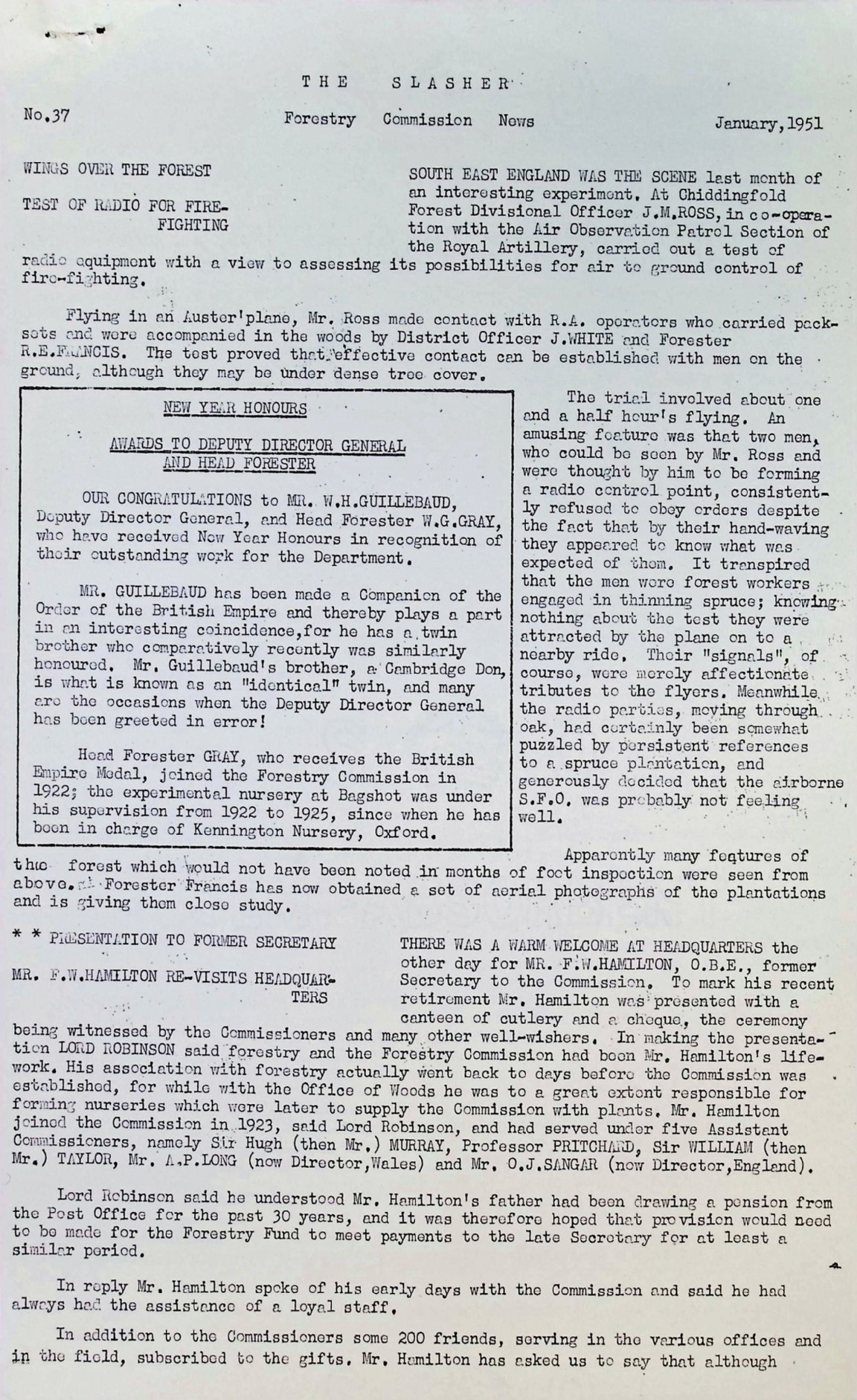
Slasher Magazine Summary: Publication No. 37 - January 1951
The scanned images of the Slasher were produced by and courtesy of the Forest Research Data and Information Team staff based at Roslin, where some of the original copies are located. The Forestry England Information Knowledge Management Team and New Forest Heritage made available copies of The Slasher from their collections. Brian Mahony of the FC Retirement Association devised and coordinates the Slasher Project and has been instrumental in locating many missing editions and coordinating the searches to locate all the earlier publication numbers.
The content summary below was again very kindly compiled by Diane Birkett, Bedfordshire. See PDF attachment link below the text summary to view the full document. A total of over 420 issues or publications were produced between January 1948 and the final publication in 2010.
Wings Over the Forest - Test of Radio for Fire-Fighting
South East England was the scene last month of an interesting experiment. At Chiddingfold Forest Divisional Officer J.M. Ross, in co-operation with the Air Observation Patrol Section of the Royal Artillery, carried out a test of radio equipment with a view to assessing its possibilities for air to ground control of fire-fighting.
Flying in an Auster plane, Mr Ross made contact with R.A. operators who carried pack sets and were accompanied in the woods by District Officer J. White and Forester R.E. Francis. The test proved that effective contact can be established with men on the ground; although they may be under dense tree cover.
The trial involved about one and a half hour's flying. An amusing feature was that two men, who could be seen by Mr Ross and were thought by him to be forming a radio control point, consistently refused to obey orders despite the fact that by their hand-waving they appeared to know what was expected of them. It transpired that the men were forest workers engaged in thinning spruce. Knowing nothing about the test, they were attracted by the plane onto a nearby ride. Their 'signals' of course, were merely affectionate tributes to the flyers. Meanwhile, the radio parties, moving through oak, had certainly been somewhat puzzled by persistent references to a spruce plantation, and generously decided that the airborne S.F.O. was probably not feeling well.
Apparently many features of the forest which would not have been noted in months of foot inspection, were seen from above. Forester Francis has now obtained a set of aerial photographs of the plantations and is giving them close study.
Presentation to Former Secretary - Mr F.W. Hamilton Re-visits Headquarters
There was a warm welcome at headquarters the other day for Mr F.W. Hamilton O.B.E., former Secretary to the Commission. To mark his recent retirement Mr Hamilton was presented with a canteen of cutlery and a cheque, the ceremony being witnessed by the Commissioners and many other well-wishers. In making the presentation, Lord Robinson said forestry and the Forestry Commission had been Mr Hamilton's lifework. His association with forestry actually went back to days before the Commission was established, for while with the Office of Woods he was to a great extent responsible for forming nurseries which were later to supply the Commission with plants.
Mr Hamilton joined the Commission in 1923, said Lord Robinson, and had served under five Assistant Commissioners, namely Sir Hugh (then Mr) Murray, Professor Pritchard, Sir William (then Mr) Taylor, Mr A.P. Long (now Director, Wales) and Mr O.J. Sangar (now Director, England).
Lord Robinson said he understood Mr Hamilton's father had been drawing a pension from the Post Office for the past 30 years, and it was therefore hoped that provision would need to be made for the Forestry Fund to meet payments to the late Secretary for at least a similar period.
In reply Mr Hamilton spoke of his early days with the Commission and said he had always had the assistance of a loyal staff.
In addition to the Commissioners, some 200 friends, serving in the various offices and in the field, subscribed to the gifts.
Mr Hamilton has asked us to say that although obviously he cannot write to each individual, he is deeply indebted and grateful to all who have wished him well.
Upgrading of Posts
A number of changes in the grading of certain posts in the Executive Class have recently been made. Those include the upgrading of the posts of Chief Clerk in all three countries and those of Chief Clerks in Conservancy Offices.
Mr G. Childs, hitherto at the Office of Director, Scotland, moves to Aberystwyth as Chief Clerk, while at Headquarters Mr W.E. Coggins has been promoted from Senior Executive Officer to Principal and Mr A.D. Palmer from S.E.O. to the post of Deputy Establishment Officer, with the rank of Chief Executive Officer.
Flying Saucers are Meteorites - An Opinion from Headquarters
There are no such things as flying saucers, this is the view of Mr P.J. Jooste, a Messenger at Headquarters, who is a member of the British Astronomical Association and secretary of the Astro-Physical Group of the International Short Wave League; members of the Group are concerned with the investigation of radio and astronomical phenomena.
Mr Jooste carries out research work from his home in London and uses a radio-telescope which enables him to locate sources of radio energy as far distant as the Milky Way.
"My theory" he says, "is that flying saucers are nothing more or less than meteorites. I have observed a number of these objects, sometimes with the naked eye and often with the radio telescope. Their appearance depends upon their height; they can usually be seen when as high as 80 miles above the earth, and then their speed is in the neighbourhood of 60 miles per second. As they travel in the earth's atmosphere, their speed diminishes and friction causes the illumination of the particles of dust which are given off. Thus there is an incandescence which could be credited with forming the 'flaming exhaust' of the power units of the 'saucers'.
"Several of the meteorites I have seen could have been mistaken for 'saucers’. Some, when low in the sky have, in fact, emitted sound in the form of a hiss and have left vapour trails not unlike those formed by an aeroplane engine. I have seen several explode in mid air and then carry on flight as two or three separate meteorites; such instances could have given rise to reports that 'saucers' have been seen flying in formation.
"I have been making special enquiries regarding the 'saucer' seen over Brecon (The Slasher, last month), but to date I have received no information.
Occasionally, of course, meteorites strike the earth and explode, leaving a tremendous crater. The largest known is that made by a meteorite which fell in Siberia at the beginning of the present century and devastated many miles of forest."
For those who are interested in popular science, we would mention that some of the radio energy only now being recorded by Mr Jooste actually emanated from its source in the universe millions of years ago.
An Official Criticism - Armchair Critics Please Note
He who objects to what is proposed or written in the transaction of business should consider himself under an obligation to propose and execute something to be substituted; for every political measure is in the nature of an alternative, and is not to be pronounced good or bad, except as it is better or worse than some other equally definite course of proceeding which might be adopted instead of it. Moreover, the trouble of maturing an alternative is no more than a proper curb upon the indulgence of a spirit of crude criticism. From 'The Statesman', by Sir Henry Taylor.
She Met The Queen
At a recent parade which marked the disbandment of the Women's Land Army, Miss Kathleen Roberts, Forest Clerk at Friston, South East England, met the Queen and received a badge from Her Majesty in recognition of 10 years service in the W.L.A.
Miss Roberts' first job with the Commission was at Penrith; she was subsequently absorbed into H.T.P.D, as a timber measurer. There followed some training in the Dean before she eventually found herself at Grizedale, N.E. England, in some of "the most beautiful country in England"; she has since worked in a number of other localities and in Miss Roberts' own words, "the ten years were the happiest of my life, especially those actually spent in the woods."
Asked for 5 Cwt of Amanita Muscaria – Received Nearly a Ton
The Deputy Director General has received a letter of thanks from Dr J.W. Trevan, of the Wellcome
Physiological Research Laboratories, expressing "gratitude for the extreme keenness and efficiency of Forestry Commission officers" who collected for him large quantities of the fungus Amanita muscaria. Dr Trevan asked for an amount of not less than five hundredweight, but in fact received nearly a ton. A considerable quantity was brought by lorry from Lincolnshire, this being collected by Forester H. Adams and his staff.
Amanita muscaria is a bright scarlet fungus (toadstool) with white spots, and is most commonly found under birch. It sometimes appears in fanciful paintings as a pixie's seat. It is very poisonous. Dr Trevan required a supply for pharmacological research.
Alice, Where Art Thou?
The Research Branch occasionally have to explain that "Alice Holt" is the name, not of a girl friend, but of one of the Commission’s forests in Hampshire, But none has hitherto supposed that "Alice" was a real person. She was, but "she" was a man, and "her" real name was "Alfie". The usual explanation of the name has been that it is a corruption of "Alers Holt", meaning the "alder wood". But The Slasher’s special investigator now reports that Alice Holt was entered as "Alfiesholt" on the Close Rolls of 1242 A.D., which indicates that its original Anglo-Saxon name was "Aelfsiges Holt", or as we should say nowadays, "Alfie's Wood".
In the Public Eye - Nursery Seen By 30,000 Tourists
How many people, we wonder, really stop to look at what the Commission has been doing in the way of forming new forests for Britain.
Forester Alistair Cameron, of Strathyre Forest, West Scotland, has been busy finding out. It so happens that his nursery office overlooks a main tourist route into the Highlands, and in recent summers, the motor coach drivers have made a practice of halting beside the nursery in order to point out to their passengers the trim rows of spruce and pine.
By making a rough count of these coaches, and knowing the average number of people carried by each coach, Forester Cameron has estimated that no fewer than 30,000 coach tourists alone saw and heard something about his forest last summer. Knowing Strathyre, with its six miles of thriving plantations running down the glen, and fringing the shores of Loch Lubnaig, we feel sure they were favourably impressed.
The Festive Season
The South East England Conservancy party is planned for Saturday 27th January 1951 at the Cotteridge Hotel, Guildford Road, Woking. Tickets 4 shillings, available from Miss Cheale at the Woking Office.
There were a number of social events at Christmas and the New Year. The staff of the Office of Director, Scotland, and friends gathered in the Afton Hotel, Edinburgh, for the annual dance. About 90 were present and as is appropriate in Scotland, a raffle was held for a bottle of the "right stuff".
The Staff of Brechfa Forest, South Wales, held a dinner. There seems no doubt as to the success of the event, and it is hoped that a similar function will be held annually in future. The organisation was admirably carried out by the Mechanical Engineering Section. There were fears, however, that arrangements would be in vain, for during the day snow fell so heavily that the local bus proprietor called off his transport. The forest employees, however, were not to be outdone for they "chartered" a cattle lorry, cleaned it and replaced the cow-ties with seats, and arrived at the hotel only 20 minutes late. The company was entertained by local talent.
The staff of Fetteresso Forest, East Scotland, held a dance at Stonehaven. The arrangements were efficiently made by a committee of which Foreman G.B. Thow was secretary. The Grand March was led by Mrs Anderson, wife of Forester D. Anderson, of Fetteresso, and District Officer H.A. Maxwell.
At Headquarters the committee of the Inforesta Table Tennis Club organised a staff Christmas party and earned the thanks of all who took part. Lord Robinson made his room available and Mr B.R. Davies provided a Christmas tree from his own garden. About 80 attended, among them being Lord Robinson; Mr A.H. Gosling (Director General); Mr H.A. Turner (Secretary); and Mr V. Bates (Controller of Finance). A highlight of the evening was a cabaret in which seven males gave (with apologies to Shakespeare) their version of the seven ages of the female species. Other acts were also successful, and many people were left wondering who the new "girls" could be.
Proposing a toast to the Forestry Commission, at the Christmas Party and dinner held by the Director's Office at Aberystwyth, Mr Miles, a guest from the Ministry of Agriculture, said the Department was not only adept at growing trees but equally successful in producing wives. It should be explained that the speaker met his wife, formerly Miss Beattie, a C.O. in the Aberystwyth office, when both were resident in the Newlyn Hostel. The organisers, let by Miss Horsham, arranged a number of games.
The Christmas party for the staff of the office of Director, England, coincided with festivities at Headquarters. Some 80 guests were present at Cadogan Square. A Christmas tree was kindly presented by the Director, Mr O.J. Sangar, and the next day it was moved to a ward of St. George's Hospital.
There was much pleasure at the visit during the evening of the Director General and Mrs Gosling, and the secretary Mr Turner, who looked in from the party at Savile Row.
Unfortunately, that nightmare of organisers, the technical hitch, occurred during the proceedings and amplified music was prohibited. A portable gramophone was brough to the scene by Mrs Graham, who resides nearby.
While on the subject of the festive season and its attendant events, we would mention that the Commission supplied a number of trees at reasonable prices to various local authorities who wished to place them on public show. Cardiff, for example, obtained from the department, a fine Norway spruce some 56 feet tall. This came from Tintern Forest and its felling and transportation was carefully supervised by Head Forester A. Jones, who was no doubt relieved when the tree eventually arrived safely in the city.
Festivities started in good time in the New Forest. Despite adverse weather conditions, the annual party was well attended. Credit goes to Mr Harry Madden and his committee for some excellent organisation. The staff of the North Conservancy, Wales, had fun and games at the annual party at Shrewsbury.
News in Brief
An application for a felling licence sent to the Bristol office was accompanied by the following reason. "It is my belief that we have far too many trees on the estate, insofar as the carbon monoxide gas they give off at night cannot be conducive to good health. Certainly we all got up in the morning feeling very tired and listless."
Scores for the West Scotland Conservancy Office football team are: -
WS Conservancy scores first. 4-0 Pitfichie; 2-2 Pitfichie; 3-2 Alltcailleach; 2-4 Drumtochty; 1-1 Alltcailleach.
Chief Clerk J.P. Lenman has shown exceptional prowess at right back.
Birch Grows From a Chimney - Some More Unusual Sites
Last month we referred to the unusual site of a birch tree, which is growing from the side of an old windmill in East England. District Officer G. Hampson, of North Wales, tells us of two interesting sites in his territory. A birch about 6 ft high is growing from a tall chimney at Gwydyr Castle, the 16th century seat of the Wynn family.
Another unusual sight of tree growth is the ancient bridge in the Machno Valley. Until recently this carried a profuse natural regeneration of oak, ash, birch and rowan. Those people at the Ministry of Works who are responsible for ancient monuments feared that this growth might damage the masonry, and at their request we cut back the trees and poisoned them.
Those who have access to the New Naturalist book "Snowdonia" will see these sites and the growing trees, illustrated on pages 362 and 371.
New Year Honours
Mr W.H. Guillebaud, Deputy Director General, has been made a Companion of the Order of the British Empire. His identical twin brother, a Cambridge Don, was similarly honoured recently.
Head Forester W.G. Gray, received the British Empire Medal. He joined the Forestry Commission in 1922 and supervised the experimental nursery at Bagshot from 1922-1925, since when he has been in charge of Kennington Nursery, Oxford
Transfers
P.J. Langley, District Officer, Cambridge, E(E), transferred to Bellingham, NE(E);
J.E.A. Keen, District Officer, Woking, SE(E), transferred to Winchester, SE(E);
R.L. Baird, Forester, Langdale, NE(E), transferred to Allerston, NE(E);
G.W. Croft, Assistant Engineer, Chester, NE(E) transferred to Shifnal, NW(E);
W.M. Phillips, Assistant Engineer, Glenfinart, W(S), transferred to Knapdale, W(S);
Miss B.B. MacNiven, E.O., York, NE(E), transferred to Glasgow, W(S).
Appointments
B.D. Hughes, District Officer, N(W);
M. MacPherson, District Officer, W(S);
N. McBrown, District Officer, S(S);
D.T. Seal, District Officer, N(S);
R.W. Yates, Assistant Engineer, N(W);
K.J. Wharton, Senior Professional Accountant, Bristol;
E.G. Parker, Executive Officer, NE(E);
D.J. Jones, Clerical Officer, Cardiff;
T.J. Jones, Clerical Officer, Cardiff;
J. Cheyne, Clerical Officer, H.Q.;
A. Smith, Clerical Officer, H.Q.;
A.M. Johnston, Clerical Officer, Glasgow;
Miss M.M. Jones, Clerical Officer, Aberystwyth;
Miss M.P. Jones, Clerical Officer, Aberystwyth.
Marriages
Mr E. Jones, District Officer, South Wales Conservancy, married Miss Pat Kennea, a Clerical Officer on the Conservancy staff.
Mr John Matthews, Geneticist, Alice Holt, married Miss Marjorie Thompson, until recently his assistant at the Research Station.