Slasher Magazine Summary: Publication No. 27 - March 1950
The scanned images of the Slasher were produced by and courtesy of the Forest Research Data and Information Team staff based at Roslin, where some of the original copies are located. The Forestry England Information Knowledge Management Team and New Forest Heritage made available copies of The Slasher from their collections. Brian Mahony of the FC Retirement Association devised and coordinates the Slasher Project and has been instrumental in locating many missing editions and coordinating the searches to locate all the earlier publication numbers.
The content summary below was again very kindly compiled by Diane Birkett, Bedfordshire. See PDF attachment link below the text summary to view the full document. A total of over 420 issues or publications were produced between January 1948 and the final publication in 2010.
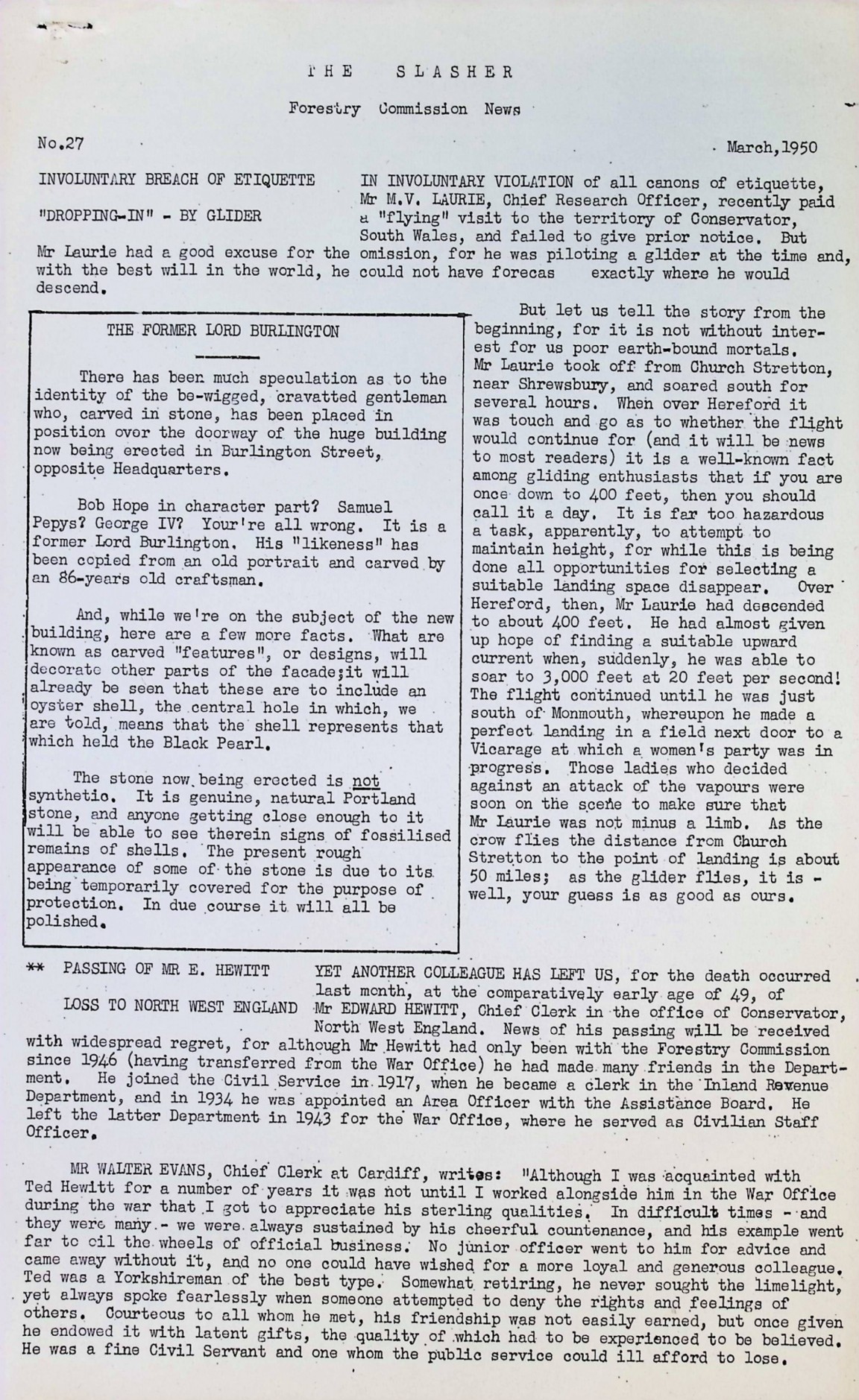
Involuntary Breach of Etiquette “Dropping-in” – By Glider
Mr M.V. Laurie, Chief Research Officer, recently paid a "flying" visit to the territory of Conservator, South Wales, and failed to give prior notice. But Mr Laurie had a good excuse for the omission, for he was piloting a glider at the time and he could not have forecast exactly where he would descend.
Mr Laurie took off from Church Stretton, near Shrewsbury, and soared south for several hours. When over Hereford it was touch and go as to whether the flight would continue, for when down to 400 feet, you should call it a day. It is far too hazardous a task, apparently, to attempt to maintain height, for while this is being done, all opportunities for selecting a suitable landing space disappear. Mr Laurie had descended to about 400 feet over Hereford and he had almost given up hope of finding a suitable upward current when, suddenly, he was able to soar to 3,000 feet at 20 feet per second! The flight continued until he was just south of Monmouth, whereupon he made a perfect landing in a field next to a Vicarage at which a women’s party was in progress.
The Former Lord Burlington
The be-wigged, cravatted gentleman who, carved in stone, has been placed in position over the doorway of the huge building now being erected in Burlington Street, opposite Headquarters is the former Lord Burlington. His 'likeness' has been copied from an old portrait and carved by an 86-year old craftsman.
Carved 'features', or designs, will decorate other parts of the façade, these include an oyster shell, the central hole in which means that the shell represents that which held the Black Pearl. The stone is not synthetic. It is genuine, natural Portland stone, and anyone getting close enough to it will be able to see therein signs of fossilised remains of shells. The present rough appearance of some of the stone is due to its being temporarily covered for the purpose of protection. In due course it will all be polished.
The Road Comes to Plashetts - An Isolated Village is Opened Up
With the construction of a Bailey Bridge over the North Tyne River, a new mile-long road to Plashetts Village, near Kielder, in North East England Conservancy, has been opened to traffic. Plashetts is to be the site of one of a number of complete forest villages which are to be built in the Border Country. About 100 new houses are expected to be built to augment the existing buildings.
Plashetts Village consists of two or three scattered farm houses, a Forester's house and seven Forest Workers Holdings, all in the vicinity of the railway station. In the old days, some coal-mining took place in the area and the abandoned mining village still stands a mile or more up the nearby hill. When the Forestry Commission took over the area, they renovated the houses near the station so that they might be used as homes for forest workers, but until recently there was no road connecting the community with the main road in the North Tyne Valley, one and a half miles away. For shopping, residents made a train journey to Bellingham, 16 miles away, or to Hawick, 25 miles distant. For forest operations, equipment had to be sent by train or hauled across the River Tyne by tractor when the water was low. Inspection of the forest entailed a three mile walk from Plashetts, and for fire protection the 2,500 acre plantations were largely dependent upon the forest staff of eight men. Outside help could only arrive on foot with a time lag of about three quarters of an hour.
By the construction of the road and the erection of the Bailey Bridge, the Engineer Branch has earned the thanks of Plashetts. For now tradesmen's vans from Hawick and Hexham call daily at the village. Labour, plants and materials can now be taken direct to the forest and help for fire-fighting is available in minutes.
Note on Nuthatches etc - Systematic Nest Building at Wareham
Foreman J.H. Styles, Research Branch, Kennington Nursery, South East England provides some interesting observations on the use of nesting boxes.
He says observations at Wareham Forest, Dorset, showed that due primarily to the disastrous fires of 1947-49, and to some extent to the sandy, heath-like conditions, all rules of nesting procedure were swept aside.
Coal tits were not using the nesting boxes provided because they preferred to rear their young in mouse runs in the ploughed furrows of the F.Y.35 plantings.
A pair of green woodpeckers built their nest at the base of a young Monterey pine (at ground level).
Nuthatches attacked pine shoot beetles and weevils for, like woodpeckers, they are able to locate the position of grubs under the bark and a sharp tap reveals the hidden food. An examination of the nest of one pair of nuthatches revealed that it weighed more than 15 ounces and consisted of some 3,800 separate flakes of material, involving a tremendous number of flights to and from the box during building operations.
The Owl in the Milk Churn
Divisional Officer W.A. Cadman, North Wales, writes with reference to reports in recent issues of The Slasher about birds being found drowned. He does not think the Tawny Owl found drowned in a milk churn was in search of water. Owls normally investigate holes, and a milk churn would be likely to attract because of its resemblance to a hollow tree. In the case of the Tawny Owl found drowned in the 400 gallon water tank (which contained 20 drowned birds), he thinks it is probable that this particular owl was attracted by the prospect of food, having spotted one or other of the corpses. It would be interesting if we could have an exact list of the other species which were drowned.
Community Centre for Llaneglwys - Big Day for a Welsh Hamlet
The first village hall to be built in Wales by the Forestry Commission has been opened at Llaneglwys, in the heart of Brecon Forest. District Officer A.W. Arends gives the details. Centuries ago, he writes, monks lived in what is now the Forester's house. Had they returned to the district in 1920 they would probably not have detected any major change in the locality, for Llaneglwys is buried deep in the Welsh countryside and at the end of the only road into the forest. In the 1920s the Forestry Commission afforested the area and provided six bungalows for the forest workers. Another six houses are being built. The Commission believed there was need for a hall at Llaneglwys, and a Nissen hut was brought from a disused Army camp many miles away and erected in the hamlet. In it were installed or built such amenities as Calor gas lighting, kitchen with cooking facilities, dance hall, stage, library, committee rooms and so on - all at Commission expense. A local Committee, under the chairmanship of Mr Millechamp, a local farmer, provided the furniture and curtains.
The hall has just been officially opened by Alderman Tudor Watkins, M.P. supported by Mr Gibson Watt (local Conservative candidate). Among those present were the Conservator, South Wales, Mr W.D. Russell; Divisional Officer J.T.L. Fitzherbert; District Officer S.J.C. West; District Officer Arends; Clerk of Works J.R. Gibbs; and Forester A.J. MacKenzie. The hall is leased to trustees at a nominal annual rent.
During the afternoon a presentation on behalf of former fellow workers was made to ex-Forest Worker Morgan, who has recently retired after being employed at Brecon since planting first commenced in 1926.
Transfers
W. Gilmour, Forester, Carradale, W(S), transferred to Loch Ard, W(S);
A. Calder, Forester, Devilla, W(S), transferred to Knapdale, W(S);
W.M. Phillips, Assistant Engineer, Edinburgh, transferred to Benmore, W(S);
W.H. Clarkson, Assistant Engineer, Dumfries, S(S), transferred to Aberdeen E(S);
J.W. Telford, Foreman, Redesdale, NE(S), transferred to Plashetts, NE(S);
R.O, Millett, Foreman, Dartmoor, SW(E), transferred to Cannock, NW(E);
B.G. Howland, Foreman, Research, Dean, transferred to Research, Wareham;
R.J. Reid, Foreman, Research, Bettws-y-Coed, N(W), transferred to Research, Dean.
Origin of Forest Terms Brash, Sheugh, Sned, etc.
Forester E.D. Fraser of Loch Ard, West Conservancy, Scotland, gives alternatives to the origin of certain terms as suggested by earlier correspondents.
BRASH: From the Anglo-Saxon BRECHAM or BRYTAN - brittle; or from the German BRECHAN - to break; or BARSCH - rough. Alternatively, the Dutch BRAAK or BRACKE means a tool for breaking flax or hemp and the latter word, in German, to clear of weeds.
Without going deeply into etymology it would appear possible that variations of the above could have developed into Brash, due to the considerable traffic of merchants and others between Scotland and the Low Countries in the 17th and 18th centuries. It would be interesting to discover the earliest known use of the term in connection with forestry, excluding its American employment to mean Tender - Brittle.
SHEUGH: A variation of the Anglo-Saxon SOUGH - a trench, ditch or drain. Normally used in southern Scotland and northern England. Plants laid in a trench would normally be "HEELED" in to make the soil firm.
SNED: Origin may be from the German SCHNEID - to cut, edge of a knife, etc. It is understood that the English SNAG, which means the same, is in general use in some parts of the country.
District Officer H.L. Edlin of Headquarters, who first opened the debate on the origin of forest terms, has a few words to say about SNEDDING. Foreman Rex, he says, who seeks the origin of the word "Snedding" (The Slasher, December, 1949), may be interested to know that this is the modern version of the Anglo-Saxon SNAEDAN - to cut or prune. It occurs in an old manuscript of St. Matthew's gospel, now in the Bodleian Library at Oxford, in the phrase: "Sume sneddun telgran of treowum" - "others cut branches off trees". So it is a good old English word which has been used by foresters for untold generations.
The Mighty Oak
District Officer Wilkins, South Wales, sent an extract from a contemporary record relating to an oak which was felled in 1810. It was known as the Gelenos Oak and stood about four miles from Newport in Monmouthshire. When felled, it yielded 2,426 cubic feet of sound timber and six tons of bark. It was bought standing for £405, and the purchaser had to pay £82 for labour for stripping, felling and converting. Five men were employed for 20 days in stripping bark and felling the tree, and after that a pair of sawyers, working six days a week, were five months cutting it up. But the bark realised £200 and the timber about £400."
Tractor Driver Injured
Eric Litt, a 24-year old Tractor Driver of Thornthwaite Forest, North West England, was badly hurt and taken to Keswick Hospital when the tractor overturned in the Dodd section after it struck an obstacle.
Case For Our Cartoonist
Divisional Officer W.A. Cadman, North Wales, wonders if there is a large accumulation of cases at Headquarters after staff are asked to make a case to send to Headquarters.
The Things We Smile About
A Conservancy office in England recently issued an official memorandum with the heading: "Sick Leave With Pay - W.L.A. Members". The Forester replied with the same heading, as follows: "The attached memo has been sent here in error, as no worker of this name is employed in this unit."
Extract from another memo: "I am informed by the Air Ministry that the under-mentioned R.A.F. Stations will not now be in a position to provide assistance in fire-lighting."
An extract from a London newspaper: "Forestry Commission men and police patrols are guarding Christmas trees from black market gangs. Some of the Commission men are patrolling in 'Q' cars to trap would-be thieves. A 24-hour guard is being maintained". And each 'Q' car, we suppose, was equipped with a wailing siren, and each 'C' man with a six-shooter.
Retired
Mr William Needham, Warrener at Laughton Forest, East England Conservancy, has retired after 24 years service with the Commission. He was presented with a gift by Forester H. Adams on behalf of his workmates.
Birth
A son was born to Mrs Stewart and Mr E.A. Stewart, Forester, Dallas, East Scotland.
Obituary
Mr Edward Hewitt, Chief Clerk in the office of Conservator, North West England, has died aged 49. He joined the Forestry Commission in 1946, after transferring from the War Office.
Download Large Version (1.7MB)
Groups: Forestry Commission staff magazines