Scottish Women’s Timber Corps article published in Journal of Royal Scottish Forestry Society
By: Jessica Evershed, Outreach and Learning Archivist at National Records of Scotland
Bio:
Jessica Evershed (BA Hons, Pg Dip) is an Outreach and Learning Archivist at the National Records of Scotland. She is also co-tutor of the University of Edinburgh’s College of Open Learning course ‘Scottish Handwriting: 1500-1700’ which teaches the skill of palaeography.
(This article in magazine and pictorial format appeared in the Journal of the Royal Scottish Forestry Society Volume 78 No 1 Spring 2024 and Jessica kindly passed on her article file to Forestry Memories).
INTRODUCTION
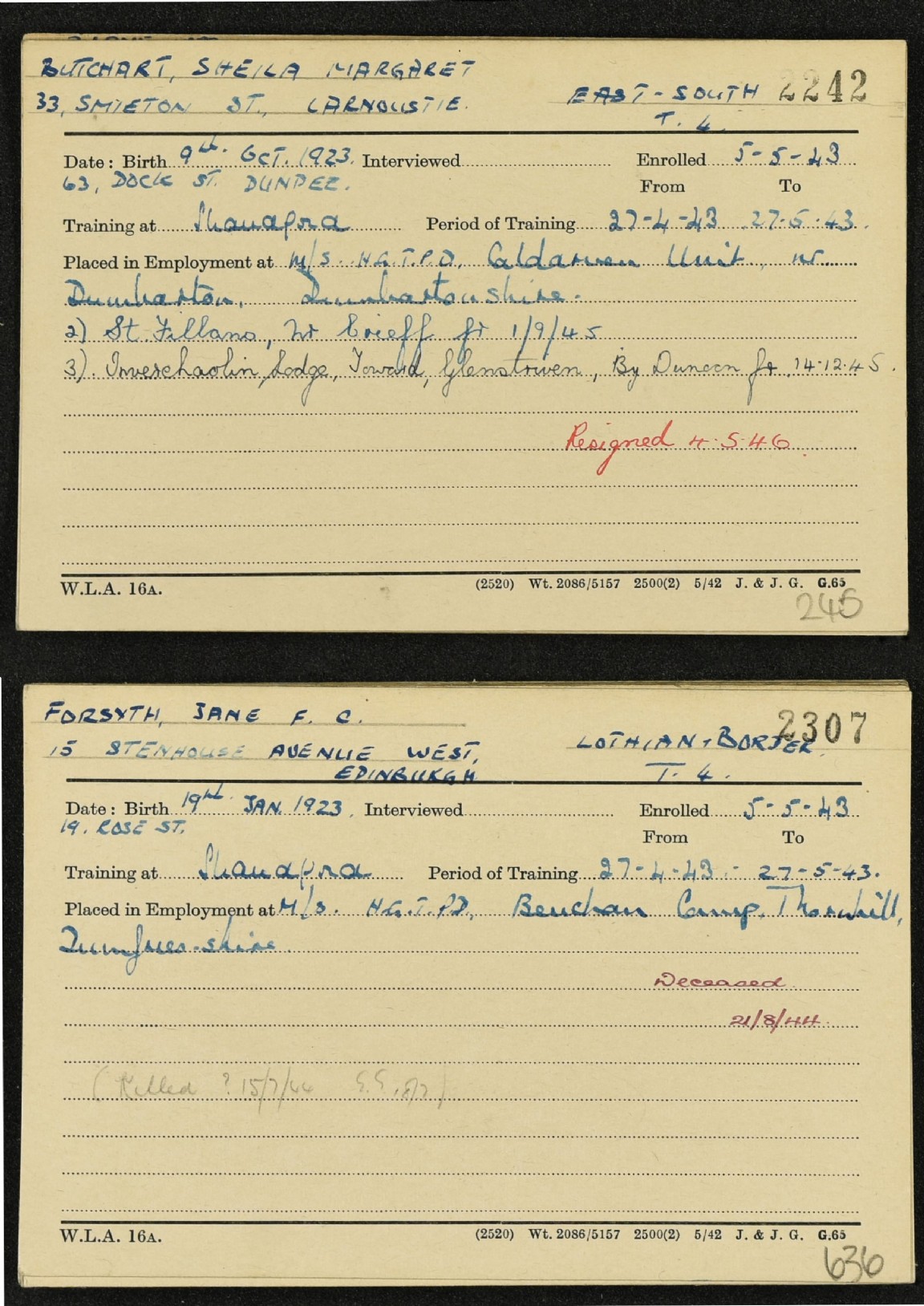
This article focuses on the experience of those who served in the Scottish Women's Timber Corps between 1942 and 1946. The staff index cards (examples in image above) of almost 10,000 women who served with the Women’s Timber Corps (WTC) and Scottish Women’s Land Army (SWLA) from 1939 to 1950 have been digitised and are now available online to search and view on the Scotlands People genealogy website. These records are a valuable source for tracing an individual's service and gaining a wider perspective on the work of the WTC and SWLA.
The Scottish Women’s Timber Corps (WTC), a separate section of the Scottish Women’s Land Army (SWLA), was created by the Ministry of Supply in May 1942. Both groups had the same objective: to reinforce the agricultural labour force who, specifically to replace those men who had joined the Armed Forces during the Second World War. Women had already begun to replace men in urban areas by taking positions in factories, utility services and high street stores. The women who volunteered for the WTC and SWLA played a vital role in the war effort and contributed to the production of food and kept vital industries supplied with timber during the war and its immediate aftermath.
BEGINNINGS
The SWLA was originally formed in 1917, originally named the Women National Service Volunteers. Its establishment was driven by two key factors: firstly, 1916 had seen the introduction of conscription for single men aged between 18 – 41, depleting the number of men able to work in the agricultural sector; secondly attacks on British merchant shipping in the Atlantic had led to food shortages and highlighted the necessity for home-grown provisions. The organisation survived the First World War and in 1919 became known as the Scottish Women’s Land Army. This predated the English and Welsh Land Army which was founded later in 1939.
With the outbreak of war in Europe appearing imminent, the SWLA was reactivated in 1939 under the control of the Ministerial Department of Agriculture for Scotland. Forestry work was originally part of the SWLA in the early stages of the Second World War. However, the work required specialist training and immense physical strength. Many recruits who had expected to be undertaking agricultural work became demoralised, as such, a separate Women’s Timber Corps was established in 1940.
Like the SWLA, the Women’s Timber Service can trace its origins back to the First World War, when it was founded by the Forestry Commission. The Women’s Timber Service was reactivated in 1940 under the name of the Women’s Timber Corps (WTC) and control of recruitment and training was passed to the Ministry of Supply. Quickly ‘Lumberjills’ were carrying out the work of ‘Lumberjacks’ in forests across Scotland.
The work of the WTC’s Lumberjills was vital: Britain was the world’s biggest timber importer and during the war was compelled to upscale British timber production. A reliable supply of wood was essential to the war effort: masts for shipbuilding, communication in the shape of telegraph poles, the production of aircraft, pit props for coal mining, railway sleepers and structures for military training all relied on huge quantities of the natural resource.
RECRUITMENT AND TRAINING
Women with varying experience and backgrounds volunteered for the WTC. The minimum age for recruitment was 17 years, but younger women managed to sign up unchallenged. In May 1942, training camps in Scotland were established to give instruction to new recruits who were initially given a month’s training (this was later extended to 6 weeks). Shandford Lodge, near Brechin (See Picture No 2608 on this website) and Park House near Banchory were both stately homes repurposed for WTC training camps. These buildings were emptied of their fine furnishings and saw thousands of keen volunteers filter through their doors in the coming years.
The work carried out by the WTC was considered skilled and psychically demanding compared with that of the ‘Land Girl’. A number of WTC posts also required mathematical competence, such as surveyors and measurers. These factors may have contributed to the wages paid to WTC being higher than their SWLA counterparts (i). The work was predominantly located deep in the forests of the Highlands, and the women took up placements many miles away from the diversions of a city or the comforts of home. The types of work carried out included tree felling, snedding (trimming the side shots and branches from a felled tree), cross-cutting, loading timber onto bogeys and the measuring of timber. This work was undertaken almost solely with hand tools, including large axes (often weighing 6lbs/2.7kg) and saws. Many of the workers succumbed to the physical demands of the work and resigned on medical grounds. This is reflected in the information recorded on the WTC index cards. A number of volunteers were turned away after training due to being “naturally slow showed no sign of being able to work faster” or deemed “unsuitable for outdoor work” and some left because they “did not like the work”.
ACCOMMODATION
Accommodation for WTC members consisted of purpose-built sectional wooden huts, which could accommodate between 20-30 volunteers, with a warden or staff member to support the women, but also to keep them in check and report any unsatisfactory behaviour. The common room was primarily used as a dining area (located next to the kitchen, see plan in attached PDF link below), but could also be used for games, dancing and singing.
This plan shows the wooden sectional huts built to accommodate Land Army workers, but was also used to board other workers, including WTC members. This hostel could accommodate up to 32 workers. Detail of plan dated 1942, National Records of Scotland, AF59/12/2.(SEE PLAN IMAGE IN PDF LINK BELOW)
This plan is of a SWLA purpose built hostel, but was probably also used to build accommodation for WTC workers. The entrance of the hostel leads into a ‘Blackout Lobby’, a must during wartime, and an area for wet ‘Boots & Macs’.
One of the sectional huts can be seen in Picture No 2364 on this website in the background of the photograph of Mary Low, WTC member originally from Portlethen, Aberdeenshire appears to be chopping wood for the wood burning stoves that heated the huts.
The WTC recruited across Scotland and the backgrounds, training and placements of WTC volunteers can be researched further by consulting the WTC index cards. These records give a flavour of each Lumberjills’ career, from initial interview to release.
WTC PROFILE: Sheila Margaret Butchart
WTC index card of Sheila Margaret Butchart (Shown in top of picture image above). The index cards were a directory to the service record files and include basic details of each woman’s service. Crown copyright, National Records of Scotland, AF59/285/1/245
Enrolment in to the WTC gave the members independence and a sense of purpose. Many of the members went on to have successful careers, and Sheila Butchart is one of those women.
Butchart was born in 1923 at Carnoustie to Gordon Butchart, ‘boot finisher’, and Leonora Margaret Norwell or Butchart. She enrolled in to the WTC in May 1943 and undertook a month’s training at Shandford Lodge. Butchart must have had a good understanding of mathematics as she took on a ‘specialist’ post as measurer. This was a less physical WTC role that took place behind a desk rather than in the depths of the woods. Butchart’s task would be to survey and calculate the volume of timber from an area or particular tree. In March 1946 Butchart left Scotland for Germany, as she was appointed ‘supervising measurer over German labour under the North German Timber Control’(ii). Butchart had returned to Scotland by 1949, as she married Frederick Joseph Edwards, a Custom and Excise Officer in April of that year in Carnoustie. Her occupation on the marriage certificate is detailed as ‘Forestry Surveyor’(iii). Butchart became an ‘Export Clerkess’ in later life and died at the age of 68 in 1991 (iv).
WTC PROFILE: Jane Fair Colburn Forsyth
Index card of Jane Fair Colburn Forsyth (Shown on bottom of picture image above). The card is annotated in pencil ‘Killed ?15/7/44’. In fact Forsyth died the day before in a road accident. Crown copyright, National Records of Scotland, AF59/285/1/636
Injuries were a common occurrence in the WTC; fellers lost fingers to saws, the breathing in of sawdust could result in respiratory diseases and cold working conditions meant rheumatism could set in. One WTC member, Jane Forsyth died one morning while catching a lift on a timber waggon from Beuchan Camp to start work further in to the forest.
Forsyth enrolled in the WTC on 5 May 1943 and undertook a month’s training at Shandford Lodge between 27 April 1943 and 27 May 1943. She was born at 187d Fountainbridge, Edinburgh to William Anderson R. Forsyth, an Oil Coke Worker, and Jane Fair Forsyth (née Colburn) (v). Forsyth was placed at Beuchan Camp at Thornhill, Dumfriesshire, the surroundings of which must have been quite different to that of the industrial area of Fountainbridge, which had several breweries and factories within its vicinity. Sadly, Forsyth died at 7.40 am on 14 July 1944. Forsyth and three other WTC members fell from a timber waggon being pulled by a tractor, ‘they fell off and were caught in the wheels of the waggon’(vi). The tractor was taking the group from camp to work in the woods. Annie Ward, aged 19, also died and two other girls were injured. A Fatal Accident Inquiry was launched to investigate the sudden deaths and the cause of death given for both women was ‘Laceration of Lungs, Road Accident’ (vii).
CONCLUSION
The release of the SWLA and WTC index cards provides insight in to lives of the thousands of women who volunteered. From those interviewed and deemed ‘lazy and unsuitable for outside work’ and ‘dismissed for insubordination’, to those who went on to have careers in other sectors (a small number in forestry or related jobs), the WTC had an effect on a generation of women. The members learned new skills, found a new freedom and made life-long friendships. The WTC was disbanded in 1946, however one volunteer, noted in the index cards as the ‘Last member of T[imber]/C[orps]’ (enrolled 4 January 1944) was ‘still effective’ until she was released from her duties by the WTC on 20 August 1948. It appears that they had continued working with the Forestry Commission into peacetime (viii).
The members of the WTC kept Britain supplied with timber during the Second World War, ensuring other key industries like mining could continue. It is hoped that the achievements of the WTC and the Scottish women who served in it, have their contribution to the war effort fully recognised.
RSEOURCES
The index card records of the WTC and SWLA are available to view on ScotlandsPeople will be of particular interest to family historians hoping to learn more about the role their relatives played in the Second World War.
For more information about these records please see the guidance on the Scottish Women’s Timber Corps and Land Army records [Link to guide: www.scotlandspeople.gov.uk guides/record-guides/Scottish-Womens-Land-Army-records] and our feature article profiling the lives of some its members [Link to feature: www.scotlandspeople.gov.uk/ article/our-records-scottish-womens-land-army-records].
(i) Vickers, Emma, ‘The Forgotten Army of the Woods’: The Women’s Timber Corps during the Second World War’, The Agricultural History Review, Vol. 59, No. 1 page 109
(ii) ‘Angus Woman for Germany’, The Sunday Post, 17 March 1946. The British Newspaper Archive: https://www.britishnewspaperarchive.co.uk/viewer/bl/0000566/19460317/116/0018, accessed 25 January 2024
(iii) Crown copyright, National Records of Scotland, Statutory Register of Marriages, 274/8 page 4
(iv) Crown copyright, National Records of Scotland, Statutory Register of Deaths, 420/385
(v) Crown copyright, National Records of Scotland, Statutory Register of Births 685/8 92
(vi) ‘Edinburgh Timber Corps Girl Killed’, Edinburgh Evening News, 18 July 1944, British Newspapers Archive, https://www.britishnewspaperarchive.co.uk/viewer/bl/0000452/19440718/074/0002, accessed 25 January 2024
(vii) Crown copyright, National Records of Scotland, Register of Corrected Entries, 833/ 00 001 64
(viii) Crown Copyright, National Records of Scotland, Women’s Timber Corps index card, AF59/285/1/404