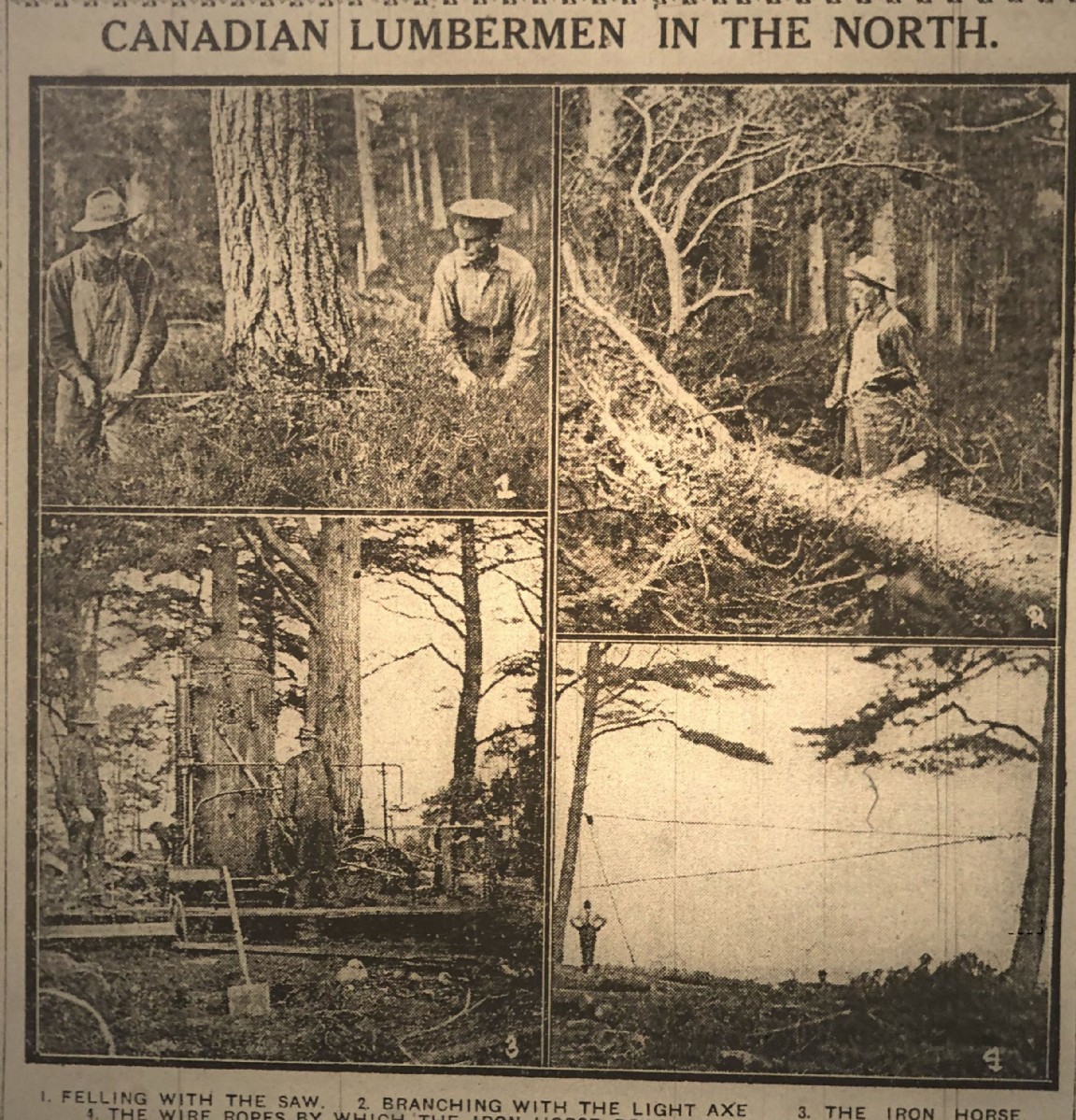
The 120 Company Canadian Forestry Corps in Nairn and Moray in WW1
Below are the results of detailed research and its compilation by Stuart Farrell of Moray and Nairn Family History Society from newspaper reports and Canadian National Archives on the Canadian Timber Corps in the vicinity of Nairn during WWI
“The following article appeared in the Nairnshire Telegraph of 8 July 1919:
Kinsteary and Orton Timber Camps. A very pretty souvenir booklet of No. 120 Company Canadian Forestry Corps has just been published. Mr James Lamb, National Bank, Nairn, in lieu of a formal introductory chapter, expresses in a letter to Major Sinclair, the Officer Commanding, the warm appreciation of the high character of the officers and men of the company, who during their sojourn at Kinsteary were on such good terms with the community of Nairn. The booklet is beautifully illustrated with woodland scenes, and pleasantly written throughout.
An interesting event to Major Sinclair was on being located at Kinsteary Camp to find it to be within ten miles of his father's birthplace, Easter Daltulich, Daviot, Inverness, where the Sinclairs still reside.
The following account of the Kinsteary operations is of permanent interest:-
"The Urchany Wood and the Knockoudie Wood in this operation is situated in the hills rising from the Moray Firth and about four miles south of Nairn on the main road to Grantown, and consisted in all about 400 acres. The wood was mostly Scotch Fir, with a quantity of Larch and some Beech. The age of the wood averaged about 100 years, while parts of the wood showed an age of 130 years. The trees in the Urchany Wood were high and straight with high branches, while those of Knockoudie were low and with heavy branches, making this wood very difficult to operate, the ground being also of a swampy nature.
The system of getting the logs to the mill from three-fourths of the Urchany operation was over a pole track railway, steel rails not being suitable on account of the long sloping hill, which in some places was very steep. A good part of the logs were got to this rail by being sent down a long chute. The balance of this wood and the Knockoudie wood was got to the mill over a steel railway. The cars in places being hauled by teams then by a donkey engine and cable. The total railway constructed was - Pole Track System, 1 1/2 miles, Steel 21/4 miles.
The logging cars were constructed by the company carpenters and blacksmiths, the cars being in two sections with four wheels each. The logs were cut into lengths from 8 to 20 feet, mostly 12 to 18 feet. The estimate of the timber on this operation was 5,000,000 F.B.M., and 27,714 lin. Ft. of pit props.
The mill was a Canadian Waterous having an engine of 40 H P and a boiler of 60 H P. The mill consisted of circular saws and carriage, and an edger and trim saws. It was the portable type of mill, and was very light considering the heavy work required of it. The working day consisted of ten hours, and the average daily cut was 27,000 to 28,000 F.B.M. The largest cut for one day in this mill, No. 120 Coy. was 32,814 ft. and the mill frequently made 30,000 ft. The mill was used throughout the Broadshaw operation by No.6 Coy. and was re-erected at Kinsteary. The total mill cut for Kinsteary from 5 June, 1917, to 1 May, 1918, when the cutting was completed, was 4,925,066 F.B.M., the mill was closed for some time in cleaning up the operation, before the final sawing was done. The pit props taken out by the wood's crews amounted to 166,982 lin. ft.
The total shipments from mill yard to railway point at Nairn, four miles, from 7 June, 1917, to March, 1918, was - Pit props, 166,982 lin. ft., leaving a yard stock taken over by the Timber Department of the Board of Trade of 2,634,116 F.B.M., covering which, after stock-taking, a receipt was given to us for this quantity.
During this time there was shipped from Broadshaw Camp stock 1,951,987 F.B.M. of sawn material, and 209,722 lin. ft. of pit props. The transport used in shipping, which was at first by contract, was steam tractors and trailers, and afterwards the shipping was done by the company by motor lorries, driven by drivers attached to the company from Det. No. 614 M.T. Coy., R.A.S.C. The camp site chosen proved to be both useful and picturesque, being on high ground and sheltered by the Urchany Hill. From the top of the hill over which operations extended, a splendid view of the surrounding country and the Moray Firth could be enjoyed. The main camp was built in two lines of huts, sleeping quarters of the men, with the men's mess building facing one end of the street, and the Y.M.C.A. Hut faced the other end. The Officers' mess, N.C.O.'s mess, Orderly Office, and Stores were situated apart. Stables, sided with slabs, were built with a capacity for fifty horses. An interesting statement is also given of the work done at the Orton Camp, to which No. 120 Company removed in February, 1918.
Copy of booklet held in the Imperial War Museum London but not available online to view. Canadian National Archives notes history as: No. 120 Company, Canadian Forestry Corps organized in May 1917 as No. 64 Company, Canadian Forestry Corps but renumbered as No. 63 Company shortly thereafter. Redesignated as No. 120 Company, Canadian Forestry Corps on 7 August 1917. Employed at Kinsteary, from May 1917 to March 1918 and at Orton, Elgin from March 1918 to My 1919. Also in the Canadian National Archives (RG 9 III-D-3, vols. 5019) is the following historical record:
History of 120 Company (A) (While operating at Kinsteary)
After operations were concluded at Broadshaw, the Canadian Mill was dismantled and removed to Kinsteary, being hauled over by traction engines on the 2nd, 3rd and 4th of May 1917. 106 Company commenced operations on May 4th 1917 but they were almost immediately ordered to France. They departed on the 31st May 1917, 166 strong, leaving a party of 46 men and one officer to take charge of the camp until the arrival of 120 Company, as it is now called. This company arrived at the Base from Kinsteary on 6th June 1917. It was then known as 64 Company. Later it changed to 63 Company and finally to 120 Company.
The clearing up of Broadshaw camp, which was about 6 miles from Kinsteary, was done by men of the new company. This took about a year. Lieut. Addison of 6 company, was in charge of Kinsteary, until the arrival of Major Sinclair several weeks after the arrival of the new company. The old company had built Kinsteary and nearly everything was complete except the officers' mess and the stable. Everything of practical use was taken from Broadshaw to Kinsteary except the huts. These were unfortunately eventually burned.
The production of this camp was shipped from two different stations, Nairn and Auldearn, each four miles away. Supplies were conveyed to the camp by horse and motor transport. Rations were drawn from the Officer i/c Supplies, Inverness, and came by train to Nairn and thence by transport.
Men from the old camp at Broadshaw arrived 14 May 1917 and cleared the site for the camp and erected buildings. The party from Base Depot arrived on the 6th of June 1917. Local food purchases were made mostly from A. McHattie, Nairn, and from A. McKenzie. The latter installed a canteen at the camp. The water supply was good, being pumped from a steadily running spring within the camp boundaries, up to a large cistern on a hill from which the water was piped through the camp by gravitation. The water for the men's bath was heated by stoves.
The camp buildings were of wood construction and consisted of:- Orderly room 20 x 30, Q.M. Stores 20 x 75, Recreation hut 20 x 60, Men's mess 24 x 90, N.C.O.'s mess & quarters 24 x 48, Canteen & wash & bathhouse 16 x 60, Hospital 18 x 30, Dental hut & guard room 16 x 18, 1 hutment 16 x 60, 4 hutments 18 x 60, Officer's mess 24 x 48, Stable 50 x 148, Mill 26 x 90, Blacksmith's shop 18 x 24, Farrier's shop 14 x 32. The stable was roofed with board and rubberoid roofing and was enclosed with edged slabs, accommodating 50 horses. The orderly room, Stores and Officer's Mess were sided with edge slabs over boarding. All other buildings had 1" boards covered with tarred paper.
A portion of the men for a time were billeted in marquees, but huts were soon built and the men made very comfortable.
This company kept a farm but it did not yield very much. Pigs were kept from the beginning of operations, and quite a lot of money was made, which was put into the Regimental funds. The following from the war diary will give an idea of the number of pigs kept:-
"Sixteen pigs were taken over from No.6 Company upon our arrival and the transactions since were as follows:
Purchased June 6th 16 pigs £48, Aug 8th 9 pigs £16.10/-, Sep 4th 6 pigs £16.4/-. Sold July 18th 6 pigs £26.8/-, Aug 7th 5 pigs £38.5s.l0d, Sep 4th 5 pigs £40, Dec 6th 6 pigs £49.10/-.
No foreigners or prisoners of war were attached or employed in connection with the operations of this company.
For a time commencing the 30 of October 1917, an average of 15 men was employed by arrangement with 107 Company on general work in the bush, in addition to those on the regular strength. On October 13 Lt. General Sir R. E. W. Turner, V.C., K.C.M.G. with Colonel J. B. White and party inspected the camp and operations. Many distinguished visitors called and were shown through the operations among them being Lord Finlay, The Lord Chancellor and sister, Mrs Thompson, Sir Frederick and Lady Liddle, Lady Dunbar of Auldearn who was very kind in corning to the camp one evening each week to entertain the men in the recreation hut. A company recreation and Y.M.C.A. hut was constructed and open every evening. A supply of books and papers was kept on hand and a piano was loaned to the Company. A concert was given at least once a week b parties coming from Nairn and elsewhere. The hut was operated by the Company Committee and Y.M.C.A. man on the strength was detailed in charge.
About 1500 yards of slab and sawdust roadways were constructed for teaming in the yard, to stable and bush. The main roads were always in fair condition but the heavy traffic made it necessary to effect repairs at times. The messing was good. The men were served individually at the kitchen counter and were seated at tables of six men each. N.C.O.'s and technically paid men had a separate mess.
About two miles of railroad were constructed from the camp to the hill across the road. The pole track was in vogue for most of the operations.
Several accidents occurred which were of a painful nature.
775542 Pte. Nixon. A. H. had his jaw broken by flying timber, caused by tripod falling in the bush. He was admitted to Nairn Hospital on the 22 day of August 1917.
1087259 Pte. Cyr. J. had several ribs broken by logs falling from a loaded car. He was admitted to Nairn Hospital on the 11 day of December 1917.
820012 Pte. Goodie. J. had internal organs badly ruptured by being crushed between two cars loaded with logs. He was admitted to Nairn Hospital on the 28 December 1917 at 2.50 p.m. and passed away on the same dale at 3.30 p.m.
2250709 Pte. Crossan. J. S. had a hand crushed by being run over by one of the cars used for hauling logs. He was admitted to Nairn Hospital on the 27 December 1917.
Three quarters of the output of the operation was large clear Scots fir and larch. One quarter was short wild Scots fir running heavily to branch. No serious difficulties were met with during Urchany Wood operation, but the Knockandie Wood, which was about 13/4 miles from the mill, presented difficulties because of the swampy mature of the ground and because the wood was short and ran heavily to large branches. Transportation to the mill was naturally difficult under such conditions and the quality of the logs made them harder to handle.
At this point the history unfortunately ends. In March 1918 the move was made to Orton, Moray but the next surviving records date only from February to April 1919:
War Diary 26 February 1919 - During the past month the mill was closed for 56 hours, owing to frozen exceedingly dirty logs. The mill crew was engaged during that time, in clearing yard and working on extension of spur from the Highland Ry. Production, and the operation generally, is greatly hampered by a lack of men. The company is now 27 O.Rs. under establishment. All felling of trees was stopped on 24 Feb 19. The bush crew are now cross-sawing and skidding all fallen timber.
Ten horses, 8 H.Ds. and two R11s, were transferred to 107 Coy. C.F.C. Ord. This leaves 38 H.D. horses on the strength of the company.
On February 18, the company gave a dance in the Assembly Rooms, Elgin. A most enjoyable evening was spent by all who were present. There has been very little sickness during the past month. A few of the men have been suffering from severe colds.
War Diary 21 March 1919 - The daily production for the past month has been much the same as usual.
The operation was closed down from the 12th to the 181 for a general stock taking of all equipment and stores. Major W. H. Burwash of 107 Coy. C.F.C., Lieut. W. E. Scott of 122 Coy. C.F.C., and Lieut. E. F. Violette of 106 Coy. C.F.C. being in charge of this work. Stocktaking is now very nearly completed.
There has been considerable change in the staff of officers, Capt. A. M. Grimmett, M.C. the 2nd in command, proceeded on command to H.Qrs. C.F.C. London 21 Mar 19. He is now Capt. of the Canadian football team. Lieut. F. H. Sutherland was S.O.S. to Base Depot 3 Mar 19 on being admitted to 1s1 Scottish General Hospital, Aberdeen. Capt. H. E. Parson reported to this company from base Depot for duty and was appointed Adjt. & Q.M. with effect from 7 Mar 19. There has been very little sickness during the month.
War Diary 23 April 1919 - The daily production for the past month has been much the same as usual. All branches of the operation, with the exception of shipping, have been closed down, and the men granted final leave from 19 Apr 19 to 23 Apr 19. Enough men to carry on with shipping and general camp duties have been retained. The health of the personnel in general has been excellent, very little sickness being reported during the past month.
So it seems that operations ceased in April 1919. But what of the men mentioned in the above reports?
Pte. J. Goodie noted as 820012 was actually Pte. Gerry Goodie 821102 and is buried at Nairn Cemetery. Headstone is inscribed: 'Jerome Gaudet served as 821102 Private J. Goodie Can. Forestry Corps 21st December 1917 age 27. Rest in Peace.'' Canadian Service Records (RG 150, Accession 1992-93/166, Box 3628 - 22 item 417820) states he was born 10 November 1892 enlisted 26 January 1917 at Fort Frances, Ontario when he stated his address of as Oleary, Prince Edward Island with occupation stated as Labourer. Next of Kin Sophia Goodie (Mother) Romford Falls, Maine, U.S.A later address of 16 Bennett Street, Lawrence, Mass. U.S.A. In his will left everything to Walter Gerrier (Brother-in-law) of 214 Franklin Street, Rumford, Maine, U.S.A. Admitted to hospital 26 February 1917 to 4 March 1917 with Pleurisy, transferred from 141st Battalion to Forestry Company 10 April 1917 as having flat feet and defective vision.
Embarked from Halifax on H.M.T. Metagama 1 May 1917, arrived Liverpool 14 May 1917. Admitted to hospital 20 December 1917 'Died shortly after arrival at Nairn County Hospital from result of crushing injuries to chest and abdomen caused while on duty, Inquiry held by Maj. Sinclair o/c 120 Coy. C.F. Corps.' The following witness statements were given to the accident:
First Witness - Number 2157475 A/Sgt. Anderson, C. - I am the N.C.O. in charge of transportation of logs from the bush to the mill. Private J. Goodie was employed under me as brakeman and for coupling cars. He was employed on this work on the afternoon of December 20th, 1917. Part of his duty was to couple together loaded cars of logs to be hauled by cable to the vicinity of the mill. I was not present at the time of the accident.
Second Witness - Number 2251105 A/Cpl. Garbutt, F. W. -1 am an N.C.O. in charge of track construction at No. 120 Company, Canadian Forestry Corps. On the afternoon of December 20th at about 1.45 p.m. I was proceeding along the logging railway and when nearing the usual point where the loaded cars of logs are coupled, I noticed two loaded cars about to be coupled and then noticed the first car starting to run backwards, the block placed for holding it stationery having evidently fallen away through some shaking of the car, allowing the two cars to come together. I then noticed Private Goodie, whose duty it was to connect the cars, crawling out between them evidently hurt and I immediately rushed up to him and found that he had been caught between the ends of logs from each car which had come together. He had evidently failed to connect them with the eight feet coupling pole. I then noticed that he was badly hurt and at once with the assistance of several men who appeared after the accident, placed him on a car and took him to the main roadway at the Camp after sending word of the accident to the Adjutant and Medical Sergeant.
Third Witness - Number 2303322 Private Ashe, L. - I am employed as a teamster at No. 120 Company Canadian Forestry Corps and it is part of my duty to haul loaded cars of logs at certain places on the logging railway. On the afternoon of December 20th, at about 1.45 p.m. I was driving my team in moving a loaded car so as to couple it with one which had been placed. The one placed was on a slight incline and had been blocked so as to hold its position.
Private Goodie was waiting in position with the coupling pole to connect the two cars and one end had been coupled to the standing car. In moving the second car forward, Private Goodie failed to drop in coupling pin and the shock of the second car on the coupling pole slightly moved the first car and the block holding it fell off the rail and the first car commenced to run backwards. In some way which I did not see Private Goodie did not make the connection and the pole dropping too low the end to be coupled was shoved under the car I had moved. The car was moving very slowly and when they came together I did now know that anything had happened until I saw Private Goodie crawling out from between the cars evidently hurt. A/Cpl. Garbutt was coming towards the car from a short distance away and I helped him to put Private Goodie on a small car which took him to the Camp. I was watching my team and did not see how Private Goodie was hurt.
Fourth Witness - Number 525508 A/Sgt. Comrie, F. J. - I am Medical Sergeant, C.A.M.C. at No. 120 Company, Canadian Forestry Corps, Kinsteary. On December 20lh, at about 2.00 p.m. I was notified that Private Goodie had been hurt and at once went to see him. On examination I found that he was badly injured and could feel that his ribs were broken, I made him as comfortable as I could on a stretcher and took him on a Motor lorry to the Nairn County Hospital. We arrived there at about 2.45 p.m. and put him to bed. About five minutes later he died. Dr. E. Wilson arrived about five minutes after he died. There was no Doctor present at the time of his death.
Fifth Witness - Captain W. B. Honey, C.A.M.C. Medical Officer No. 51 District, C.F.C. - I saw the body of Private J. Goodie on December 21st, 1917. The body was lying at the morgue of the Cottage Hospital Nairn. The body was somewhat swollen and there was blood and froth on the lips. The body showed signs of having been severely contused on the side over the region of the liver. I am of the opinion that death was caused by the aforesaid contusion due to a crushing injury and resulting in rupture of the internal organs in the region of the liver.
Death Certificate states him name as Jeremiah Goodie, Lumberman died 20 December 1917 at 2.50 p.m. at Nairn Hospital cause 'Accidentally killed'. Name of father not stated Mother Sophia Goodie. Corrected Entry cause 'Accidentally Killed while engaged in timber operations with Canadian Forestry Corps'. Court of Enquiry was held on 28 December 1917 stated 'The Court having heard the evidence of the several witnesses as given herein, find that number 821102 Private Goddie, J. died at 2.50 p.m. on December 20th, 1917 in the Nairn County Hospital, Nairn as the result of injuries received while in the performance of his duty and of the opinion that the accident was not due to any negligence or carelessness on the part of Private Goodie, J. or anyone connected therewith'.
Sadly Pte. Goodie was not the only casualty of the Canadian Forestry Corps, there is a headstone in Forres (Cluny Hill) Cemetery to Sergeant Charles Andre of the 122 Company, who had been with the 120 Company at Kinsteary. Canadian Service Records (RG 150, Accession 1992-93/166, Box 174-19, item 9823) states he was born Lille, France 1 December 1876 and enlisted 25 January 1917 at Victoria, British Columbia when he stated his address as Seattle, Washington, U.S.A. Occupation stated as Cook (though his Medical Report states Soldier and Interpreter) and formerly served in the Light Saphis of the French Army in Algeria. Next of Kin given as Roland Andre (son) of Y.M.C.A, Walla Walla, Washington, U.S. A. later of Bremerton, Washington and lastly of Athena, Oregon, U.S.A. Embarked from Halifax 3 May 1917 arrived England 14 May 1917, appointed Lance-Sergeant 5 June 1917 at Nairn. Medical Board on 5 November 1917 when he was in 120 Company noted that he was 'much older than age stated' and suffered from Emphysematous and Arteria Sclerosis. Died 29 December 1918 at Orton Camp, having been found unconscious and deemed to have died of natural causes.
But it was not all deaths, Ken Nisbets article of Canadian Marriages (see Moray Miscellaneous section on our website) notes the following two marriages of Canadian Forestry Corps men when they were stationed at Orton -On 23 November 1918 at the United Free Church Manse, Nairn George Frederick Clisby Private No 297786 Canadian Forestry Corps stationed at Orton Camp, Moray son of the deceased James John Clisby, Hatter, and the deceased Selina Elizabeth Woodgate to Margaret MacGregor aged 31 Domestic Servant, 9 Mill Road Nairn daughter of Donald MacGregor, Gardener, and Isabella Kinnaird. George was a lumberman and cook born 29 February 1884 at Leeds, Yorkshire and had enlisted on 30 March 1916 at Saskatoon where he was living.
On 17 December 1918 at the Roman Catholic Chapel, Nairn after banns according to the Roman Catholic Church Murray George Cusack Private No 2303411 Canadian Forestry Corps stationed at Orton Camp, Moray son of Charles Cusack, Farmer, and Mary Dopson to Margaret Hopwood Bakeress aged 19, 23 Simpson Street, Nairn daughter of William Hopwood, Grocer, and Mary Hopwood McNeil. Murray George Cussack was born 7 April 1899 at Lower Ridge, Kings County, New Brunswick and enlisted April 12 1917 his address being Catamount, New Brunswick.
Of some of the Officers and men mentioned above, here are some details of their service: Major William Henry Sinclair, C.O. 120 Company when at Nairn - Canadian Service Records (RG 150, Accession 1992-93/166, Box 8945 - 39, item 231642) born 31 January 1876 at London, Ontario enlisted 18 October 1915 at Winnipeg with address of 954 McMillan Avenue, Winnipeg with occupation of Lumber Manager. Next of kin Estelle K Sinclair (wife) with children Lambert Douglas 18 and Marjorie M 16. Noted as formerly served 4 years 90th Rifles and 6 years in the 79lh Cameron Highlanders of Canada. Appointed Captain 5 June 1916 179th battalion, transferred to 174th Battalion 1 June 1917 then to 14 Reserve Battalion then to Canadian Forestry Corps from 7 May 1917. Sailed from Halifax per S.S. Olympic 29 April 1917 returned home 13 August 1919 by RMS Baltic, arrived Canada 21 August demobbed 27 August 1919.
2250709 Pte. John Saunders Crosson - Canadian Service Records (RG 150, Accession 1992-93/166, Box 2169 - 26, item 127208) born 28 March 1880 Barrie, Ontario enlisted 26 March 1917 at Toronto formerly served 18 months 10th R.G. Attempted to enlist 201st Battalion but was rejected due to bad eyesight. Address at enlistment 301 Wilton Avenue, Toronto, occupation stated as sawyer. Next of kin Elizabeth Eva Crosson (Wife) with daughter Edna 6. Embarked Halifax 1 May 1917, arrived Liverpool 14 May 1917.
Details of Injury - The men who witnessed this accident are not now with this company, but it is understood that when it occurred the man was riding an empty timber truck, going to the woods. The truck was being hauled by a cable attached to a donkey engine. The truck stopped suddenly and the jerk caused the man to lose his balance and fall. The truck starting again almost immediately, a wheel passed over the man's hand. Admitted to Ontario Military Hospital, Orpington Kent 30 January 1918 crushed hand 'inability to completely flex fingers' discharged 1 March 1918. Sailed for Canada 23 September on H.M.T.S. Cardingshire arrived 7 October 1918 discharged 9 November 1918 as unfit due to flat feet, defective sight and injuries to hand. Paid $190 War Gratuity. Last address 2 Vivian Street, Toronto. Died 27 February 1964.
1087259 Pte. Joseph Cyr - Canadian Service Records (RG 150, Accession 1992-93/166, Box 2254- 14, item 13178) born6 June 1877, enlisted 9 March 1917 at Lindsay, Ontario in 252 Battalion. Address at enlistment 1670 St. Dominique, Montreal occupation stated as Labourer. Next of Kin Florida Cyr (wife) 677 Colonial Street, Montreal with children Les 8, Emilie 3, Simone 11/2 and Orand 6m. Sent $15 a month to his wife plus his Separation Allowance of $20. Arrived England 14 May 1917 attached to 63 Company C.F.C having been transferred to 200th Battalion on 4 April 1917. Admitted to Ontario Military Hospital, Orpington Kent 30 January 1918 fractured clavicle and ribs discharged 1 March 1918. Returned to Canada 7 May 1919. At discharge was attached to 113th Company Canadian Forestry Corps.
775542 Pte. Albert Harrison Nixon - Canadian Service Records (RG 150, Accession 1992-93/166, Box 7340 - 42, item 548687) born 22 July 1895, enlisted 27 December 1915 at Brampton in 126th Battalion transferred to 116th Battalion 18 October 1916 and to Canadian Forestry Corps 1 February 1917. Address at enlistment Brampton R.R No.4 Ontario occupation stated as Farmer. Next of Kin Hannah May Nixon (Mother) Father Thomas Albert Nixon. Sent $20 a month to his mother. In hospital at Niagara 22 June 1916 to 5 July 1916 with measles. Sailed from Halifax on RMS Empress of Britain 14 August 1916, arrived Liverpool 24 August 1916. Admitted hospital Branshott 7 October 1916 with N.V.I and on 24 December 1916 with bronchitis. Admitted 2nd Scottish Hospital, Edinburgh 6 September 1917 with fracture to upper jaw, caused by being struck by leg of tripod, discharges 30 November 1917. February 1918 awarded Good Conduct Badge. Married Ella Mclntosh 19 Domestic Servant daughter of Angus Mclntosh Gas Fitter Deceased and Annie McKerron previously Mclntosh maiden name Smith on 7 March 1918 at 143 High Street, Forres after Banns of the United Free Church. Daughter Pearl Nixon born 6 March 1919 at 33 High Street, Forres. Wife's address 143 High Street, Forres, later c/o Mrs Grant, Inchberry, Orton.
Embarked from Liverpool 3 August 1919 (day of discharge) S.S. Metagama disembarked Ontario 14 August 1919. Last address 14 October 1919 -Mrs A H Nixon, Merchant Bank of Canada, Brampton, Ontario.
Contributed by Stuart Farrell”
Download Large Version (1.5MB)
Groups: Canadian and Newfoundland sawmillers in Scotland, Northeast Scotland