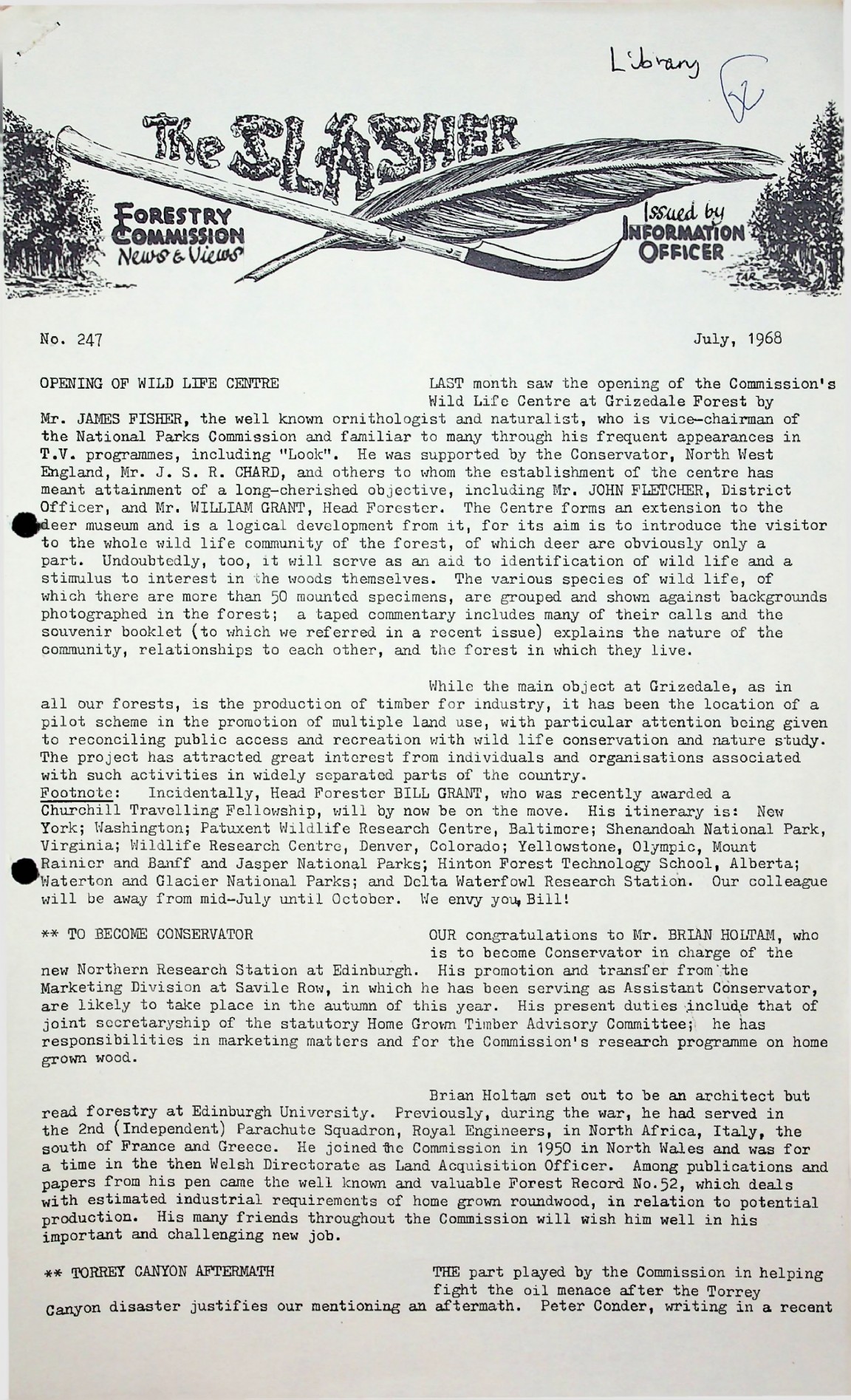
Slasher Magazine Summary: Publication No. 247 - July 1968
The digitisation of the Slasher was undertaken by, and images courtesy of, the Forest Research Knowledge and Information Management staff based at both the Northern Research Station in Roslin, Scotland and Alice Holt in Surrey, where the original copies are currently located.
The content summary below was very kindly compiled by Diane Birkett, Bedfordshire. See PDF attachment link below the text to view the full document. A total of over 400 issues were produced between 1948 and the final issue in 2010.
Opening of Wildlife Centre
The Commission's Wild Life Centre at Grizedale Forest was officially opened by Mr James Fisher, the ornithologist and naturalist, who is Vice Chairman of the National Parks Commission. Among those also attending the opening were Mr J.S.R. Chard, Conservator, North West England; Mr John Fletcher, District Officer; and Mr William Grant, Head Forester.
Churchill Travelling Fellowship
Mr William Grant, Head Forester was recently awarded a Churchill Travelling Fellowship and from mid-July until October will be visiting New York; Washington; Patuxent Wildlife Research Centre in Baltimore; Shenandoah National Park, Virginia; Wildlife Research Centre, Denver, Colorado; the Yellowstone, Olympic, Mount Rainier, Banff and Jasper National Parks; Hinton Forest Technical School, Alberta; Waterton and Glacier National Parks; and Delta Waterfowl Research Station.
Promotion
Mr Brian Holtam, currently an Assistant Conservator in the Marketing Division at Savile Row, is to become Conservator in charge of the new Northern Research Station at Edinburgh.
Torrey Canyon Aftermath
After the oil spill from the Torrey Canyon, Peter Conder, reports in the Royal Society for the Protection of Birds journal on the effects to the birdlife in the area: "Nearly 8,000 oiled birds were rescued from the sea. Despite the utmost care by the various bodies concerned, only 100 to 150 recovered sufficiently to be released to the sea. Of these, 60 were ringed before release, and within a month, 16 were found dead. There is no evidence whether the others are alive or dead".
Foot and Mouth Disease
Members of the Commission's staff were thanked by the authorities for their co-operation with the Ministry of Agriculture in administering restrictions and controls in the fight to eliminate Foot and Mouth disease.
Alder and Carrs
An inquiry was received at the Savile Row office from an East Anglian historian seeking information on "carrs" in relation to alder wood.
The name "carr" comes from the Old Norse Kjarr and is applied to marshy woodlands in regions of Scandinavia.
The "carr" place names are found in East Anglia, Lincolnshire, Yorkshire, Lancashire and the Lake District. In Scotland they sometimes take the form "Ker" as at Kershope. Carrs, which include willows, alders, and shrubs like alder buckthorn, are natural in origin, being the climax vegetation on a fen-peat bog. Their foliage, by annual leaf-fall, helps to build up the peat. The process of renewal by coppice shoots can go on for several hundreds of years.
The wood of alder can also be used for hat blocks, clog soles, turnery poles and charcoal for gunpowder. The bark was once used for tanning leather. General uses still include provision of firewood, manufacture of furniture, fencing posts and rails, posts for buildings and small hand carved objects.
Drinka Pinta
A discourse between a Commission office and a Field Officer, after a complaint by a dairyman about thistles on neighbouring Commission land.
Forest Archaeology
A recent reconnaissance in Rowardennan Forest, Stirlingshire, brought to light evidence of the little known iron smelting industry that drew on native woods of birch, pine and oak for its charcoal wood.
The Commission's investigators reasoned that the "bloomeries" where the iron was smelted would lie close to the mouths of the burns that run into Loch Lomond.
Water-power was needed to drive the bellows for the furnaces where the ore was reduced to metal and also to work the tilt hammers used to force impurities out of the crude iron. It was known that the ore itself was brought by sea to Dumbarton, thence up the River Leven and finally up Loch Lomond. The ore, though heavy, was easier to carry than the bulky charcoal.
Inspections of low mounds near the mouths of a burn just north of Rowardennan Pier, and another one further south, showed unnatural vegetation. Excavation revealed masses of black furnace slag, the residue of iron smelting.
Further north, beyond the Commission's boundary, the stone ruins of well-built bloomeries have now been discovered. It is not easy to imagine the "bonnie, bonnie banks" as a kind of Black Country for the West of Scotland, but it is clear that these ironworks were extensive and worked for long periods of time. They probably continued in use until about 1800, when the discovery of iron smelting with coke caused the industry to migrate to the coalfields of the Clyde Valley.
The Squibbit
One of our foresters engaged in deer control in South East England, writes: Four-thirty in the morning is not the best time to be confronted by a young rabbit possessing a tail usually seen attached to a grey squirrel. The normal rabbits with which it was feeding having departed, however, I managed to catch the squibbet unharmed. On closer examination it proved to have a softer, thicker pelt and slightly smaller ears than a rabbit, while the tail was not so bushy as that of a squirrel. To my knowledge, this is the first record of such an animal being seen in a British woodland, What is it?
or the More Erudite
A chance to win £50 and a silver medal. Education and Training Branch draw attention to the Haldane Essay Competition, organised by the Royal Institute of Public Administration, and held annually since 1924. It aims to secure "significant and original contributions to the study and practice and history of public administration".
Farewell to Fiunary
Many readers will know the Scottish song with its haunting Gaelic refrain, "Eirich agus tingainn, O" meaning "We must arise and go now". A few will actually have visited Fiunary Forest, which lies so remotely on the Morvern Peninsula of Argyll that it is usually reached by steamer from Oban, rather than by road from Fort William. The song was written in 1810 by the Rev. Dr Norman MacLeod, son of the Minister of Morvern Parish, who had witnessed the emigration resulting from the "Clearances".
The whole sad story has just been published in book form as "Morvern Transformed - A Highland Parish in the Nineteenth Century", by Philip Gaskell. Cambridge University Press, 1968. The book also gives an insight into the settlements hidden beneath the trees in the area.
Championship Runner-Up
Twenty six competitors took part in a chain saw competition at the Great Yorkshire show in Harrogate. Mr R. Cox, Forest Worker in the New Forest won the second prize of £50 and a tankard. Messrs D.A. and G.R. Sharp, sons of Head Forester Mr G.A. Sharp of North East England Conservancy, won the third and fourth prized respectively.
Forest Walks
Forest walks established in South East England were featured in the Conservancy exhibit at the South of England show at Ardingly in Sussex. Large maps showed their location and notes on each walk were distributed to the public. One of the forest walks at Joydens Wood is the nearest Commission area to London, being only 14 miles from Charing Cross.
Congratulations: Births
Congratulations to Rannoch Forest, E (S), Forester and Mrs J.D. Menzies on the birth of their son Niall.
Congratulations to Rannoch Forest, E (S), Forester and Mrs D. Frazer on the birth of their son Douglas.
Congratulations to Rannoch Forest, E (S), Forester and Mrs D. Cotton on the birth of their daughter Jacqueline.
Congratulations to Rannoch Forest, E (S), Trainee Forester and Mrs D. Yeats on the birth of their son Nicholas.
Stoneleigh Royal Show
The Commission's exhibit at the Royal Show at Stoneleigh this month won the Moxon Medal for the best educational display in the forestry section. The theme was "Forest Going", covering forests, recreation and conservation of wildlife. Congratulations to Mr Morley Penistan, who designed the exhibit, and to the following and their respective teams, who produced it, Mr Stanley Rogers, Mr Jock White and Mr Jim King.