Historic forestry ploughs on the move
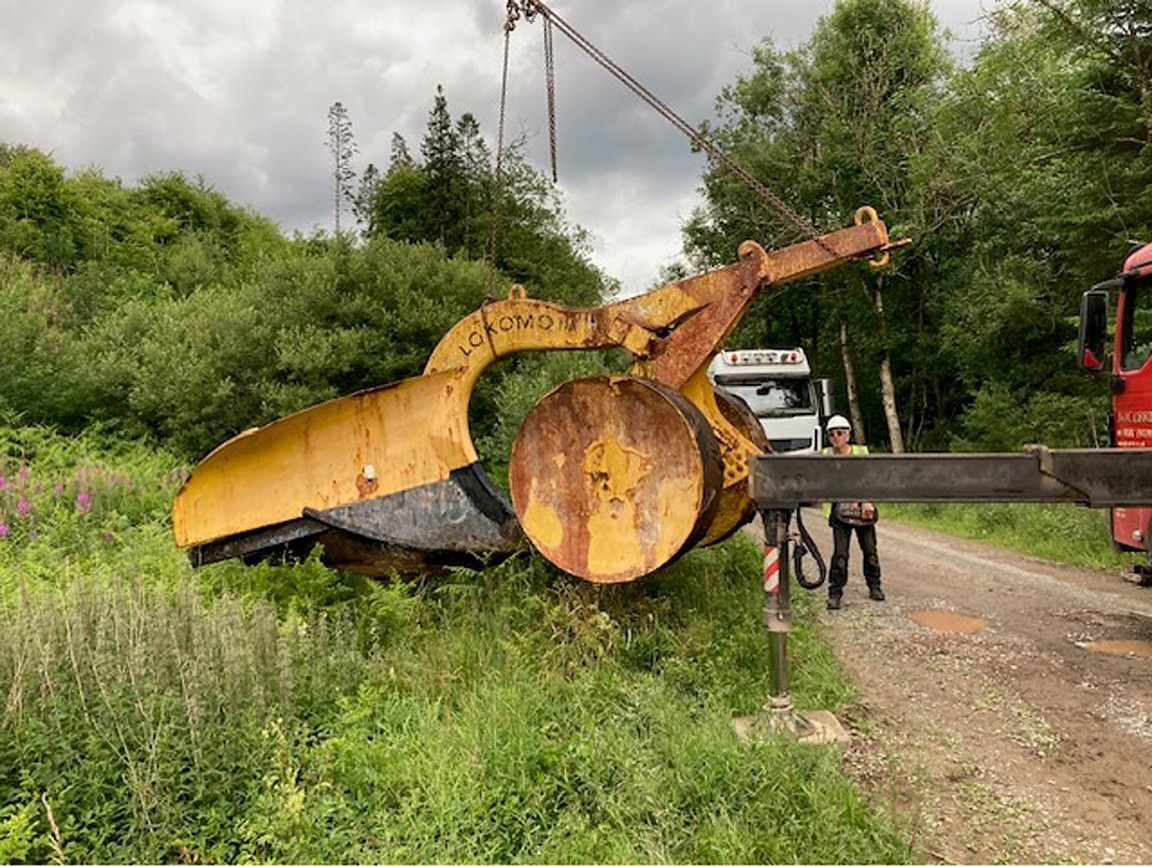
The image is courtesy of Douglas Clark of Parkgate and in this case shows the Lokomo draining plough about to be lifted onto a lorry trailer from its long term location at the Forest of Ae.
Photographs by Donald Thomson reveal that as early as 1975 this plough, along with a number other historic forestry ploughs, were all painted up and placed on show near to the former training centre at Forest of Ae. The location was known as the Ae forestry plough museum. Since the demise of the Ae training centre, the Forestry Commission in Scotland and diminishing numbers of local forest staff with resources to look after the site, the machines languished in the increasingly over grown area seriously rusting away.
Douglas Clark of Clark of Parkgate and forestry plough fame offered to take the contents of ‘the plough museum’ and place them along with other historical ploughing equipment from the Clark collection on a publically accessible area on their Duncow Estate. Douglas has already embarked on a 10 year project to shot blast and long lasting two pack bake paint each of the historic ploughs with currently two machines completed.
The PDF link below has two more views of machines on the move, the first of a Clark Parkgate double beam plough and the second image is of the lorry loaded with a Cuthbertson F single furrow draining plough with its innovative levelling system and distinctive sliding pole and all metal drum wheels. Further back on the lorry is a plough skid float developed for use on very soft peat conditions where wheels would simply sink in. These floats were certainly used on Flanders Moss and Moss of Cree (see items on this website).
Douglas has come to the rescue of some iconic machinery that had a profound effect on the establishment of forests in this country. Relegated away from productive farmland and onto lower nutrient and sites with steep, rocky or very wet conditions, the forest industry had to provide viable planting conditions for trees to survive. It was just possible to do this by manual hand methods but at very high costs and with a very large labour force. The plough very significantly reduced the manual work effort to plant a forest and the existing local labour forces vastly increased their productivity and so began the era of the very large planting programmes of the 1950 and 60s. Trees and forest were rapidly established and thus changed the landscape and industries of Scotland.
2 Comments
Thank you for your kind comments.
We have a small estate and the ploughs are on display there next to a WW1 Woodland Trust woodland next to the road. I don’t have any plans to display other equipment but, who knows what opportunities might come up, I am adding six ploughs from my own collection. Due to the size and cost of the job (the ploughs are very rusted) it is a five to ten year project. We are also trying to turn Duncow Estate into a large arboretum so, lots of plans ahead.
Regards,
Doug Comment left on 10 November 2023 at 14:52 by Douglas Clark
Will these ploughs be the only exhibits, or is there any intention to enlarge the range of machinery/tools displayed and explained?
Good health, Bill Rayner Comment left on 09 November 2023 at 20:17 by Bill Rayner