FCA Magazine (Forest Forum) - Issue 74: Summer 2022
FC staff Retirement Association magazine. The content summary below was very kindly compiled by Diane Birkett, Bedfordshire. See PDF attachment below the text to view the full document. A total of 77 issues were completed between 1997 and the final issue in 2023. Issue 74
Forest Forum – Spring 2022
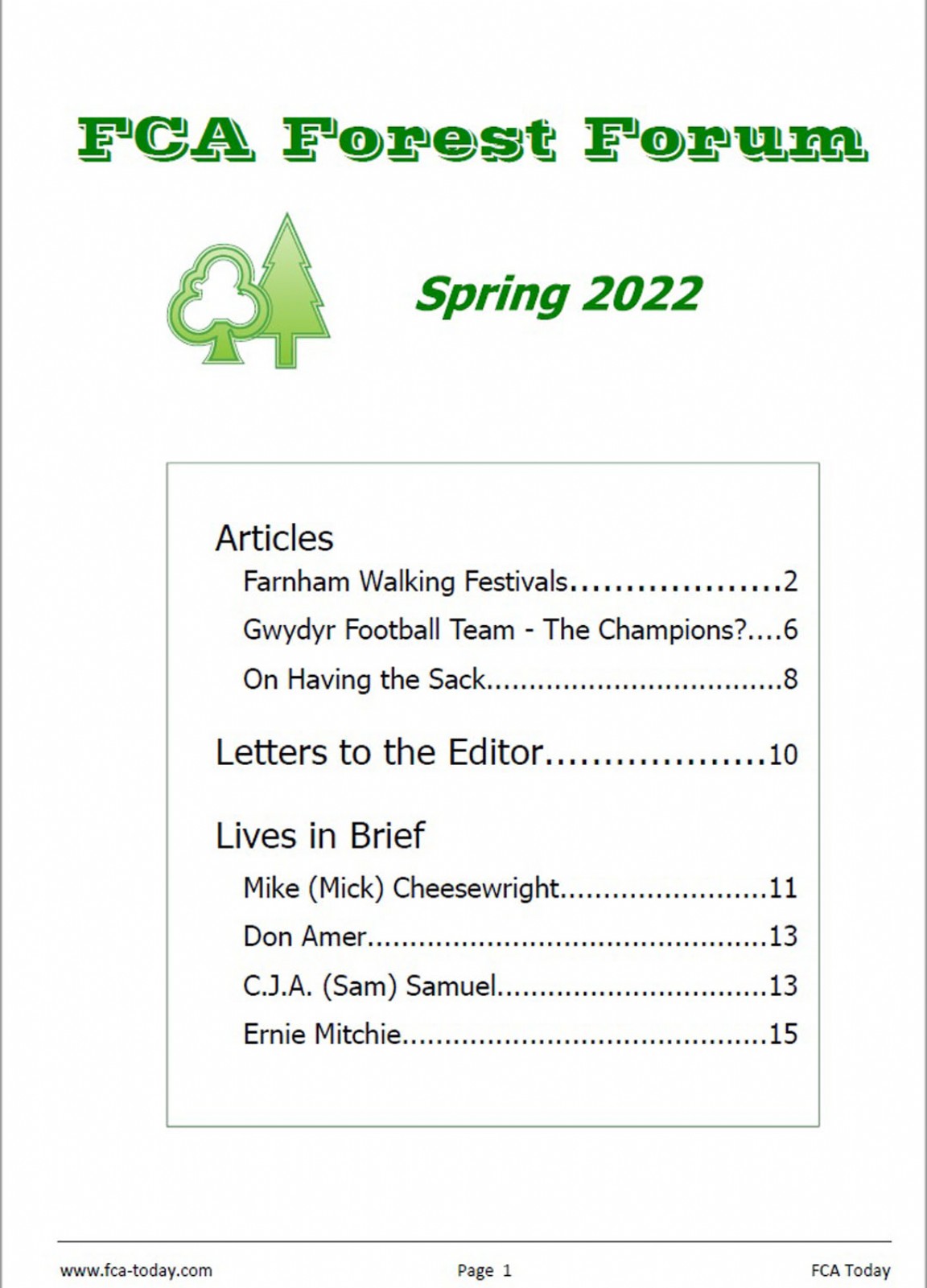
The Forest Forum edition features: -
Articles
Farnham Walking Festivals 19 May – 2 June 2019
From Brian Greig: - In May 2017 a Walking Festival was organised by Farnham Town Council with over 30 walks around the town and in the local area. They ranged from less than a mile to 12 miles. The Festival was so successful that it was repeated in the following two years. In 2020 a more ambitious Festival was planned with over 60 walks, but unfortunately due to Covid it had to be cancelled. As part of the Festival I arranged three guided tree walks. One was around a residential housing estate in the village of Rowledge. It had been built in the 1980s in the grounds of a large house which the Planning Authorities imposed TPO’s on 61 trees of 24 different species. The second was around the grounds of the Alice Holt Research Station. It followed a tree walk which featured 30 notable trees, some of which were rare specimens and others that were planted when Alice Holt Lodge was a private residence. The third walk, that is the subject of this note, was the little known Alice Holt arboretum. The arboretum was originally set up in the 1950s as a fenced research enclosure for testing the suitability of trees for forestry. The research focused on a range of conifers and broadleaved species like alders, beech and hickory. By the mid 1970s, many of the experiments had finished, leaving behind an interesting variety of trees. The area was developed as an arboretum for recreation with picnic tables and a network of paths. Over recent years it has been restored with the paths being repaired, the removal of overcrowded trees, cataloguing the important specimens and planting the next generation of trees. Volunteers from the Alice Holt Community Forum and the South Downs National Park Ranger Service are currently involved in its restoration and regeneration. There is a trail through the arboretum with 30 numbered trees. It starts with an imposing pair of Oriental spruce, (Picea orientalis) and finishes with a rather shabby specimen of Dallimore’s horse chestnut, (Aesculus x dallimore). Over time some of the original trees have succumbed to disease and these have not been replaced, although as in the case of Common beech, there are plenty of other examples nearby. The full list of the original trees is below. All are individual specimens unless stated otherwise.
1. Oriental Spruce (Picea orientalis) - a pair of trees.
2. Sweet chestnut (Castanea sativa)
3. Hybrid larch (Larix x marschlinsii)
4. Western red cedar (Thuja plicata)
5. Common beech (Fagus sylvatica) - felled.
6. Rauli - Southern beech (Nothofagus alpina)
7. Roble - Southern beech (Nothofagus obliqua)
8. Lodgepole pine (Pinus contorta var latifolia)
9. Scots pine (Pinus sylvestris) one of a group.
10. Coast redwood (Sequoia sempervirens) A magnificence grove of majestic trees planted as rooted cuttings in 1954. One can imagine being in California when standing among these.
11. Leyland cypress (Cupressus leylandii) A group of almost 70 year old huge trees which show the potential of the species if left unchecked.
12. Italian alder (Alnus cordata)
13. Monterey cypress (Cupressus macrocarpa) A species that is one of the hybrid Leyland cypress.
14. Douglas fir (Pseudotsuga menziesii) A specimen illustrating the fine form of the species as a timber tree.
15. Dawn redwood (Metasequoia glyptostroboides) A small grove which was planted as rooted cuttings taken from a tree raised from one of the earliest batches of seeds collected in the wild. It is rare to see dawn redwood planted as a group, rather than as single ornamental trees.
16. Sitka spruce (Picea sitchensis) A few trees planted in 1954 which show the growth potential of the species, even on a low rainfall site in southern England. The most important commercially grown conifer species in Britain.
17. Shagbark hickory (Carya ovata)
18. Coast redwood (Sequoia sempervirens) This specimen is larger than any of the trees in the grove.
19. Giant sequoia, Wellingtonia (Sequoiadendron giganteum) A very impressive single specimen.
20. Yew (Taxus baccata) A 500 year old tree remaining from the oak woodland that was on the site before clearance for the research plots.
21. Scrub pine (Pinus virginiana)
22. Weymouth pine (Pinus strobus) now felled.
23. Western white pine (Pinus monticola)
24. Armand’s pine (Pinus armandii)
25. Pitch pine (Pinus rigida)
26. Gregg’s pine (Pinus greggii)
27. Jeffrey pine (Pinus jeffreyi)
28. Ponderosa pine (Pinus ponderosa)
29. Leyland cypress (Cupressus leyandii)
30. Dallimore’s horse-chestnut (Aesculus x dallimorei)
Most of the information above is taken from the Alice Holt Arboretum Tree Trail Guide, which used to be available for visitors at the entrance to the arboretum. Unfortunately this is now out of print and needs updating. It is hoped that a new edition will be produced shortly.
Gwydyr Football Team - The Champions?
John Brian Griffiths sent in the photo of the Gwydyr intake of 1959-61 football team which played in the local league. In the photo are: - Tom Robinson, Bob Matthews, Dick Knotts, John Lilley, John Robertson, Gus Drew, Tom Daley, John Griffiths and Dai King. Two are missing, Bobby Howes and Don Price. Don was a fine footballer, but an even better rugby player. He was a first choice outside half for Abertillery.
On Having the Sack
Eric Rogers remembers the sack: - For eighteen months, in the late 1940s, before National Service, I was a trainee forester on a North Hertfordshire private estate. An essential piece of gear carried by all staff was a sack. A real, brown, potato sack, about two foot wide by four foot long. A length of binder twine was secured tightly to one of the bottom corners and there we had one of the most useful and versatile pieces of equipment known to man! Setting out from home in the morning, for my five or seven mile bike ride to work, the sack was slung across my shoulder and tied around the mouth. It carried my bottle of cold tea or, in winter, a vacuum flask bought with a special Agricultural Worker’s permit and cheese sandwiches. When I arrived at the wood yard an axe and billhook might be added to the sack, or it might be used to wrap around the blade of a six foot cross cut saw, so that it could be safely carried over the shoulder. First job at the work site was to get a fire going, often with the embers from the previous day, either to burn up branchwood, or ready for lunch breaks. Then the sack would be used to kneel on when using the saw, to fell trees, or as a shoulder pad when carrying logs out. Often we carried fifteen foot logs with a diameter up to 12 inches and, even with four men, the weight would give today’s Health and Safety Inspectors apoplexy. Come the lunch breaks, we would sit around the fire with our sack on a springy heap of spruce branches toasting our sandwiches. I have fond memories of those breaks. We didn’t use tractors in the woods, it was all horse extraction. But if drafted to the farms at harvest time, the sack made a comfortable cushion on the old metal seats which, although well crafted to the human posterior, were jolly hard, and cold. During really bad weather, or if special orders were required, we worked under cover in the wood yard cutting out planks or firewood, or splitting kindling wood for the Manor. The sack would then be used as an apron, or tied around the waist, to keep the dirt and resin off our clothes and as a pad when pushing logs into the saw. I learnt a lot about identifying timber while working in the wood yard. I can still identify many by the smell alone. When the snow and rain came and we were working outside, one corner of the sack was pushed into the other and it was worn over the head like a pixie hood to keep head, shoulders and back dry. If the rain was too heavy, the sack would be laid across a whorl of spruce or pine branches and we would stand underneath, close enough to the fire to keep warm. When the day’s work was nearly done, I would saw up a few logs or split some kindling to take home and, once a week there would be a rabbit, for which I paid the keeper the sum of six pence, to take home. A useful addition to the meat ration. I doubt if there has ever been a more useful and versatile piece of equipment than my old hessian sack.
Letter to the Editor
Brian Greig adds some additional notes to Simon Malone's article "Alice Holt - A Crown Forest". He says he spent the first six months of married life in a caravan just behind Keepers Cottage during the freezing winter of 1962/3. Keepers Cottage was sold by the FC in the 1980s. It has been unoccupied for several years and is now in a sad, derelict condition. The cottage was sold at auction in July 2021 for £612,000. There has been considerable speculation as to the whereabouts of the sign that used to be attached to the wall of Keepers Cottage which Simon researched and is shown in his article. The same or an identical sign next surfaced at an auction house sale room in Itchen Stoke in Hampshire with an estimated price of £300-£400.
From the Editor
A comment from Richard Toleman.
Obituaries
Charlie Taylor reports that Mike (Mick) Cheesewright passed away last November aged 82. Born into a farming family in Leicestershire, he chose a career in forestry and started work at Fineshade in Northants. He attended Faskally Forestry School, near Pitlochry, from 1961-63.
Alison Amer has told of the sad passing of her Granddad Don Amer in January aged 91. He worked for the FC for 42 years and wrote up memories of his wide range of activities in FCA Today.
Steve Lee and Alan Fletcher have put together memories of C.J.A. Samuel, known by friends and colleagues as Sam Samuel. He died at home on Boxing Day. He joined the Statistics and Computing Branch at Alice Holt Research Station in 1970. He made a significant contribution to forestry research in various capacities for over fifty years and retired in May 2021.
Graham Hamilton has reported the death of Ernie Michie on 13th November in Inverness. He was 88. Ernie was born in Dundee and graduated from Aberdeen University with a BSc (Forestry) in 1954. He joined the Forestry Commission in 1957.