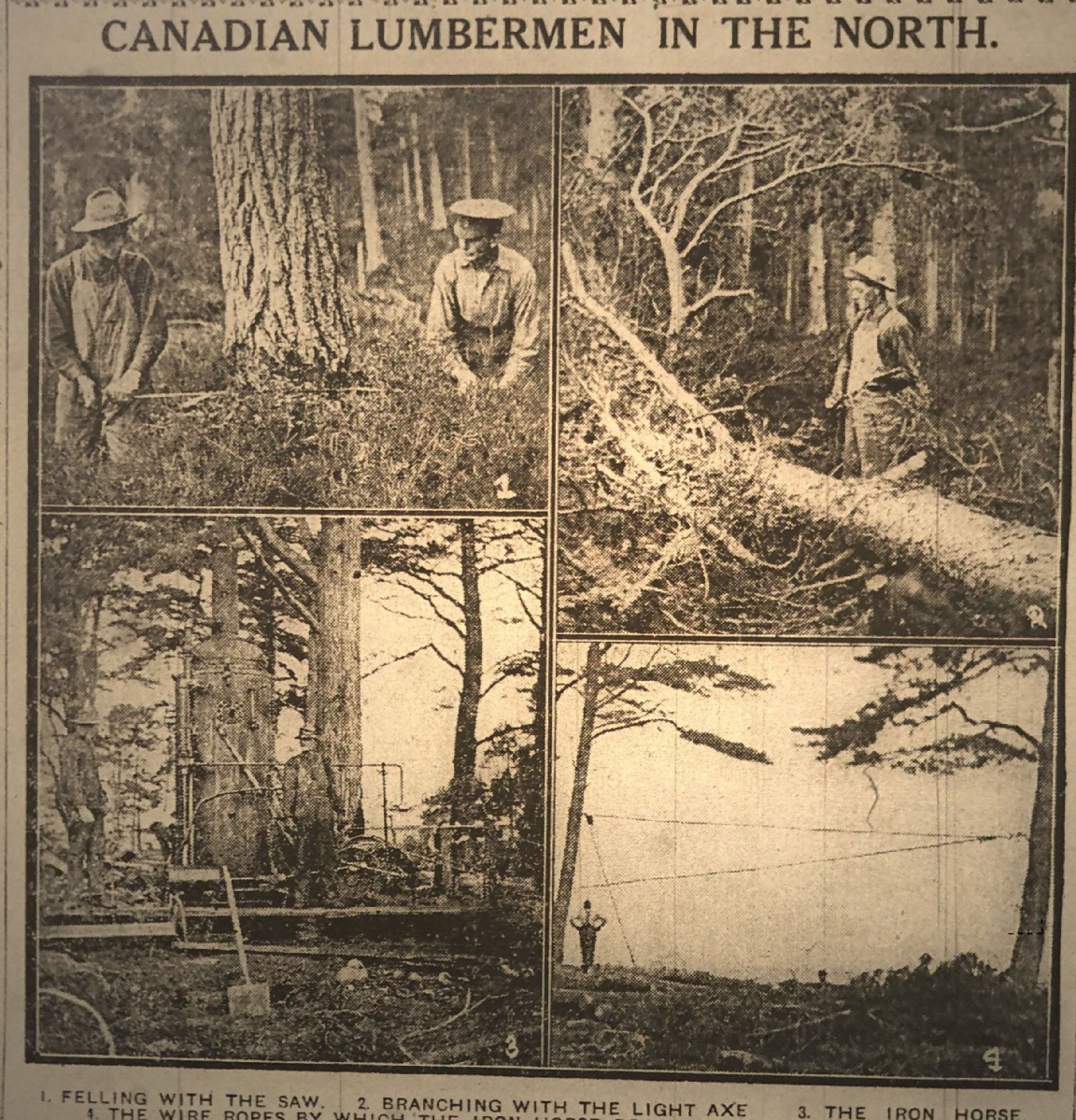
Canadian Forestry Corps Sawmill in Morayshire circa 1917
This image is from a newspaper cutting but unfortunately no date or newspaper name is included but assumed to be an Elgin area newspaper. The question has been raised - is this from 1919 WW1? A notice in a Forres newspaper 1919 refers to Candian camp at Broadshaw and warning people not to remove backs or other wood material with out permission!
The report that accompanied the image is reproduced below:
“Canadian Lumbermen in the North
The Canadian lumberman has for many years been one of the most picturesque figures in British fiction. Tales of the lumberman has been surrounded with a halo of romance. It is there¬fore, an event of very great interest to find the Canadian lumberman taking up his calling in Scotland. This remarkable fact is one of the many strange outcomes of the war. When Canadian lumbermen volunteered to fight for the Motherland and come back in thousands to the old country they brought new modes of living with them, and established a real Canadian lumber industry in the forests of Scotland, in the County of Moray.
Their main headquarters have been set up at Bradshaw, on the boundary that divides the largely wooded estates of the Earls of Moray and Cawdor. On each estate the Government has acquired a large tract of mature timber. On the Cawdor side the timber being cut is about 65 years old, but on Darnaway the age exceeds 100 years, and they are of great dimensions, some of them containing as much as 90 cubic feet. According to the lumbermen these trees closely resemble in size those they are accustomed to fell in Eastern Canada, where the majority of men hail from. At present at this camp there are employed about 300 men, but a large increase in number is yet expected. Other camps in the vicinity are springing up, and the removal of all of the mature trees of these northern woodlands seems inevitable. It is for the seat of the war that these mills are now daily producing immense quantities of manufactured timber. Railway sleepers 9 feet long, 10 inches broad, and 5 inches thick are cut out of all the logs of sufficient dimesions. The demand for these sleepers is unlimited.
New Methods and Old
The new methods used in the felling, transport, and sawmilling timber differ somewhat from the practices of our home woodmen. As to the superiority of their methods, I am not convinced. Although there are points to be learned from them, there are home methods which seem more adapted to the type of trees dealt with. For present requirements it is no doubt essential the Government must get the manufactured material with all possible speed, and the methods, which I consider would be financially impracticable for a home timber merchant, are thus, under present, conditions, justified. In felling the home method of "stumping" --notching the tree all round above the ground with the axe— is abandoned. The saw is inserted in the side of the tree to which it is to fall, and a fairly deep saw draught made. It is then withdrawn, and a notch is taken out with the axe. This has the same effect as our "stumping." and allows the tree when it, is falling to break off the root without splitting. After the notch is made, the saw is inserted in the opposite side, and the tree sawn through until it commences falling. The men show very smart work, and cut the trees off close to the ground.
The Iron Horse
The branches of the firs are then axed off, and "snedded" out to two inches in thickness, and thrown together. Their axes only weigh three and a half pounds, and seem mere toys to the six and seven pounders used in our woods. However, there is no doubt they are able to swing them oftener, and can remove the hardest of branches. The tree has now become a log perhaps fifty feet long, and weighing over two tons. In the distance, two hundred yards off, is the “Iron Horse” a strong steam winch, fixed on a sledge, which enables it, with the aid of its wire rope fixed to a distant tree, to drag itself to a new area, which is yet uncleared. This engine, fired by waste timber, drives two winches, one of which has a wire rope twelve hundred feet long. This rope is fixed to the point of the fifty foot log, and a signal given to the engineman. The winch commences to wind in the wire rope, the huge log starts its rough journey through brush and over stumps towards the loading bank. Its passage doesn’t take long, and it is soon cross-cut into eighteen foot lengths. The other winch controls a rope going through pulleys overhead, and hauls the eighteen foot lengths to a loading bank built up of logs. Alongside the teamster draws up his pair of horses and four wheeled timber wagon. With the aid of the steam winch, the wagon, on level with the loading bank, is soon loaded with logs. Standing astride the lumber the teamster pulls his reins, and his team sets off towards the Canadian mill. He drives alongside an unloading bank of long poles, on which the logs are rolled and cross-cut into 9-foot lengths. These are loaded on to a truck on light rails, and run down into the lumber mill, and removed on to a bench near the saw. The Canadian lumber mill is a huge erection fitted with a sixty horse power engine, which is fired solely with the waste slabs from the mill. The fifty feet funnel, which is fixed by wire stays to the surrounding trees, ensures a sufficient draught, and makes the sur-roundings look typically Canadian. The engine drives a four foot, saw, fitted with removable teeth, and seems to be, if one may judge by the output of sawdust, of rather thick dimensions. The saw¬dust is kept cleared from beneath the saw by a chain elevator with small bars, which draws it up, and tips it over into a heep outside the mill. On rails along¬side the saw runs the log carriage, drawn by a wire rope. A lever beside the saw controls the carriage which is drawn up alongside the bench in which the logs have been placed. Two men roll one of the logs on to the carriage and fix it with iron clamps, which makes the movement of the log in sawing impossible. True-cut, timber is thus ensured. A man aboard the carriage, with the aid of a lever, sets the position of the log. According to the dimension of the timber he wants cut. The carriage is then set in motion, passes alongside the saw, and the outside slab is sawn off and lifted.
From Canadian to Scotch.
The carriage then returns to the load¬ing bench, and the two men turn the log clamp it, and another slab is removed. This operation is repeated until the log is cut up into timber of the desired dimensions. As the manufactured material comes off the saw it runs on to a bench with rollers, on which it is easily moved by a man who walks alongside it on a gangway. This bench juts out for about a hundred yards from the mill, and stands twenty feet above the ground. On each side of the bench are depots for different sizes of timber, to which each piece is slid down at their re¬spective sizes, and are stacked together. In this mill there, are also fitted up two different types of machines for squaring the edges of boards, &c., and cutting the ends square. Heavy slabs are curried on a railway to the Scotch portable mill, which is constructed about 200 yards away. Here, boards are cut out of the slabs and logs of smaller dimensions are manufactured. The engine also drives the dynamo and generates the light with which the mills and camp are installed.”
MORE INFORMATION
This website is indebted to the Library and Archives Canada for the following brief summary of The Canadian Forestry Corps operations in WW1 and below this from their list the Companies that operated in various locations in Scotland. Note that the name spellings are sometimes unusual and actual locations may have very local names. Hopefully this may raise interest in some localities and any old photographs and stories would be very welcome.
“Guide to Sources Relating to Units of the Canadian Expeditionary Force 1 Canadian Forestry Corps Introduction Authorized in October 1916 under the command of Lieutenant-Colonel Alexander McDougall, the Canadian Forestry Corps was composed of companies, each of which came under one of the six district headquarters in Great Britain or one of the eight district headquarters in France. Companies in France were numbered below 100 and those in Britain were numbered 101 and up. The base depot was at Smith’s Lawn, Windsor Great Park. The Canadian Forestry Corps in France came under the British Expeditionary Force Director of Works until March 1917 when a Directorate of Forestry was created. Forestry Battalions raised in Canada (224th, 230th, 238th, 242nd) were absorbed by the Canadian Forestry Corps depot upon their arrival in Great Britain. Districts in Great Britain were Nos. 51 (formerly No.1 at Inverness), 52 (formerly No.2, at Carlisle), 53 (formerly No.3, at Egham), 54 (formerly No.4, at Southampton), 55 (at Stirling) and 56 (at East Sheen). Districts in France were organized in groups (Central, Bordeaux, Jura). Most companies were engaged in forestry operations (including the making of pitprops, sleepers, sawlogs and axe handles) but some cleared, drained, levelled and graded sites for aerodromes, both in England and in France.
Companies based in Scotland
No 6 Company - Background Information - Organized at Sunningdale in June and July 1916 under the command of Captain Herd. Originally No. 8 Detachment, 224th Battalion. At Broadshaw Camp, near Main, Scotland from July 1916 - April 1917. Company ordered to France in May 1917.
No. 106 Company, Canadian Forestry Corps - Background Information - Organized at Sunningdale in 1917 under the command of Captain G. D. Blakadar. Employed at Knockando, Scotland (Spey Valley) from November 1917 and at Phones Wood, Blacksboat, Scotland.
No. 107 Company, Canadian Forestry Corps - Background Information - Organized in December 1916 as No. 7 Company, Canadian Forestry Corps under the command of Major Burwash. Originated as a detachment from No. 6 Company, Broadshaw. Employed at Keppernack, near Nairn, Scotland. Redesignated as 107th Company, Canadian Forestry Corps on 7 August 1917.
No. 108 Company, Canadian Forestry Corps - Background Information - Organized in the fall of 1916 as No. 8 Company, Canadian Forestry Corps. Employed on the Mansfield estate, January-November 1917, and at Taymount, Logie Almond and Methven, Perthshire, Scotland.
No. 109 Company, Canadian Forestry Corps - Background Information - Organized as No. 9 Company, Canadian Forestry Corps in the fall of 1916. Most personnel from No. 5 Company, Canadian Forestry Corps. Employed on Duke of Portland’s estate, February-May 1917, later at Mauchline.
No. 109 Company, Canadian Forestry Corps - Background Information - Organized at Sunningdale on 12 October 1917 as 127th Company, Canadian Forestry Corps. Re-numbered as 109th Company on 19 October 1917. Employed at Tulliallan estate, Kincardine.
No. 110 Company, Canadian Forestry Corps - Background Information - Organized at Witley in the fall of 1916 as No. 10 Company, Canadian Forestry Corps. Employed at Glenmore, November 1916 - October 1917, and at Abernethy, Nethybridge from October 1917.
No. 111 Company, Canadian Forestry Corps - Background Information - Organized in October 1917 as No. 11 Company, Canadian Forestry Corps commanded by Captain J. H. Johnston. Originally “F” Company, 238th Battalion. Employed at Castle Douglas, December 1916 - February 1918 and then at Longtown, near Gretna Green.
No. 117 Company, Canadian Forestry Corps - Background Information - Organized in January 1917 as No. 33 Company, Canadian Forestry Corps under the command by Lieutenant A. C. McDougall. Employed in Wales, February-November 1917 and at Dornoch, Sutherland from November 1917. Redesignated as No. 117 Company, Canadian Forestry Corps on 7 August 1917.
No. 120 Company, Canadian Forestry Corps - Background Information - Organized in May 1917 as No. 64 Company, Canadian Forestry Corps but renumbered as No. 63 Company shortly thereafter. Redesignated as No. 120 Company, Canadian Forestry Corps on 7 August 1917. Employed at Kinsteary from May 1917 to March 1918 and at Orton, Elgin from March 1918 to July 1919.
No. 121 Company, Canadian Forestry Corps - Background Information - Organized in July 1917 at Sunningdale as No. 64 Company, Canadian Forestry Corps commanded by Major M. C. Rousseau. Redesignated as No. 121 Company, Canadian Forestry Corps on 7 August 1917. At Loch Morlich, Aviemore from July 1917
No. 127 Company, Canadian Forestry Corps - Background Information - Organized in September 1917. Most of personnel from No. 111 Company. Employed at Jedburgh, Roxburgh.
No. 128 Company, Canadian Forestry Corps - Background Information - Organized at Sunningdale in October 1917. Employed at Tulliallan, Kincardine from November 1917.
No. 129 Company, Canadian Forestry Corps - Background Information - Organized in November 1917. Employed at Dornoch, Sutherland from November 1917.
No. 130 Company, Canadian Forestry Corps - Background Information - Organized at Sunningdale in October 1917 under the command of Lieutenant J. Fee. Employed at Fetternear, Kemnay, Aberdeenshire.
No. 138 Company, Canadian Forestry Corps - Background Information - Organized at Sunningdale in July 1918 under the command of Captain Sidney Leary. Employed at Braemore, Ross-Shire, near Ullapool and, later, at Lochbroom.
No. 139 Company, Canadian Forestry Corps - Background Information - Organized in [February 1918] under the command of Captain Richards. Employed at Lanton Hill, Jedburgh from February 1918.”
Download Large Version (1.5MB)
Groups: Canadian and Newfoundland sawmillers in Scotland, Forestry Areas, Forestry in Action, Sawmills, pulp mills, chipboard mills
7 Comments
If you go the the National Library of Scotland (NLS) website and navigate to their "Maps Home" page and select the "Ordnance Survey" maps, OS 25 Inch 1892-1914 maps, with a Google Maps background and navigate to the following grid reference:
British National Grid Ref: NJ 31189 52835
BNG Eastings, Northings: 331189, 852835
Latitude, Longitude: 57.560347, -3.151732
You will see that this is the site of a sawmill, to the south of Orton railway station. Orton House and it's adjacent woodlands/ policies are to the north of the station and whilst I cannot find any evidence of a "camp", on the 1937-1961 1:25,000 map and the 19149-1972 1:10,000/1:10,560 map of the area, immediately to the north of the Sheriffmuir holding at NGR:
British National Grid Ref: NJ 30403 53096
BNG Eastings, Northings: 330403, 853096
Latitude, Longitude: 57.562569, -3.164941
Was the site of an "Officer's Cairn"! Whether this relates to the potential site of Orton Camp, or the officer's stationed there, I cannot say. But I hope that this may help you in your search for information.
I do not know if the current owner, Mr Jim Macleod, of Orton House will be able to help you in your research as the Grade "B" listed building was gutted by fire for the second time in mid May 2023, two weeks before he was to re-occupy the house.
However, a quick scan of the online British Newspaper Archive, held by the British Library, an article in the Midlothian Advertiser, Friday, 19th, April, 1918, has the following sentence:
"Owing to the urgent need for timber, a lumber camp is to be established on Mr Wharton Duff's estate at Orton".
There are further reports in the "Aberdeenshire Press and Journal" and the "Nairnshire Telegraph and General Advertiser for the Northern Counties" of criminal offences, community events and a "death by burning" relating to the camp, until this advert was placed in several July editions of the "Aberdeenshire Press and Journal".:-
"GOVERNMENT PROPERTY DISPOSAL BOARD, (BOARD OF TRADE, TIMBER SUPPLY DEPARTMENT). SALE, BY AUCTION, OF HUTS AND BUILDINGS, AT ORTON TIMBER CAMP. ORTON, MORAYSHIRE, ON THURSDAY, 15th JULY, 1920, 1.30 p.m. Prompt." There then follows a list of items for sale.
Given a bit of time I could transcribe some of these articles, but please be aware of the following copyright on all newspaper images published from the "British Newspaper Archive" site:
"Our Optical Character Recognition (OCR) data is under copyright and requires permission to reproduce. You are, however, free to create your own transcriptions using the newspapers found on The British Newspaper Archive.
If you plan on creating your own transcripts from the newspapers, then please be advised that unsigned newspaper text goes out of copyright 70 calendar years after the year of publication, and signed newspaper text goes out of copyright 70 calendar years after the death of the author(s)."
Comment left on 20 June 2023 at 01:38 by Bill Rayner
I quote from the initial posting by Norman and his quotation from the information supplied by the Library and Archives Canada:
"No. 120 Company, Canadian Forestry Corps - Background Information - Organized in May 1917 as No. 64 Company, Canadian Forestry Corps but renumbered as No. 63 Company shortly thereafter. Redesignated as No. 120 Company, Canadian Forestry Corps on 7 August 1917. Employed at Kinsteary from May 1917 to March 1918 and at Orton, Elgin from March 1918 to July 1919."
N.B. that this implies that both Kinsteary and Orton are near Elgin, whereas Kinsteary is in fact 4 miles southeast from Nairn, near Auldearn and Orton is 3˝ miles southwest of Fochabers.
I will try and extract specific detail from the local newspaper articles when I have some time to do so and post transcriptions on this website. Comment left on 20 June 2023 at 10:09 by Bill Rayner
The Sawdust fusiliers living history group is very greatful to you as this is helpful for our display and talking to the public Comment left on 20 June 2023 at 10:42 by Clive Ashton -Clements