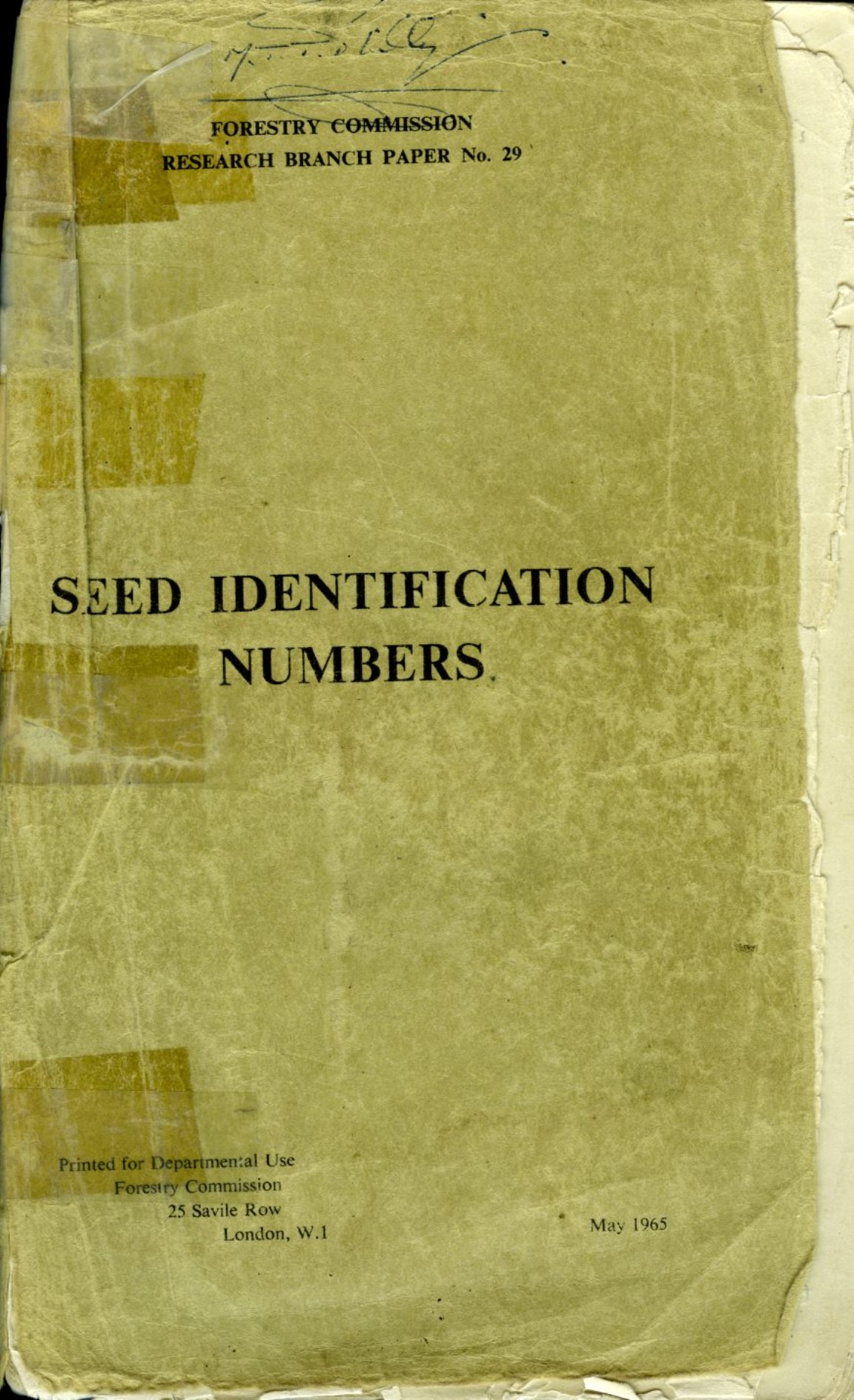
Seed Identification Numbers – Forestry Commission Research Branch Paper No 29-3rd and last Section
As may just be seen by the signature on the front cover, this copy of the 364 page booklet published in 1965, was once retained by the late Mike Phillips, Seed Officer, Forest Research, Newton near Elgin. It was very much his major reference publication for his work of nursery tree seed sourcing identification work.
Let us suppose in the days before genetic testing and cloning that somewhere in the back of a forest you came across a small stand of really good looking Sitka spruce and you were aware that there was a very significant demand for this species for sowing in private and state nurseries. Once you had assured yourself that the whole stand was of a similar quality you contacted Mike to come and check and hopefully register it as a nursery seed source. As well as checking the actual target stand and also the quality and species of the surrounding trees (to ensure no cross pollination from low quality trees) a search was made through the actual planting records of the trees in question. This involved going through, in the case of a Forestry Commission forest, the R1 Planting record folder religiously kept and updated by the foresters since the very start of any forest. If you were fortunate you were able to home in on the most likely entries that referred to your special stand and you also noted any Beating Up replacement trees that were used in subsequent years. The tree deliveries to the forest all had an advice note which stated the Identity number of the consigned trees. This was the key information required to establish from which location in the world the seed was sourced and thus the origin of your trees. Hopefully in all the various stages through nursery and out to the forest the numbers were transcribed correctly – sometimes not!
This was the stage where your trees planted in 1954 reveal their origins and the reference numbers such as ‘Sitka spruce 51/5’ directs you to page 257 in the Seed Identification Booklet. You will note that your trees are part of seed consignment number 5 in 1951consisting of 1592 pounds of Picea sitchensis collected in 1949 in British Columbia and shipped by R G Roche. Mike would then have to contact the Seed Store at Alice Holt, Surrey for further details of collection area but the chances that by being collected in British Columbia they were not the Washington variety less suitable for planting generally in Scotland. If the stand was of suitable quality and from a suitable origin it would then be registered as a seed source. Seed collection could occur with any suitably timed thinnings or even clear felling.
Note that the booklet lists all the seed collected and registered from 1921 to 1956 and in itself is of interest to scan through to experience a worldwide tour of seed procurements or also the local seed collections carried out in various areas (FC and Estates) within the UK and used in private nurseries as own collections(OC).
This system did have many drawbacks, was subject to transcription error when even one digit out made it was very difficult to correct but crucially it was not having an international location system. In 1956 the process was modified to a worldwide system based on the then Universal Decimal Classification published by British Standards Institution. This classified the world into continents and sub continents 1-9, countries 1-9, zones within countries 1-9, regions with zones 1-9 and then localities defined by a suffix. Hence if we read of any seed origin number combination as 7111 this would define the source area as within British Columbia in Canada on the islands formerly known as Queen Charlotte Islands or currently as Haida Gawii. The full details are eloquently described by John D Matthews, District Officer, Research, in the partially missing appendix to the booklet but fully reproduced from an item in the 1958 Journal of the Forestry Commission. The details are in the final pages 364 – 369 of the PDF of this record in PDF below.
Any stories of collecting tree seed would be very welcome.
Note that this record holds one third of the booklet (in the PDF below) and the previous two records hold the remainder.
Groups: Forest Nurseries, Forestry Areas, Forestry Records, Booklets and Reports