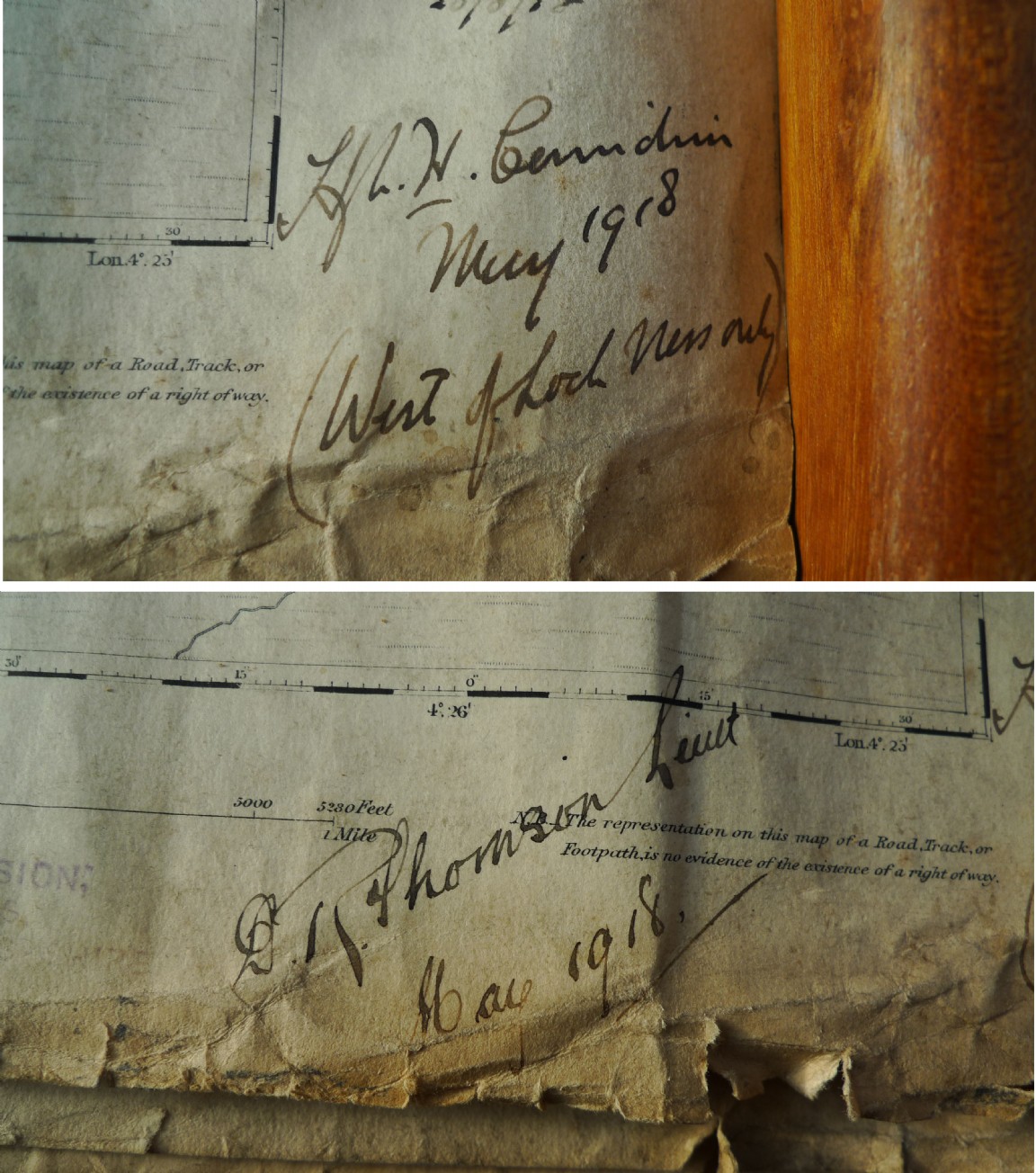
Scotland’s Woodland and forest surveyor signatures - 1918
The maps were discovered in a loft in Fort Augustus forest office along with others in ex military maps cases.
The image shows two signatures on one of the 6 inch maps used in the 1918 woodland census and survey. The details extracted from Forestry Commission publications (shown below) indicate that two survey teams were located in Scotland. There is a strong possibility that these two signatures are from those team leaders.
The one signature can be easily read as D R Thomson (Lieut) but the other in much more difficult to decipher. It may begin with initials H L W C???????? or Hugh W C?????????? Any suggestions would be very welcome.
As can be read in the extracts below the survey/census was multipurpose -note the key role of the women members of the survey teams. The publications were kindly highlighted by Wilma Harper, Edinburgh.
Extract from - 1st Annual report of the Forestry Commission 1920
Page 42
‘Production— The Commissioners have continued the survey of the rate of growth of conifers which was begun under the Board of Agriculture and Fisheries in 1917 and by the Timber Supplies Department in Scotland on identical lines in 1918. This survey has already afforded a great deal of very useful information as to the productivity of different species under varying conditions, and has enabled the Commission to proceed with their work with a precision which would not otherwise have been possible. A summary of the results of the survey was published during the year as Bulletin No. 3, which gave the results obtained from the measurement of 1,100 plots and sub-plots in various parts of the United Kingdom. The total number of pilots and sub-plots which had been measured to the 30th September, 1920, was 1212 of which 241 (89 in England and W ales and 152 in Scotland) were dealt with during the year. For the most part the plots were of a temporary character, that is to say they were measured and then abandoned. At the same time, as opportunity arises, interesting plantations are being selected by arrangement with the owners, for the establishment of permanent plots in which the results of definite methods of treatment such as thinning and underplanting may be kept under careful observation. Permanent plots were established in England before the war and have now been thinned two and three times. The total number of permanent plots under observation at the 30th September, 1920 was 45 of which 22 (8 in England and Wales and 14 in Scotland) were established during the year.’
Extract from Forestry Commission Bulletin No 3 page 6
‘Date of the Commencement and Organization of Survey Work
The collection of data was begun in England in August, 1917, under the Forestry Branch of the Board of Agriculture. Careful instructions as to method were issued to the officer in charge of the field work, and though certain modifications became necessary in course of time, by the end of the first year the final lines had been established. These instructions are embodied in Bulletin No, 1 of the Forestry Commission.
In December, 1917, a survey on the same lines was begun in Scotland under the Board of Trade, Timber Supply Department (Scotland). The same methods were used, and the officer in charge of the unit was previously attached for a time to the original party in order to ensure uniformity. The work was extended to Ireland in February, 1919, where it was carried out under the Department of Agriculture and Technical Instruction for Ireland. Uniformity in the various countries was further secured by conferences between the officers concerned.
The work was carried out by women assistants under the supervision of trained forest officers. The women received their training in the field. The inspection of woods, selection and survey of sample plots, marking of thinnings, etc., were made by the officer in charge; the actual measurement of the trees and the working up of field data being in the hands of the women assistants.
As a rule each, officer worked with two sub-parties of three women each, one of the women in each sub-party acting as forewoman. For the greater part of the time two parties worked in England and two in Scotland, operations being continued all the year round.
It is difficult to speak too highly of the services of the women assistants; the accuracy of their work and their conscientiousness have been beyond praise. In the face of many discomforts, due to working in all weathers and to incessant changes from place to place, they have been invariably cheerful and willing to do more than was asked of them.’
The current link to a PDF of the 1st FC annual report:
https://www.forestresearch.gov.uk/documents/6325/FCAR_1920.pdf
The current link to a PDF of the FC Bulletin No 3 is:
https://www.forestresearch.gov.uk/documents/6462/FCBU003.pdf
Download Large Version (1.1MB)
Groups: Forestry Records, Booklets and Reports, Maps of Forest and Woodland Areas