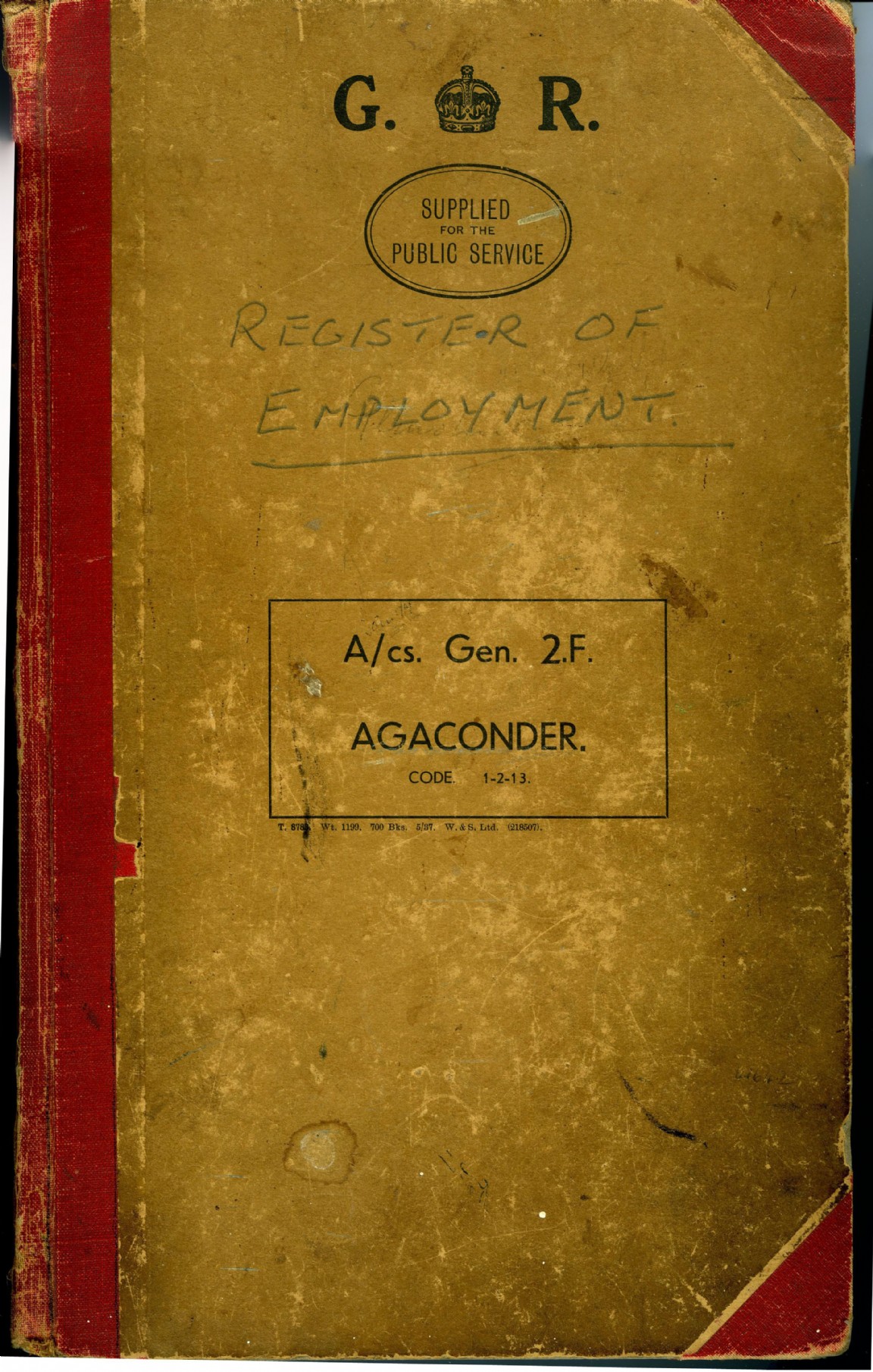
Ratagan Forest - register of employed forest workers 1948 -1970
The register was found in the old Forestry Office located at Jenkin’s Park, Fort Augustus. It appears as though the register was repurposed from an old accounts ledger and was also used as a holiday, sick days and insurance record for each employee. These rare documents seldom survived as they were maintained only within the individual forest offices. The registers were renewed and replaced as years passed and compiled in various formats. No forest worker lists or registers from times before WWII have so far been located. It appears that only the names of people currently working at the forest would be entered into any subsequent new registers.
In the 1920s, during the very early days of the Forestry Commission, employment as a forest worker would purely be a local forest event with minimum of formality and paperwork. One can imagine that in the little wooden office sheds the forester would compile a list of all the forest workers who were employed on a permanent basis. Possibly a second list was compiled of those who were employed seasonally. Formal time books with days worked in the fortnightly pay period are most likely to have been diligently completed with times and hence costs against the various operation types. The forester would also have been responsible for a basic cash account all of which would be inspected regularly by the District Officer on his pay check visits and possibly to bring over the cash imprest to enable wage moneys to be withdrawn from local bank. It is unlikely that there would be any deductions for tax and possibly only minimal amounts for national insurance. Adding a few mythical employees would not have been difficult and surprise inspections were a regular occurrence. However at some point national insurance card with its stamps had to be maintained for every employee and was a critical check.
It appears that by 1948 and 1949 with the onset of the more comprehensive welfare system there was a greater emphasis on a more formal regulation and control of the industrial forest workforce and also forest finances. Following the division of the countries into Conservancies all the forests were allocated a new set of cost centre numbers. In North Scotland Conservancy these appear to have been based largely on the order of acquisition and follow the forest numbers in the North Scotland Conservancy as listed in the 1948 annual report. This Conservancy had the initial letters NS followed by a number taken from a series 01-47. Hence Borgie Forest was NS 1, Ratagan NS 6, Glenshiel NS 16, Eilanreach NS 23 and Inverinate NS 25. The above four forests were run very much as separate forest units until 1969/70 when they were all amalgamated under the one name - Ratagan Forest.
At some point in 1948-1950 forests abandoned their informal lists of workers and created a new list with each of the current workers allocated numbers in the sequence of the year they were first employed. As a consequence forest workers acquired a special unique number such as NS6/1 /22 which when broken down identified them as working for Ratagan Forest; as at 1948/9 the earliest employed worker currently in the squad No 1 and finally the year he was first employed 22 – that is 1922.
One has to admire the lovely copperplate writing as demonstrated in this original worker list drawn up by a member of the office staff in Ratagan Forest office. The writing style appears to remain relatively consistent until 1959 apart from use of different pens and biros. The full list consisting of four pages ends about 1969, the last employee taken on in 1967 being Malcolm Sutherland and allocated the Number NS6/122/67 but left the FC in 1969. Thereafter following the forest amalgamations a new list would have been drawn up combining the members of four work forces who were currently with the Forestry Commission at that time.
Even from a casual look over of the list there is quite a turnover of labour but it has to be remembered that, following the war, large numbers of returning service men were unemployed and many took on work in ‘the Forestry’ until such time they were able to get other work more in line with their preferences or better paid and less arduous. Some individuals only lasted a few weeks but a core of workers worked on for many years and in fact a lifetime of work and retired in their 60s. It is good to see the names of a few ladies, there being too many for just office work and we have to assume they were out working in squads in the forests along with the men. Of interest also are the group of European style names, nine in total taken on in 1949, which is a stark reminder of the casualties of the conflict displaced from their areas of birth and trying to set up a home in this country. A surprisingly large number transferred to Port Clair with one going to Aviemore and one to Farigaig. Can anyone say how they fared in later life?
Within the employees’ register and the numbering system are those with an M prefix such as M574/66 George Ritchie. These were classed as Mobile Workers and generally found work as either forestry plough men or more likely in the various ‘Road squads’ that built huge networks of forest roads, in all types of terrain, a great many of which are still used to this day. These operations were carried out in many different locations and the workers, lorry, tractor and excavator drivers, drillers, carpenters and cooks lived an itinerant life in bothies and caravans only getting home at some weekends. When work was stopped such as in very severe winter weather or machines breaking down these men were sent back to their ‘home’ station and joined the local forest squad in whatever work was being carried out.
There are many names listed in the attached PDF and below are most of the surnames to ensure that searches on the website pick them up. Please see the PDF below for all the pages of the workers register. Note that some personal information has been redacted but year of birth retained to enable family cross checks to take place. Comments are very welcome.
Surnames listed include:-
Anderson: Allison:
Boyle: Berlikowski: Bird: Beaton: Barron: Burgess: Black:
Chisholm: Cameron: Campbell: Colven:
Dickson:
Forbes: Fornal: Foley: Fletcher: Forsythe
Gabrieclaw: Gillies:
Hoskins:
Johnston:
Kopjas: Kelly: Kelso:
Lamont: Legge: Lysaght:
MacQueen: Macdonell: MacLennan: MacDonald: MacRae: MacKay: MacBeath: MacLeod: MacAskill: MacLure: MacKinnon: MacKillop: MacLean: MacKenzie: MacKintosh: MacInnes:
McMahon: McDonagh: McLelland: McKay:
Morrison: Marciniak: Mooney: Moore: Miller:
Nitznjuk: Nelson:
O’Kane:
Paz:
Rzeznicz:
Stephen: Stewart: Stecz: Stephenson: Spurr: Sinclair:
Taylor: Thomson: Talbot:
Urquhart:
Wiakoro:
Yates:
Please see the PDF below for more pages from the register. Any comments and observations would be very welcome.
Download Large Version (1.9MB)
Groups: Forestry Areas, Forestry Records, Booklets and Reports, Groups of people
'Also, in image 5137, the list of workers employed in Ratagan Forest I see my Grandfather second from top of the left hand page on page 3 of the PDF (John Anderson) and again when he returned to Ratagan 11th entry on the same page.
I asked my father for a potted history of why they moved in and out of Ratagan. He can't remember the reason for the first leaving but the second was because they had been promised a job for my Grandfather and Father by Inverness District but it transpired that Inverness could only allocate the housing while the local Forester had the final say on employment and he said there was not a job for my father. They moved back to the central belt where Father got a job in a cooperage before joining FC at Garshelloch after his National Service. Comment left on 04 January 2022 at 10:42 by Norman Davidson (Website Curator)