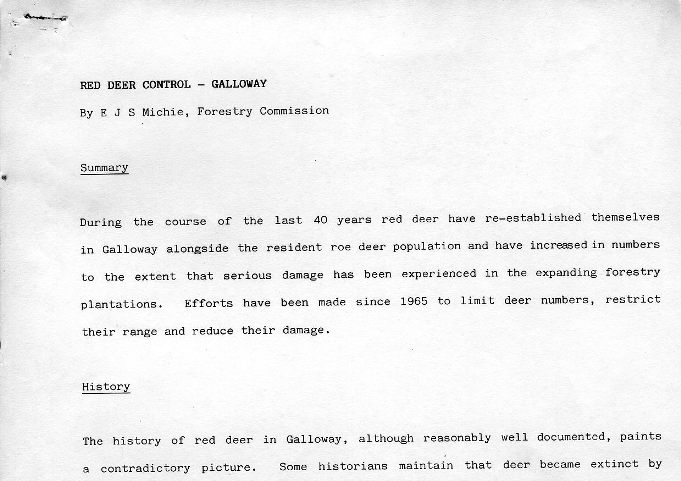
Red Deer Control — Galloway
Ernie Michie (Inverness) has kindly allowed his paper on Red Deer Control to be placed on this website. At the time he was District Forest Manager in Galloway Forest District and presented the paper to the Deer Management Conference in Inverness on 30 March 1990. The full paper is on the attached PDF - small botton on right of picture with text lines.
The paper begins with the historical population rise from early estimates in 1954 by Fraser Darling of around 415 red deer on 81,000 ha in central Galloway to an estimated figure of 1,500 red deer on 81,000 ha in 1965 which, along with increasing damage to trees, triggered the setting up of a Red Deer Control Scheme with a number of objectives.
Described also was the important early work was done on the rate of breeding development and potential along with some work on movement patterns. Vantage point counting, ear tagging of calves and critically, by using the age data from all red deer culled, cohort analysis was used with all the other information to work towards a total population estimate and annual birth recruitment. This then formed the basis from which annual cull totals could be set to initially stop population increases and then at levels to reduce the heavy incidence of tree damage.
Counting deer in forest conditions is notoriously very difficult and the paper mentions the process in persuading staff that past cull numbers were ineffective in controlling the population rise. Significantly increased targets, better equipment, training, redistribution of beat areas, improved control locations and very hard determined work contributed to a 73% increased cull which was maintain the year following and from there forward.
The process proved that, in Galloway at least, the breeding rate for red deer in the forest was much higher than ever envisaged and that in order to prevent further population increase, let along decrease, it takes much skill, much science, hard sustained effort with a very sharp focus on culling breeding age hinds just to stand still.
The paper provides more information on numbers, strategies, the wider implications of rising red deer numbers in the forest generally and pointed the way to future forest deer control systems.
Groups: Forestry Areas, Forestry in Action, Forestry Records, Booklets and Reports