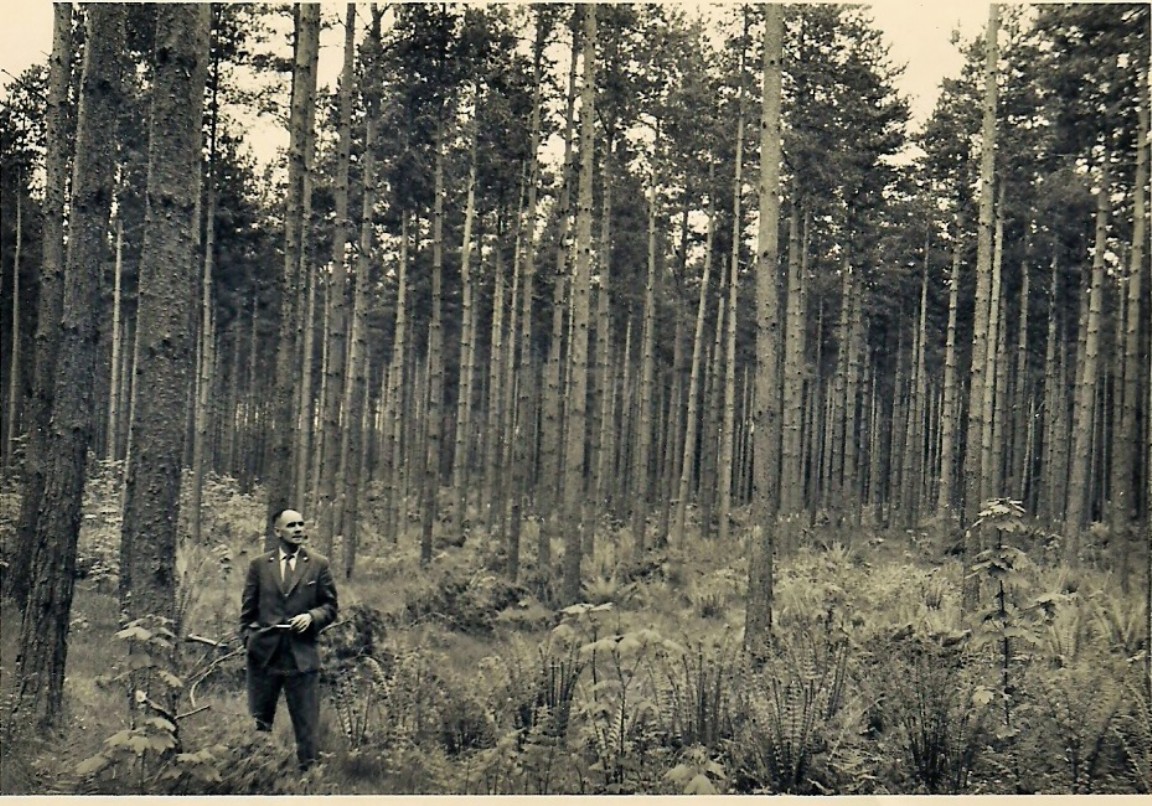
Bob Allison in SP seed stand Speymouth Forest
Photograph courtesy of Freida Murray,Buckie, daughter of Robert (Bob ) Allison.
The back of the photograph indicates that this photograph was taken in the Deer Park area of Speymouth Forest and specifically in the Hampshire stand which was planted in 1917 at 3 feet x 3 feet spacing by the then Duke of Richmond and Gordon. The area was thinned for the first time in 1953 and four times from then until time of photograph, the 5 acre area being a valuable Scots pine seed stand. Note the high pruned trees. The photograph was taken by BW Hollam or BW Holtam who was taken around the site by Bob in June 1961.
Bob Allison wrote a brief resume of his career which reads as follows:
1. 1928-1935 Joined Forestry Commission (as a boy ) at Montreathmont Forest.
2. 1935 -1936 Moved to Athailleach (Ballater ) for experience in Sawmilling and thinning at the instructions of Dr. Steven then divisional.
3. 1936-1938 Sat and passed entry examination for Benmore Forest School. Had highest practical mark in class (24) not top of class!
4. 1938 -1938 Blackcraig Forest - Ex School Ganger.
5. 1939-1941 Army Service. Wounded in France and on return to UK released at request of F.C and transferred same day to Ministry of Supply H.G.T.P.D. Posted to Kindrogan as Operations Foreman. After Job was completed I was transferred to Meikleour. Still in Perthshire, it was intended to set-up a training camp for timber workers for Liverpool men.
6. Late 1941 -1946 I was appointed Chief Instructor for the Women's Timber Corps for Scotland at Shandford nearBrechin, Angus. During this period I trained staff to start an additional school at Deemount near Aberdeen. I trained 12 instructors and had a staff of 25 men in huts, 60 Germans (imported daily) and an input of 120 women trainees each month - changed later to 6 weeks. In addition and in a separate Camp I had, working operationally, 40 women most of whom I had trained at Meikleour. In 1945 recruitment stopped and the whole unit became an operational one. During this period we put on rail 100+ tons of Timber each day over five different railway stations. At this time my district officer was John MacEwen who has just celebrated his 100th birthday this year. The board who controlled the school included Frank Oliver, Willie Riddoch etc. certainly all able and distinguished members of the Timber world. When we went into production operations the Officer in overall charge was a Mr Moody based at Perth. Mr Moody and I never quite hit it off. Now, 1 think that we both had faults and we should have known better. At any rate John MacEwen was advised to split his district in half because of its size, and appoint another District Officer - he appointed me and 2 hours later he reported his intentions to Mr Moody who immediately withdrew the appointment. So I held the post of District Officer for 2 hours (Must be a record). Incidentally John MacEwen refused to split his district and continued with it. I have never found out whether John was peeved at not getting his own way or whether there was just not another man suitable, but it meant he had much more work to do.
7. 1946-1950 On my return to the Forestry Commission I was appointed Foreman in charge at Pitmedden Forest, Auchtermuchty, with 6 men and a trapper. This was April '46 and in October '46 I was promoted (backdated to my return date ) to Forester Grade 2. During this time I built 3 miles of metalled roads by recruiting a lorry load of labour from Kirkcaldy daily. Around this time the Forestry Commission started an engineering department to build roads but I was allowed to carry on unhindered. During this period - 1949 actually, I provided 12 men for the preparations of the Highland Show at Dundee, under the control of Tom Woolridge, the Assistant Conservator in Aberdeen. The men were driven there and back daily and Mr Woolridge was most complimentary about their abilities and willingness to work very long hours. The show was a great success.
8. 1950-1973 2nd October – posted to Speymouth still a Grade 2 Forester.
9. 15 October 1950- promoted to a grade 1 Forester.
10. In October 1953, following the first Board in London I was promoted to Head Forester. At that time and for a few years I was the youngest Head Forester in the Forestry Commission.When re-organisation took place I was the only Head Forester in East Scotland Conservancy to be appointed Chief Forester on the Paper Board, which was a form of selection on merit. I believe there were only four Head Foresters selected by this method in Scotland.
11. Back to 1950 - One month after arriving on Speymouth we took over most of Crown Lands Woodlands and moor land -10,000 acres in all and their 28 Salmon fishers for every winter and their 15 River men and all their forest staff A year later we acquired the remaining 800 acres of woodland which badly needed thinning. The thinning, over 3 years, paid the purchase price and the area is presently being felled and producing many hundreds of telegraph poles each year, in addition to large quantities of logs at very good prices.
All this actually gave us a staff of around 60 men and I was asked if I could plant 1000 acres per year, and this we did for a number of years. By making up a team of trappers (5) with transport and controlled by an experienced trapper/ganger and specifically targeted on Planting areas we ruthlessly wiped out all vermin and were able to plant many thousands of acres without fencing. Because of Iron pan difficulties we used the recently produced, deep sub-soiling plough and found that by ploughing on the contour in old red sandstone we did not require drains and this was on land earlier refused by the Forestry Commission as unplantable. Ploughs were in short supply so I put a hut/bothy on the hill. Fitted lights on the plough and tractor and using two operators I worked the machine for 22 hours per day. The operators had one hour together having a meal at a nearby farmhouse and half an hour maintenance each.
All of this enabled Tom Woolridge, Assistant Conservator for North-east Scotland to inform Mr Gosling, Director General in the Forestry Commission, that all of the hills he was then looking at had been planted, including protection and preparations, for £10 per acre. The original purchase price was 1 shilling and 6 pence per acre. The results are all around here and they are well worth seeing.
At Shanford training school completed the training of 3000+ women over the period. John MacEwen died aged 105 years. I saw him when, he was 104 and he looked extremely fit and well.
During my time at Speymouth an order came through from HQ to post me to Glentress Forestry School as an instructor. Tom Wooiridge resisted this strongly and was successuful in retaining me at Speymouth. Also during my Speymouth years I sat on a few Boards assessing would-be entrants to Forestry School.
Download Large Version (371kB)
Groups: Forestry Areas, Northeast Scotland