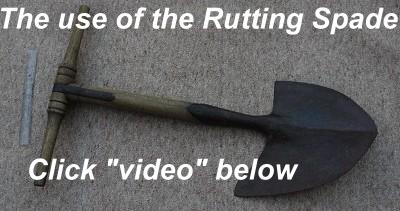
VIDEO - The use of the rutting spade
Mr.Dugald Kennedy, Fort Augustus, explains the use of the rutting spade in forestry practice.
Dougie Kennedy originally a Forest Craftsman at Glengarry Forest explains a little about how the large Rutter Spade was used. The operation of draining and providing a planting site on wet hillsides prior to the general use of forestry ploughs was an arduous task by hand and involved many forest workers over many moths of the year. The large rutter spade and its companions the cross cutting spade and the drain drag (howk or other local variations) were the tools of the trade sometimes helped by a bottoming spade to clean the main drain bottoms to achieve a smooth water flow.
As Dougie explains there men usually worked in teams of three. One man using the large rutter spade would cut, just off the vertical, deep into the peat up to a depth of around 15-20 inches through the heather and vegetation on a line which was one side of the proposed drain. A second similar line was cut parallel to the first but around 20 inches from it. The blade was pressed deep into the peat by the action of the foot set permanently on the rutter tread and powerful downward forces caused by rapid straightening of the bent leg and body. The arms and back guided the tool on the route and was used to withdraw the blade from the full depth. In full flow a man in good working mode appeared as if he was sawing the peat along the line. The body, spade and its winged side tilted slightly sideways in the cutting direction, one foot and leg pumping the blade down, arms and upper body pulling up, all in continuous, fluid, repetitive movements enabled progression of several inches every stroke. This was the most arduous part of the operation and it took considerable strength, skill and endurance to man a rutter for a whole day.
There were right and left hand versions of the rutter spades and often the other team members helped with the initial side cutting. Small metal instep protectors were often tied on the boot sole to save wear on the foot ware and also reduce pressure point sores. In rough vegetation it was essential to keep the cutting edges sharp. it was a common sight to see the upended rutter resting with its blade on the handle of another rutter, its blade buried deep for stability, and the operator giving the edges a series of vigorous sharpening strokes with a large rough bastard file.
The cross cutter spade did not have the extended side wing that aided cutting progress through tough vegetation and was a bit lighter in weight. It was placed between the two cut lines forming the sides of the drain and cut down vertically to the bottom of the drain say up to 20 inches down. The operator then pulled sharply backwards and levered the large slice (or turf) slightly upwards to break the bottom hold and tip it slightly forward before repeating the action with another cut but about 8 inches further up the drain. And so the now evident drain line was filled with a row of large turfs which were loose and slightly raised.
The third team member now swung his three pronged drain drag or howk so that the prongs dug deep into the face of the turf and lifted it bodily from the drain and placed it flat on the ground either above or below the turf drain line in a neat chess board fashion and as Dougie says at 5 foot spacing. Back to the drain for the next turf and so that over many days the hillside was gradually all covered in well spaced turfs. Working practice evolved so that as the turf drains were cut along almost on the contour they drained their water slowly into main drains running straight down the hill emulation a herring bone pattern. In steep ground the turfs were spread three rows deep down hill and two rows up hill. In time the turfs would dry out a lot, reducing in size, and at some point each was split with a spade and a tree planted in middle so that its roots were directly underneath in the moist rotting vegetation layer.
Groups: Fort Augustus, Tools, equipment and clothing, Video