Bin Forest - Burma road construction
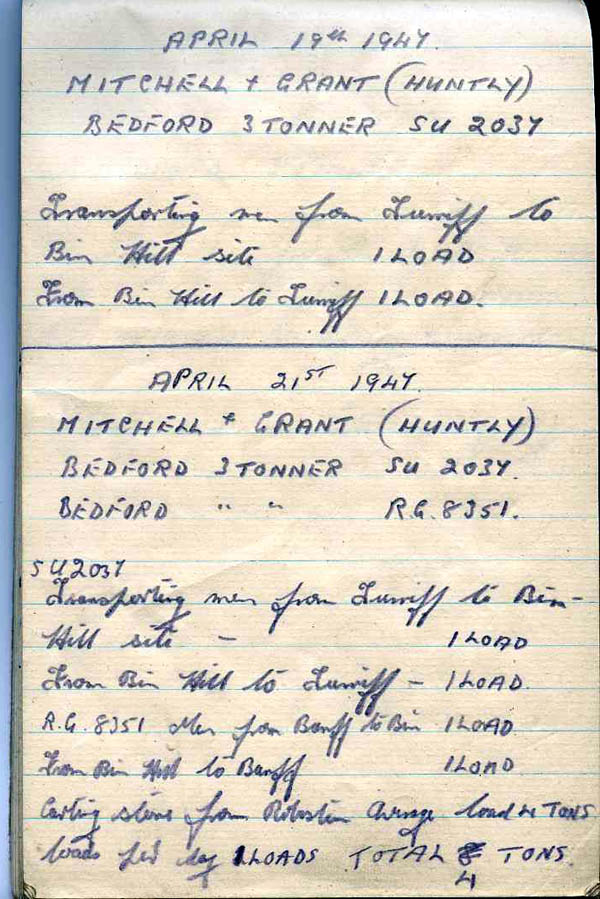
Second picture of log book sent in by Mr D MacTavish which his father had kept as a record of men and loads of material used on the construction of the Burma road in the Bin Forest.
Interested to find out why it was called 'Burma' road. Did this refer to the hard manual work by service personnel perhaps with some similarities to the infamous Burma Railway! Perhaps it was the name of a construction style perfected in colonial days in Burma?
Below is a break down of the lorry transport stone locations and other details plus an extract from a Hansard report.
D McTavish Lorry Tally Book – Burma Roads Bin Forest
Local lorries used:
Gray of Huntly – Bedford 3 Tonner CAV108
Bedford 3 Tonner BSA341
McLennan of Aberchirder – Albion 3 Tonner AV8261
Strachan of Keith – Fordson 3 Tonner SE5545
Bedford 3 Tonner SE4189
Bedford 3 Tonner SE6057
MacWilliam of Dufftown – Fordson 3 Tonner SE5987
Mitchell & Grant of Huntly – Bedford 3 Tonner SU2037
Bedford 3 Tonner RG8351
Cullen of Huntly – Bedford 3 Tonner CVE558
Up to 10 lorries were used in transporting men to and from Huntly, Aberchirder, Keith, Dufftown, Turriff, Banff and Lumsden each day to what is described as Bin Hill site (Rothiemay site also mentioned). During the day the lorries were used to haul stone, gravel and other material to the worksites.
Sites used for material supply were Robieston, Haddoch Farm, Binhill Quarry and Red Bridge. Average load quoted as 4 tons.
Stone from Haddoch Farm
Stone from Robieston
Stones from Red Bridge
Stone from Bin Hill Quarry
Piping (Culvert) form Aberdeen
Culvert pipes from Glens of Foundland
Blinding from Bin Hill Quarry
Load of shovels from Aberdeen
Load of hammers from Tillcoutry
Road Work, Bin Forest
HC Deb 08 July 1947 vol 439 cc209-10W
"44. Major Henry Spence
asked the Secretary of State for Scotland what is the number of men employed and the weekly cost of building the new road on the Forestry Commission lands in the Bin forest, near Huntly; whether he is satisfied that up-to-date equipment is being used; and what are the length and width of the road and the total estimated cost on completion.
Mr. Joseph Westwood
The number of men at present employed in the Bin Forest on road scheme work is 195, at a weekly wage bill of approximately £780. Road making machinery is in very short supply and little is at present available for use at this forest. The total length of extraction roads visualised is approximately 30 miles, specifications will vary but the principal routes will be 10 feet wide with passing bays. The total estimated expenditure on completion is £64,000".
Reading between the lines from the Hansard report (the critical lack of machinery at that period after the war was being made up for by using large amounts of manual labourers) is probably not quite what it seems. The forest roads would not really have been required at that time as the trees had all been planted many years previously but were some way from harvesting (planted 1928 – 1937). One assumes the scheme was put in place primarily to employ demobbed service personnel and lots of them because very little machinery was available resulting in some pretty hard graft. Little wonder the term ‘Burma Road’ was used.
Having looked over all the roads in the Bin Forest many of them have the signature of the one road presently called a Burma Road (The Timber Avenue). These roads appear to have a layer of largish stones (up to football size) on the bottom with a row of larger kerb stones laid by hand on either side. Over the top there are signs of river gravel and other gravel material in all forming a pavement about 10-11 feet wide. This is narrower than the present forest road surfaces but where the newer surfaces have worn somewhat the lines of kerb stones and layer of larger stones often show through. Another signature is the concrete culvert drains with large chunky concrete end walls which must have been made with some shuttering. Many have been replaced since but some still exist and were certainly made to last.
One can imagine a road construction scenario of a road line being scraped with a bulldozer to clear away the surface material and provide a reasonably even surface for a road line. In the mornings up to 10 little lorries with their army canvas canopies covering the bench seats in the back converging on the Bin Forest. Those same lorries loaded with men travelling out to source stones, initially from farms and crofts where over the centuries many have been cleared off the fields and heaped into corners. The young men dressed in a variety of ex service clothing standing next to these piles and hand loading the large stones onto the vehicles. You can hear the grumbling, jokes and the crack as they struggled to lift the larger specimens. The lorries with their loads trundle off to the forest and reversing up to another gang on recently bulldozed surfaces where the men manhandle the boulders off the vehicle to make kerbstone edges and with more stones lay a rough paving layer in between. Using the big hammers they strike again and again the boulders standing proud of the surface forcing them down and breaking them to achieve a more even surface and to lock the others together like cobbles. The next loaded lorry reverses over this last made section and the stone worn hands haul more boulders off for the next bit of the road and so on for yard after yard.
From time to time, gravel shovelled on by hand from the River Deveron flood plain arrives by lorry at the road site and men standing on back the load shovel it off and lay a smoother running surface over the rough stone cobbles. In time this is given a final coating of quarry dust to bind the material and give a longer lasting and smooth road surface.
Culverts to carry the water across the road are required quite frequently. At low points in the dozed road line, men with pick and shovel dig among the clay and boulders to prepare a deep trench across the road to lay a bed of concrete. On top of the concrete bed in the trench the heavy culvert pipes are rolled into place and fixed end to end with a bit more concrete then the end wall shuttering is made up and more hand mixed concrete shovelled in by hand. Days afterwards, the concrete has set and the culvert pipes are covered with gravel and the men set stones carefully around them to form the running surface over the pipes. The squad then set to with pick and shovel digging the side drain along the length of the road. The men wear puttees to gather the trousers against the legs and keep them reasonably clean as they toil in the mud and water. It is hard, hard going in parts as the ground is filled with large boulders with soft wet clay in between. Using crowbars and picks they lever the ‘muckle steens’ aside, dig through the sticky clay and eventually get a drain to run towards the culvert. Keeping a look out for the forester they get a little fire going and brewing up the Billy Can they reflect on the other 29 and half miles or road to go!
Groups: Forestry Records, Booklets and Reports, Northeast Scotland