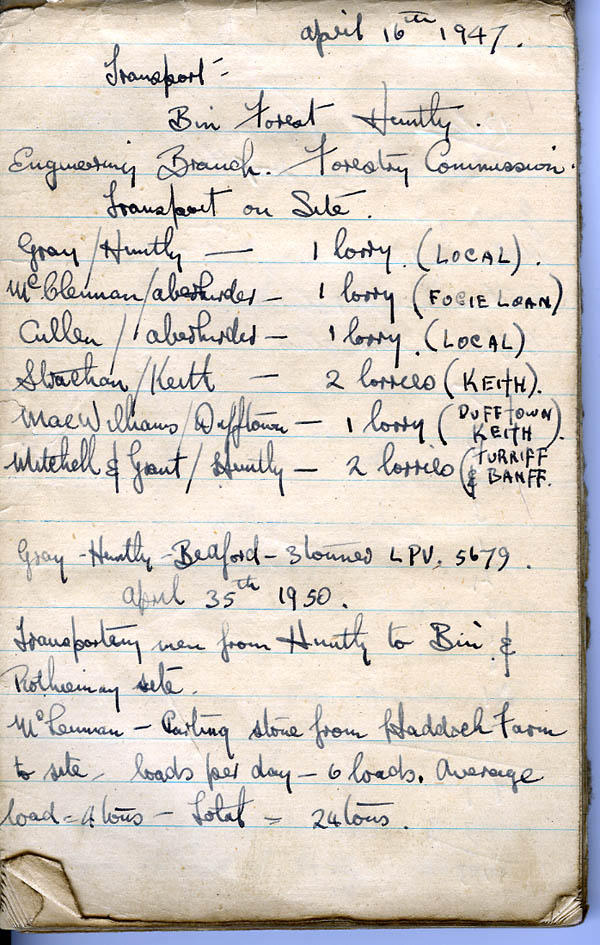
Bin Forest - Burma road construction
First page of a work log book sent in by Mr D MacTavish of Pontygates, Llanelli, which belonged to his father Mr D McTavish. The log book covers the period from 16 April to 7 May 1947 and records the daily lorry loads of men brought into the Bin Forest to work on the Burma Roads.
Mr D McTavish senior during the war worked for Rosengart and Zebenstein at their sawmill on the Pirie's Mill road in Huntly and as part of the war effort they produced 9 foot poles for use in preventing enemy planes from landing and also 2.5 foot pit props. After the war Mr McTavish was employed by the Forestry Commission and helped supervise the construction of the Burma roads one of which starts in the forest opposite Croft of Dykeside, runs past the two ponds and down to the Bin Moss Road. His log book indicates that up to 10 loads of men, I am told mainly demobilised service personnel, were collected daily from many places including Huntly, Aberchirder, Lumsden, Dufftown, Keith, Turriff, Cullen and Banff to do all the manual work (Note all the local lorry firms used). This would most likely have involved loading the lorries with stone, digging out culverts with spades and shovels, laying large stones edge on in a ten foot wide pavement and spreading finer blinding material on top all by hand. If you look carefully coming from Dykeside about 250 yards past the first pond before it climbs the little slope you can still see the layer and rows of big stones where the top gravel surface has been worn away. Further investigation reveals that many of the Bin Forest roads were initially constructed at this time by this method
The whole note book has been scanned and is now in the attached PDF which shows locations from where men, stones and material were transported over a period of one month or so.
Page 2 is shown in Picture No 165
Groups: Forestry Records, Booklets and Reports, Northeast Scotland
Group: Road and Bridge Engineers and Works - 175 pictures
7 Comments
Road Work, Bin Forest
HC Deb 08 July 1947 vol 439 cc209-10W
44. Major Henry Spence
asked the Secretary of State for Scotland what is the number of men employed and the weekly cost of building the new road on the Forestry Commission lands in the Bin forest, near Huntly; whether he is satisfied that up-to-date equipment is being used; and what are the length and width of the road and the total estimated cost on completion.
Mr. Joseph Westwood
The number of men at present employed in the Bin Forest on road scheme work is 195, at a weekly wage bill of approximately £780. Road making machinery is in very short supply and little is at present available for use at this forest. The total length of extraction roads visualised is approximately 30 miles, specifications will vary but the principal routes will be 10 feet wide with passing bays. The total estimated expenditure on completion is £64, 000.
Comment left on 08 September 2010 at 21:11 by Norman Davidson
A colleague of mine there, had once served in Burma, now Myanmar, where he suffered as a POW of the Japanese, building the original Burma road. Are Scotland's Burma roads perhaps given that name by other returned exPOWs of that generation,fortunate enough to have survived the construction of the infamous Burma road in Asia? Comment left on 29 June 2022 at 22:06 by wray menzies
During the 1950s,I worked at Rosarie Forest, and witnessed one day the haul of one of the two Rosarie trappers. It included a wildcat.
Even then, I could not understand what threat a wildcat posed to forestry operations.Today in Clashindarroch, the risk is reversed to the severe endangerment of UK's last wildcats Comment left on 29 June 2022 at 22:14 by wray menzies
As for cats in Clashindarroch there are still many cats living very well there. Sadly however domestic cats from houses within the forest and around the area have been breeding with the original wildcats since the early 1960s at least. The wildcat genes are disappearing very quickly now. Comment left on 30 June 2022 at 08:46 by Norman Davidson