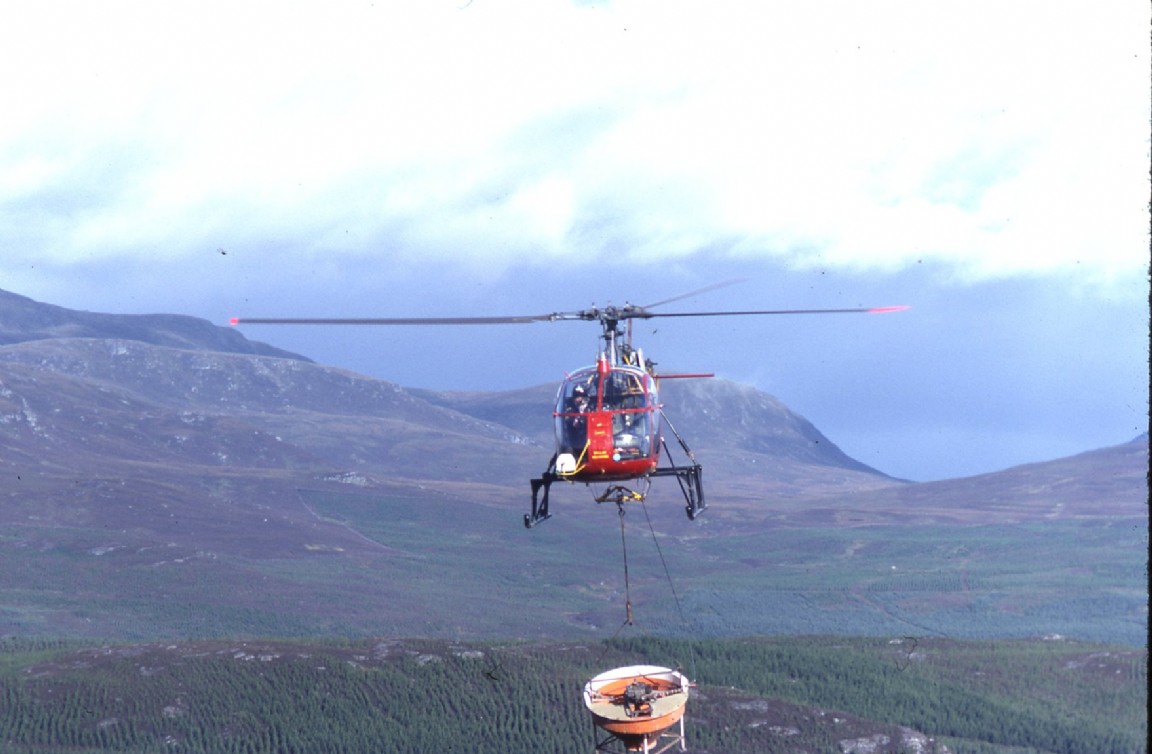
Dollar Helicopters - Fertiliser spreading - Contin
The photograph is courtesy of the family of George Dey. George took many forestry photographs in his forestry career and many are now shown on this web site. Check under ‘Groups’ and George Dey Collection.
A beautiful action photograph with the flying helicopter pilot and photographer eye to eye on the return flight to the loading base. The empty fertiliser bucket has conveniently streamed back to allow an inside view of the spinner engine which runs all the time but the bucket gate is operated from the helicopter. The location is somewhere in Torrachilty Forest. Can anyone pinpoint?
Download Large Version (219kB)
Groups: Aircraft in Forestry Work, Forestry Areas, Forestry in Action, George Dey Forestry Collection
2 Comments
Judging from the backdrop of Ben Wyvis and the Beallach Mor, between it and Little Wyvis the image was taken when the Dubh Coille block was being fertilised, from the top of the access road:
British National Grid Ref: NH 38091 68001
BNG Eastings, Northings: 238091, 868001
Latitude, Longitude: 57.672658, -4.716445
The Duhb Coille block was an extension of FC planting to the west end of the Longart Forest block. At it's highest point on the slopes of Carn na Dubh Coille, to the south-east, this block sits at 366m (1,200') asl.
Tim Taylor would have been Torrachilty Forest Chief Forester, and John Spittal, my immediate predecessor, the Establishment Forester, when this operation was carried out in 1979. Willie Beattie Snr, was I think also involved in the laying out and establishment of the block.
The gate had been shut when I arrived at Torrachilty in November 1981 and in spite of the application of URP (Unground Rock Phospahate), the SS always had that overall yellow canary colour, seen when under nitrogen (N) stress, along with a lack of available phosphate (P) and potash (K). The entire block was predominantly covered by ericaceous plants, at best and lies over metamorphic foliated granite (BGS) that is not the most fertile of parent lithologies!
I suspect that after I was moved on in 1985, along with the Forest District re-organisations of the era and the loss of local knowledge, the block became a "Cinderella" block, until it's more recent clearfell and re-stocking. Comment left on 16 March 2026 at 15:12 by Bill Rayner
British National Grid Ref: NH 38091 68001
BNG Eastings, Northings: 238091, 868001
Latitude, Longitude: 57.672658, -4.716445
The Duhb Coille block was an extension of FC planting to the west end of the Longart Forest block. At it's highest point on the slopes of Carn na Dubh Coille, to the south-east, this block sits at 366m (1,200') asl.
Tim Taylor would have been Torrachilty Forest Chief Forester, and John Spittal, my immediate predecessor, the Establishment Forester, when this operation was carried out in 1979. Willie Beattie Snr, was I think also involved in the laying out and establishment of the block.
The gate had been shut when I arrived at Torrachilty in November 1981 and in spite of the application of URP (Unground Rock Phospahate), the SS always had that overall yellow canary colour, seen when under nitrogen (N) stress, along with a lack of available phosphate (P) and potash (K). The entire block was predominantly covered by ericaceous plants, at best and lies over metamorphic foliated granite (BGS) that is not the most fertile of parent lithologies!
I suspect that after I was moved on in 1985, along with the Forest District re-organisations of the era and the loss of local knowledge, the block became a "Cinderella" block, until it's more recent clearfell and re-stocking. Comment left on 16 March 2026 at 15:12 by Bill Rayner
Form Goes Here
The cold days in Scotland and the Crop Spraying work in the Summer was really good with David Dollar and brings back many good memories of the people I worked with.
Ray Peel Comment left on 15 March 2026 at 12:59 by RAY PEEL