Cablecrane course Glengarry Forest
The photograph is courtesy of the family of George Dey. George took many forestry photographs in his forestry career and many are now shown on this web site. Check under ‘Groups’ and George Dey Collection.
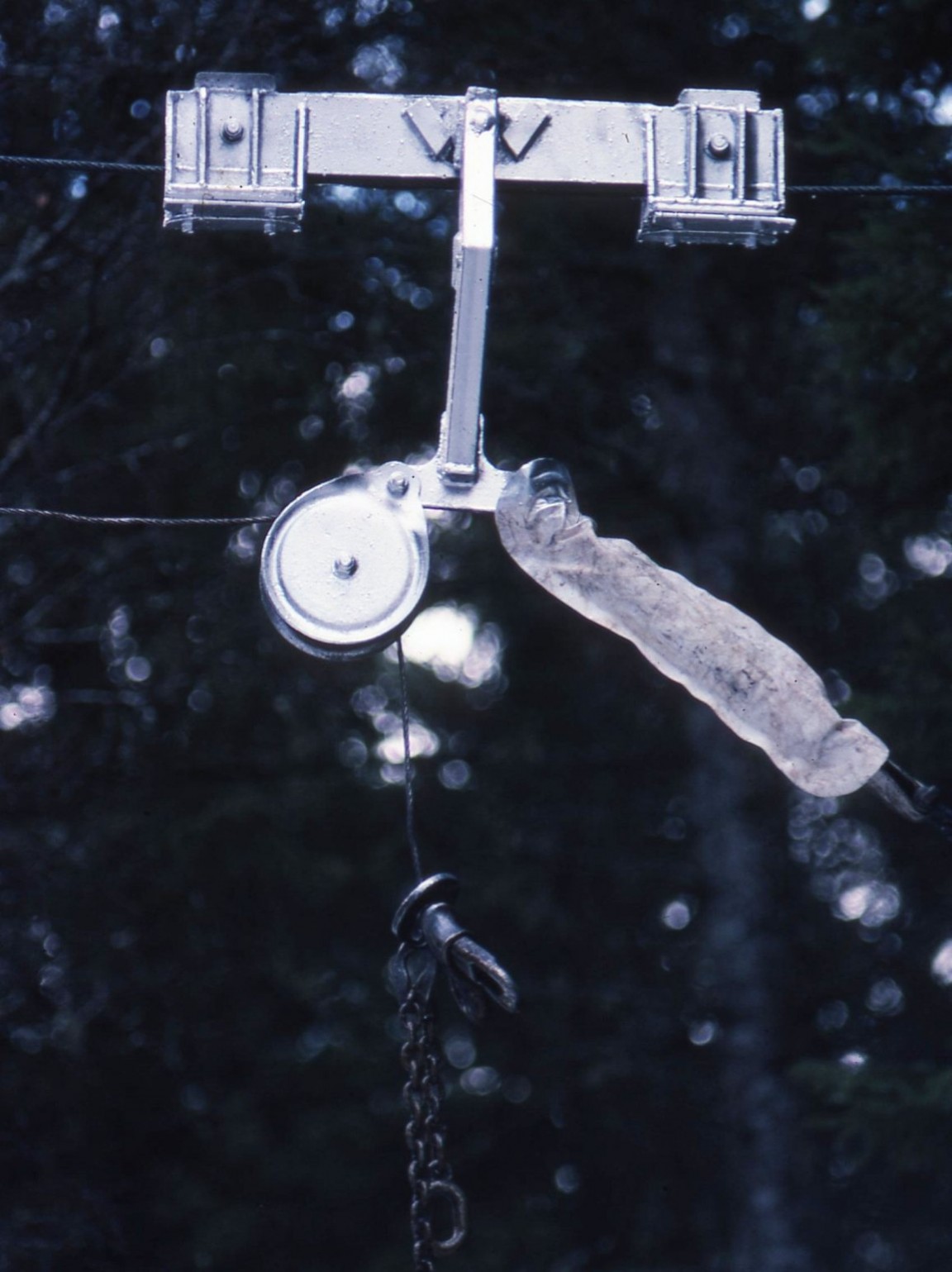
A view of the skyline carriage mounted on the skyline cable. It is unusually bright coloured and may have been sprayed with silver paint to make it more visible for the training course members. The carriage had an internal pulley at either end running on top of the cable and below the pulleys were the stop plates with a gap between narrow enough to prevent it jumping off the skyline wire but wide enough to allow the carriage to pass over the blades of the intermediate skyline cable supports.
The haul back rope is attached to the right hand side and as its name suggests, hauls the carriage back up (or down) the rackway away form the tractor. In this case there is a system load protection device fixed between the haul back rope and the carriage. Called ‘tear webbing’ it consisted of a nylon belt folded and stitched together lodged in a protective sleeve. In the event of severe overload and instead of breaking a wire rope the stitching tore and the webbing reverted to its extended length. In actual practice in many cases it was operate with the webbing in its extended state as it was a bit of chore to replace.
On the left hand side is the haul in rope which passes over a pulley and onward to end in a solid ‘eye’ with a hook just above. Basically when the haul in rope brake was off, the choker man could pull down the eye and hook and pass the ‘eye’ around a stack of timber back to, and hook into, the hook kept on the other side. This fixing was hand tightened and then the choker man would call the winch operator to ‘haul in – brake on’. The load would then be hauled towards the carriage which would not move because the haul back brake was applied. Once the load was below the carriage the choker man called ‘Haul in – no brakes’ on which the winch operator would ease the haul back brake and the carriage plus load began its move towards the winch on the forest road. By keeping a little brake on, the front of the load was kept clear of the ground but still moving towards the winch. It was a very skilled job to apply just enough haul back brake to lift but not pull the load hard into the carriage and cause breakages.
In this case above the hook and eye is a tag line chain which was long enough to hang down from the carriage to enable the choker man to catch and haul down the hook and eye. The tag chain could also be used to circle around a load of timber or a more likely a single log and add this to the haul in load.
Download Large Version (165kB)
Groups: Forestry Areas, Forestry in Action, George Dey Forestry Collection, Timber harvesters, processors, forwarders and cable cranes