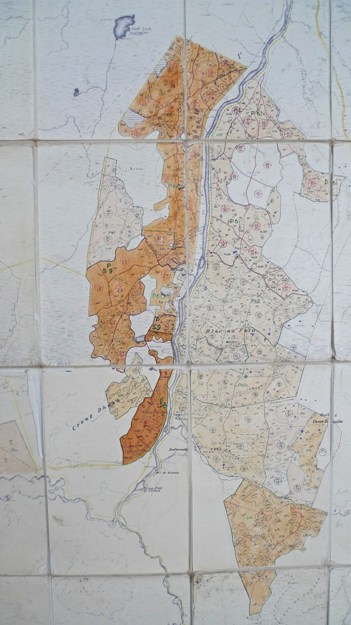
Syre and Rossal Plantations part of Naver Forest
Courtesy of North Highland Forest District.
(To see the image more clearly click on the PDF and then click the enlarge button within the PDF or Control and +)
The earliest plantings in Naver Forest appear to have started in the south of what is known today as the Syre Plantation (west of the River Naver) in compartment No1 in 1958 and the rest of the block was quickly completed by 1960 and the new planting then moved across the river to the north of Rossal and quickly southwards to Dalharrold section by 1966. There was bit of ‘up the hill planting’ in the Syre in 1965.
The Compartment sequence follows the Planting Years which alternated between several locations. Compartments 1-25 in Syre were completed by 1961 as were Compartments 26-29 in the small woods above Alnahara (Barren Ridge and Mudale Woods). The new planting programme then progressed across the Naver River from Syre into Rossal starting with Compartments 30 and pushing southwards to Compartment 58 (P61-P63). Three small woods north of Altnahara (Compartments 59-66) were also started and completed in 1961 and 1962. Along with these GrumoreWood on the north side of Loch Naver (Compartments 67-69) was likewise completed in 1963. The Compartment sequence (71-76) then moves back to the Dalharrold Wood area, south of Rossal, with the 1964 planting, then back to the two woods on the north side of Loch Naver planted in 1964 and 65 (Compartments 77-80). In Dalharrold Wood, Compartments 81 -85 and 86-88 in Syre were planted in 1965. The 1966 planting in both these areas were not given Compartment numbers and it is likely new multi-copy maps produced by the Conservancy Office cartographic team came into use. Some of the Woods mentioned above are in Picture No 1259.
It is interesting to note the large area comprising Compartments 35- 38, annotated as Archaeological Site, and left unplanted is today the well known cleared village of Rossal. Can anyone say where the Naver Forest workers lived and where the forester’s house was located?
The plantations contained a surprising amount of Scots pine (SP) in mixture as well as single species planting. Lodgepole pine (PC and in 1966 LP) is the predominant species and sometimes used in mixture with either Scots pine of Sitka spruce. There are numerous small areas of Scots pine and Larch which probably indicates the abundance of drier knolls and slopes with shallower peat and other areas or peat flushes with richer Molina grass planted with pure Sitka spruce (SS). It is quite a complex species map.
As usual with a national organisation there was a code and procedure convention for mapping of plantations some of which survive in the FC to this day. Acquisition boundaries were edged with a yellow ink (in this case green was used); compartment boundaries (rides) drawn in red ink; the extent of the planting in any year was given a light colour wash, outlined in green ink and the planting year written in green eg P.66; the compartment’s serial number and area in acres was written within the compartment sometimes within a small circle; the areas where different tree species were planted within each compartment were annotated with a species code eg SS (Sitka spruce), LP (Lodgepole pine) etc; different species areas in each compartment had to be separated by a dotted black line; internal fences, streams and other land usually indicated by a solid black line. Map scale was usually 6 inches to the mile.
Note that the annual reporting year and the planting year coincided at this time in that they ran from 1st Oct to 30th Sep. This avoided having an artificial split in the totals for the planting season which ran from November through to May. The Planting Year (PY or just P) was fixed as the first summer following planting and thus trees planted in Nov 55 and May 56 were both annotated P56.
Groups: Caithness and Sutherland, Maps of Forest and Woodland Areas
2 Comments
The team was formed and they had enough work for part of the year on Sutherland Estates. At this point also Naver Forest was just beginning with only a small work force and Jimmy MacLennan and his team were contracted by Kenny Maclean (Head Forester Naver) to do some of the planting from 1958-1960. John remembers that the area had been ploughed but as some of the ground was hard and rocky the plough skimmed over the hard bits and left areas without a planting turf. Jimmy MacLennan's team were contracted to 'harvest' bits of spare turf from the ploughed areas and spread it over the 'bare' zones before planting the whole area up. Unfortunately when a dry spell of weather occurred the plants ran short of water and moisture and died. Comment left on 24 November 2016 at 08:12 by Norman Davidson
To answer the queries above:
1. Yes 1958 was first year of planting.
2. The Foresters house was on the East bank of the River Naver on the edge of the B71 road to Kinbrace.
3 Initially the office was in the house but later an office was built in the grounds.
4 The first forester was Kenny McLean a single man for many years who eventually married the postmistress the only single lady for miles around.
5 The forest was in Dornoch District - First District Officer being Ian Grant who hailed from Speyside where his father was involved in forestry and timber negotiations. He was followed by Jim Atterson who came from Research and eventually returned to Research.
6 The workforce came from Bettyhill / Strathnaver. At the start they were all named Mackay and known locally by their by-names. Not a big work force but augmented by further members of the Mackay clan who worked in Borgie.
7 In Syre I only remember one experiment - Washington Sitka spruce was known to grow faster than Queen Charlotte Island Sitka spruce but prone to frost damage in its early years so it was tried at this Northerly location. It did suffer frost damage in the early years but eventually grew well but had numerous double stems.
8 The first large plot in Rimsdale was ploughed and planted P58 & P.59 mainly with L.P.
Small plots of Scots pine, western hemlock, Sitka spruce and Pinus peuce - a five needle pine. Phosphate was applied at planting and the other species given Nitrogen when deemed necessary from foliage analysis. Scots pine from a native source collected in Achnashellach proved to be the best provenance of Scots pine.
Comment left on 07 November 2016 at 08:22 by Norman Davidson