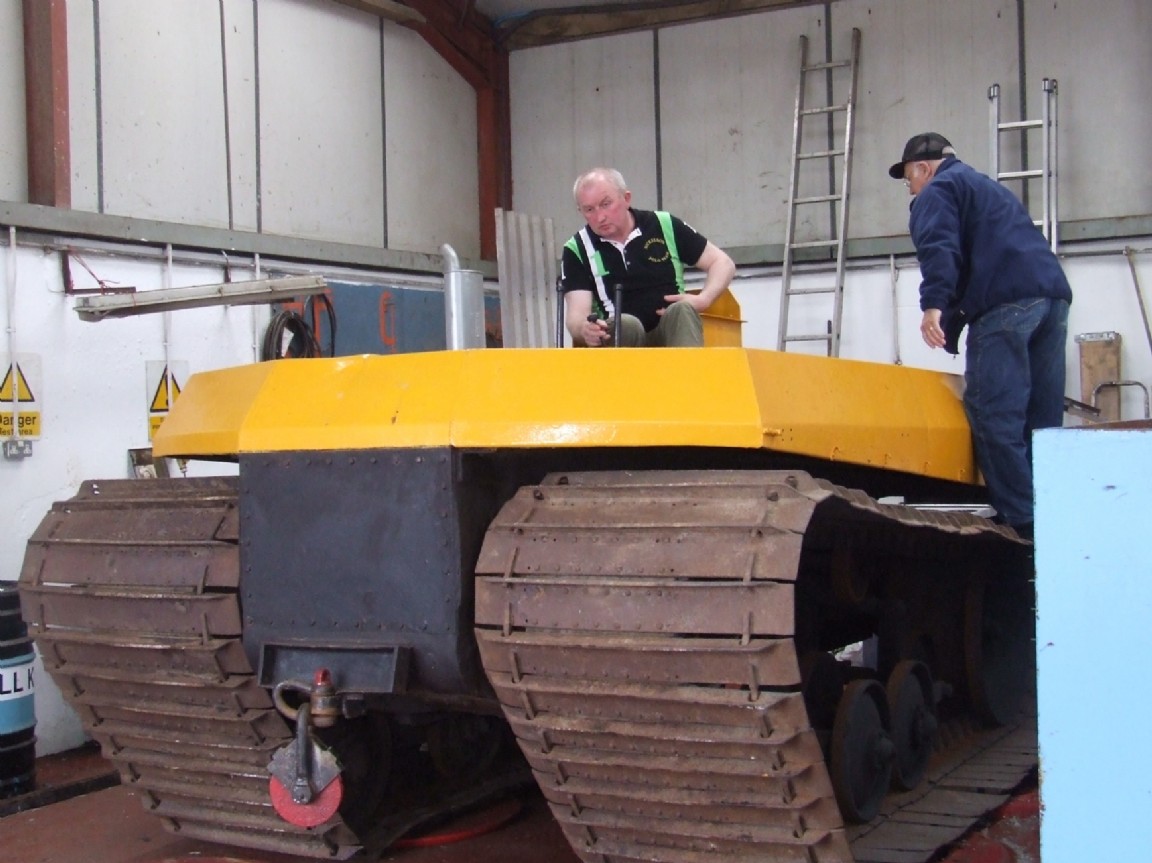
Cuthbertson Water Buffalo tractor
Pictures and details of the Cuthbertson Water Buffalo courtesy of John Flett, Dounby, Orkney.
The picture shows John Flett in the driving seat of the Water Buffalo and his colleague the late John Garroch looking on from the side.
John gives a little of the history of this machine as follows:
‘‘The Water Buffalo was purchased new by Major Winton for use in ploughing hill drains in Shetland in the early fifties. It was licensed by the Major to run on public roads but, on its arrival in Shetland, the council refused permission as they had just finished resurfacing the route and paid for a low loader to transport it to its fist site. Over the years the tractor worked in many hill areas ploughing hill drains to improve the sheep grazing. In 1970 John Garrick bought the machine and over the years restored it to running order. A major job was the replacement of the machine tracks. The original system of grouser plates bolted to thick rubber pads through which ran wire ropes to hold the whole track together was changed for very strong coal board conveyor belting onto which the grouser plates were laboriously bolted. The original winches have been removed and there is now a modern hydraulic pump in the system. In 2008 I purchased the machine transported it to Orkney and hope to show it at vintage rallies.
The Water Buffalo was designed and patented by James A Cuthbertson agriculture engineers of Bigger, Scotland and in all some 19 machines were actually constructed by North British which were famous for building railway locomotives. The running gear came from a British Tank. The track consisted of half inch thick rectangular rubber pads reinforced by a steel cable that, although anchored at each end, was free to slide over the ferrules so the track could flex in all directions. The rubber pads were joined by steel grousers above and by steel pins with dog teeth below. The intermediate track rollers mounting are spring loaded and independently articulated. The tracks are front sprocket driven from an arrangement of shaft assemblies that are extensions of the gearbox mounted forward of the engine positioned. There is no chassis in the true sense of the word rather it is a welded and bolted fabricated steel hull. This provides a watertight box housing for all the mechanical parts except for the track assemblies. Water up to 4 feet deep could be forded and the engine, transmission and steering mechanism remained dry at all times. The machine is powered by an Albion four cylinder direct injection diesel engine developing 75 HP which drives the Albion single plate clutch that transmits the power to the constant mesh Albion five speed gearbox. I believe Cuthbertson also made a larger 20 ton machine but I have no details of that.
The Water Buffalos were first seen in Orkney when two of them were hired by the film company to help transport the heavy cameras and transmission dishes used in filming the live broadcast of the first climb of the Old Man of Hoy in 1964. The Royal Navy were given the task of transporting the equipment plus two County Super Fours to Hoy via a landing craft. I was also personally told that there are two Buffalos lying in the Falklands but are non runners.’’
The attached PDF above shows various views of the machine and also the engine.
Looking over the History of ploughing by Andy Neustein it appears that the Forestry Commission in South Scotland and possibly North England purchased several of these machines to pull the large peat ploughs. North and East Scotland seem to have had a trial machines on test or hire but apparently did not buy.
Any stories and other photographs of this machine being used for forestry ploughing would be very welcome.