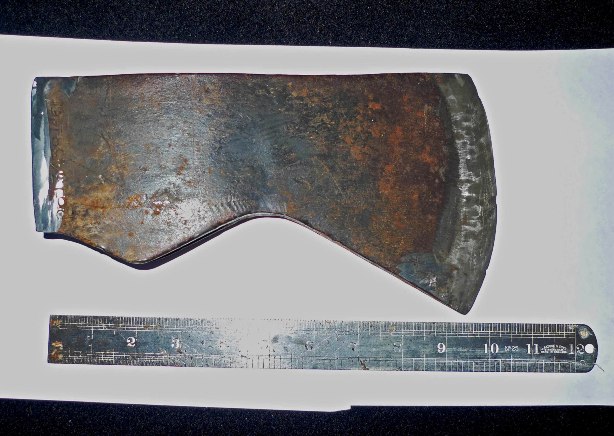
7 lb English axe head
Axe head courtesy of Roy Neish, Buckie.
Roy has kept his axe (without shaft) that he used when he worked for the firm of Ward from the north of England who had purchased Rothiemay Estate for its standing timber in the 1950s. The axe head is thought to be made by Elwell and is just over the 7 lbs in weight and in the English style pattern – quite different from the wedge style axes often used in Scotland. Note also the length against the rule which shows it to be fully 10.5 inches long. In all this was quite a size and weight to wield all day.
Roy recalls that the shaft of the axe was fixed in at an angle to the alignment of the head socket. If the head socket was kept level when the axe shaft was fitted, wedges were inserted in such a way as to lift the outer end of shaft well above the horizontal. It is said this alignment reduced the likelihood of an accidental slip of the blade into to the leg! They also shortened the shaft by cutting the end fawn foot off. The axe was used mainly on large hard woods for laying in the base of the tree preparing it for felling with the hand cross cut saw and for cutting off all the heavy branches once the tree was felled.
On examining the head a number of features can just be seen. On one side are a long series of numbers stamped into the metal and consist of ?? (possibly 56) 13438146. The other side shows two ridges in line with the number 7 in between and below can be made out the letters R NEISH formed with a pointed metal punch. See the attached PDF.
Can anyone explain the numbers or have any images of similar ‘English’ axes?
Groups: Forestry Areas, Northeast Scotland , Tools, equipment and clothing
6 Comments
On leaving FC Dad went to look at a FC post up the back of beyond Wrynose pass, miles from anywhere, and to Thoresby Estate in the Dukeries of Nottinghamshire.He chose the latter and we moved to Budby in Nottinghamshire where Dad worked for the Woods department of the estate, there was quite a few people who moved from Sleetbeck and that area down to Notts and the standing joke was that lads from up north found that the planting was a doddle in Notts due to the Nottinghamshire sandlands soils, or clays in the adjacent Knesall part of Estate.I would be interested to hear from anyone who worked up in the Sleetbeck FC around those dates. Cheers from the shire. Isaac Comment left on 26 February 2013 at 06:08 by Isaac Donald Mawdsley
The cutaway bit is I think just to keep the weight down whilst keeping the cutting edge as long as possible.
They were also used in reverse to hammer Wedges into the cut to make sure the Tree was felled in the right direction and to keep the Crosscut Saw free.
The numbers are probably just a Catalogue number with perhaps the date of manufacture at the end.
I still have my 4 ½ LB Elwell with a good few inches cut off the end of the Shaft.
The Ward who purchased the Rothiemay Estate was H. D. Ward Ltd, of Wolsingham County Durham.
I can remember in the late 1950s seeing their Red Fodens sometimes parked up in Huntly, If you Google Foden SPT 251 you will see that one of them has survived.
Comment left on 15 August 2015 at 22:25 by Jimmy Thain
ELWELL
---7---
The serial number of the axe head, though unconfirmed, should be unique to this axe. The first two digits were the year of manufacture so 1956 in this case. Comment left on 07 December 2019 at 17:11 by J. Gascoigne
(Apologies to Trigger.....Fools and Horses.) Comment left on 28 December 2011 at 17:48 by Pat Mc Auley