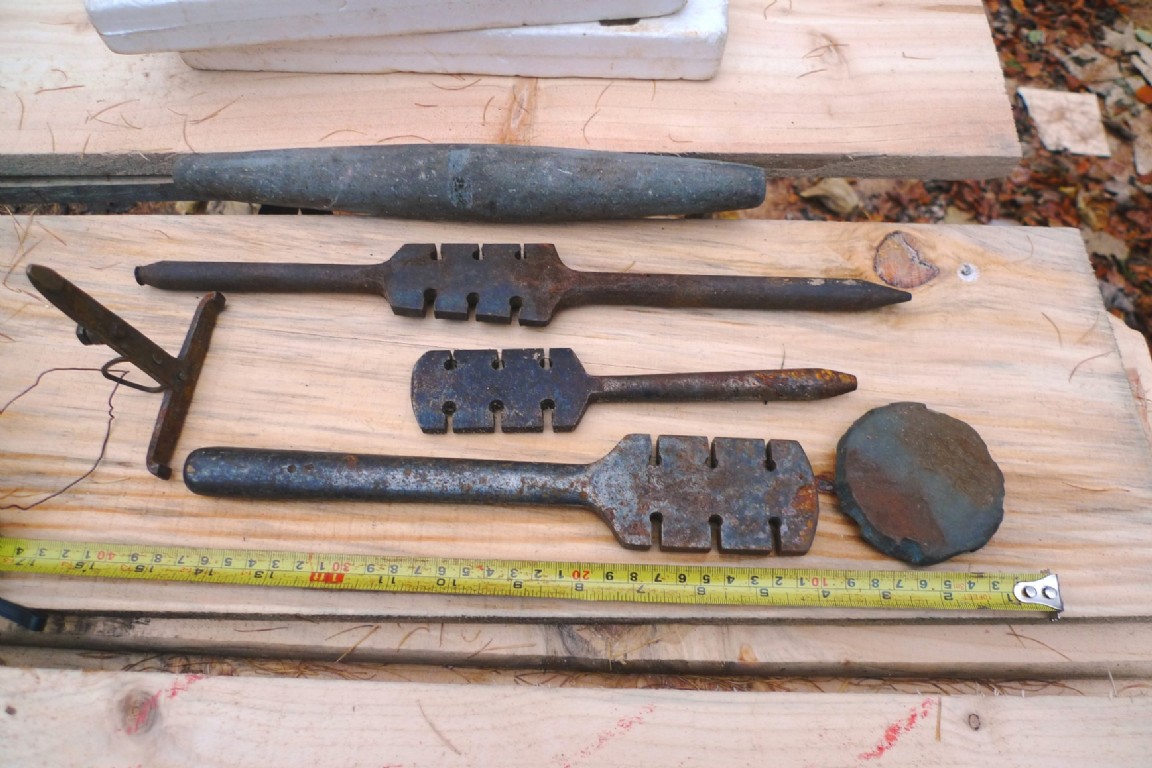
Circular saw setting tools from Charlie Smith
Saws setting tools courtesy of Charlie Smith, Huntly.
As a former and still working sawmiller, Charlie has gathered a collection of old wood working tools over his 65 plus years that he has worked in the wood business. Featured in this photograph are a variety of tools for setting up a saw blade for accurate clean cutting. In the middle are three saw tooth setting tools with a variety of slots to fit the various gauges of saw blades. Basically they act as levers to bend the saw tooth over a little sideways in order that it cuts a kerf a little wider that than the actual saw blade. The teeth are set alternately either one side or the other. This has to be done very evenly and this is the purpose of the little T shaped tool on the left. The bottom bar of the setting gauge sits on the side of the saw blade below the tooth as also does the protruding screw end in the middle of the upright bar. The very top of the bar measures how far the saw tooth has been bent over sideway. The adjustment screw in the middle has a lock nut and once it is tightened for a particular saw setting all the teeth are checked to ensure they just touch the top of the setting gauge. If required the saw setting lever is used until the tip of each tooth just touches the top of the gauge.
Periodically after a number of sharpenings the teeth begin to lose their perfect radius as well as their set. The carborundum scythe and axe sharpening stones have been used over many years to begin the process of correcting this. With the saw running as normal the stone is held carefully, very carefully, on the bench and dead in line with the saw and pushed slowly until it makes soft contact with the teeth in the blade. It is then held there during which time it grinds a tiny portion of the tips of the highest teeth. The blade is stopped and the teeth are checked to see how many are untouched. The process is repeated until only a few teeth are untouched. The sharpening process with the file then starts and ends when all the ground flats have been filed out of the teeth and all the teeth have been filed at the correct angle. Once the teeth are all checked to ensure the set is correct, the saw blade is then ready for wood cutting action. If you look carefully, particularly on the old axe round sharpening stone, you will note that the saw blade has cut flat areas all around the rim as though a rat had been nibbling a biscuit!
Download Large Version (1.4MB)
Groups: Northeast Scotland , Sawmills, pulp mills, chipboard mills, Tools, equipment and clothing
8 Comments
I did pick up some info on U Tube (who doesn't)which demonstrated some saw work www.youtube.com/watch?v=jKKcyKxu7aQ&feature=relmfu
Hope it helps - perhaps with some more safety features!
Comment left on 10 September 2012 at 08:23 by Norman Davidson
Enter these words into the 'Search' of eBay, "saw tooth setting tool" and you will see that the tools that you are looking for are still readily and cheaply available.
Good health, Bill Comment left on 06 October 2021 at 01:07 by Bill Rayner
I was interested in your article on saw blade sharpening and setting and also the photo of the tools. Many years ago i used the setting tool in a small sawmill where i worked during my summer holidays. My boss showed me how to set the saws but i did not have the gauge for checking the set.
I am now wondering if those tools are available as my son has recently bought an old circular saw bench that is driven off the PTO of his tractor and i would dearly love to show him the correct way to sharpen and set the blade.
I would appreciate any information if these tools are available.
Many thanks and i enjoyed reading the article. Comment left on 09 September 2012 at 11:41 by J.J.Meehan