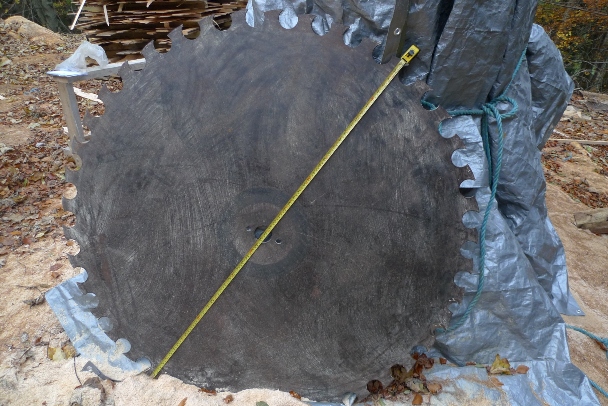
Circular saw blade at Charlie Smith's mill
Four foot six inch diameter insert tooth saw blade courtesy of Charlie Smith, Huntly.
This size of blade is now no longer often used as band saws have taken over much of the cutting of large dimension timber. This blade has had the insert teeth and carriers removed leaving the large empty gaps around the circumference. The blade is surprisingly flexible and wobbles quite a bit when shaken by the top edge.
It will be noted that there are two smaller holes in the middle of the blade apart for one for the main drive shaft. Apparently two short pins were sometimes used in addition to the two side plates to secure the blade tightly to the shaft. Charlie was always unsure of the security of these pins. He said that when there were no pins and the blade was secure just by a plate on either side tightened securely with a large nut (threaded in opposite direction to rotation) if there was any slight slackening of the shaft nut and plates, the blade simply stopped turning with the shaft. On the other hand on the blade with the pins, if the nut slackened the pins still kept driving the blade even when the securing shaft nut was greatly and very dangerously undone.
The attached PDF shows boxes of used and new insert teeth for the saw but not the tooth carriers. Also shown is the tool for removing and inserting the teeth.
Groups: Northeast Scotland , Sawmills, pulp mills, chipboard mills, Tools, equipment and clothing
4 Comments
Mark Comment left on 15 December 2021 at 23:57 by MARK D'ASCOLI
Usually only one pin hole was used.when mounting a blade you generally lined the pin directly above the centre hole. This way the blade always hung centrally on the shaft. Comment left on 20 January 2015 at 23:57 by Peter Ross